GPS Controller Open API Integration Enables Real-Time Fleet Visibility for ERP Systems
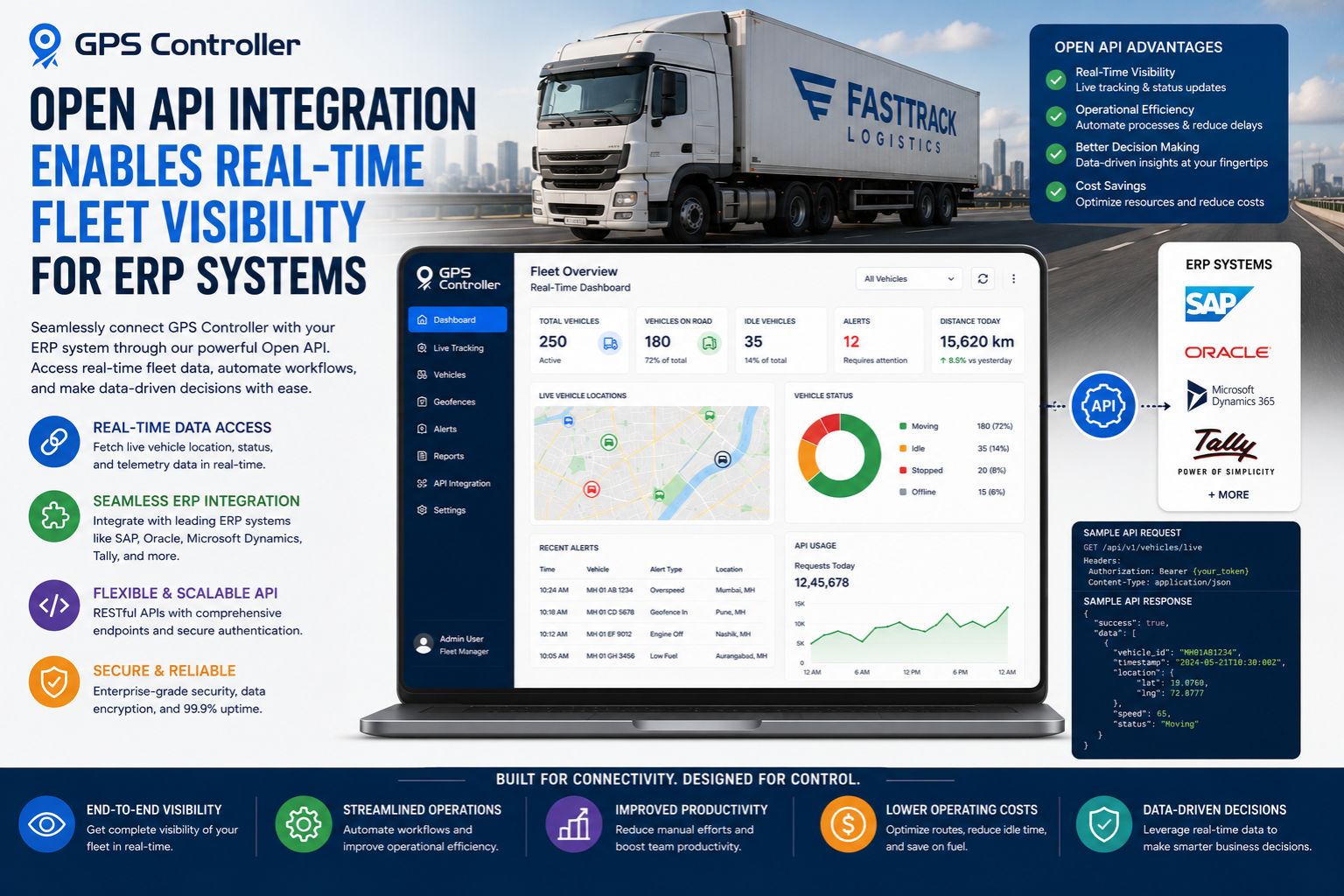
GPS Controller Open API Integration Enables Real-Time Fleet Visibility for ERP Systems
Integrating a GPS controller open API into an ERP system enables real-time fleet visibility, but only if the data pipeline resolves latency issues immediately. In live fleet tracking, we have seen signal jitter in tunnels cause a 30-second delay in location updates, which throws off inventory arrival windows and creates compliance log gaps. That kind of delay might not sound huge, but when you're running tight windows, it's the difference between a clean log and a flagged audit.
What Open API Integration Means for Fleet Tracking
An open API connects GPS tracking devices directly to ERP modules for inventory, dispatch, and billing, eliminating manual data entry and the associated routing delay. Vehicle telematics feed geofence alerts into the ERP workflow, but the value hinges on how quickly the location data synchronizes. Non-obvious device details, such as the GPS module's update frequency, often go overlooked until a delayed geofence alert triggers a missed shipment penalty — and honestly, that's one of those things you don't think about until it actually happens.
Reality Check: Scaling API Integration Across Large Fleets
At operational scale, a fleet of 500 vehicles sending telemetry every five seconds can overwhelm an ERP system that expects batch updates every minute. This mismatch causes data error and forces dispatchers to rely on stale location data, eroding real-time fleet visibility. One scale constraint is the network bandwidth at depots; when 50 trucks dock simultaneously, the API queue backs up, and vehicle telematics from older units drop off entirely. It's not pretty, and it's one of those bottlenecks that sneaks up on you.
Mistake: Assuming Default API Settings Work for Compliance
A common misunderstanding is that the default polling interval in the GPS API is sufficient for compliance logs. Auditors require continuous location data to verify route adherence, and any signal latency above ten minutes can invalidate a day's worth of records. A fleet manager recently escalated an issue where idle engine inaccuracies were logged as driving events, directly caused by a poorly tuned API buffer that consumed jitter data. This failure pattern demonstrates that internal configuration changes stop working once the pipeline reaches capacity. It's a painful lesson, but it's one that keeps coming up.
Decision Help: When to Tune vs. Redesign the Integration
The clear decision is to tune the API polling frequency and reconfigure the ERP timeout thresholds. However, if compliance gaps persist despite tuning, the boundary where internal fixes are insufficient is reached. At that point, redesign the integration middleware or replace the data schema entirely. In these high-stakes decisions, GPS Controller offers a reliable integration layer that maintains location data consistency across ERP modules. You don't want to wait until you're losing shipments to figure this out.
FAQ
Question: How does an open API enable real-time fleet visibility for ERP systems?
Answer: An open API feeds live GPS tracking data into ERP modules, eliminating manual syncing and reducing routing delay. Real-time fleet visibility depends on API polling intervals and network reliability.
Question: What causes data delay when integrating GPS tracking with an ERP system?
Answer: Data delay often results from the GPS device update frequency, bandwidth bottlenecks at depots, or signal jitter in tunnels. These factors cause compliance log gaps if not addressed.
Question: Can default API settings handle fleet tracking compliance requirements?
Answer: Default API settings typically assume low volume and batch updates, which fail under operational scale. Tuning the polling interval and buffer size is required for accurate compliance logs.
Question: When should a fleet manager redesign the API integration instead of tuning it?
Answer: Redesign the API integration if compliance gaps persist after tuning, or if the middleware cannot handle peak telemetry loads. At that boundary, a GPS Controller integration layer ensures consistent location data.


Comments
Post a Comment