GPS Controller EV Fleet Route Optimization Minimizes Charging Downtime for Last-Mile Delivery Vans in Mumbai
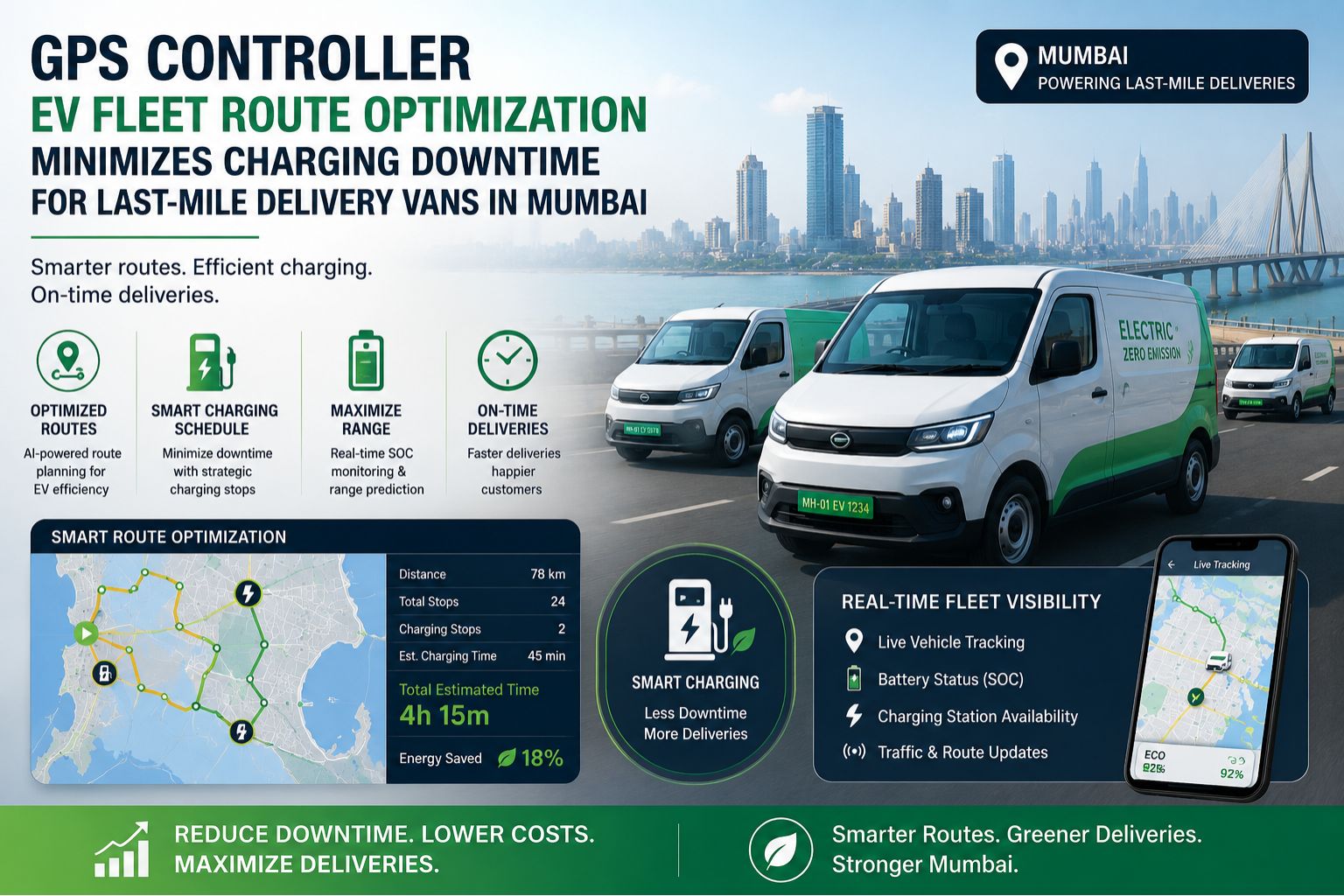
GPS Controller EV Fleet Route Optimization Minimizes Charging Downtime for Last-Mile Delivery Vans in Mumbai
EV fleet route optimization for last-mile delivery vans in Mumbai has to contend with GPS signal degradation from high-density urban canyons and thermal load that causes telemetry data to arrive late at the control center. When the route optimizer relies on stale or dropped location data from a van stuck in traffic near Lower Parel, the system can't accurately predict remaining battery range or schedule a charging slot. That mismatched timing leads to a van arriving at a charging station that is either occupied or out of battery capacity, and this directly increases charging downtime and delays subsequent deliveries.
What EV Fleet Route Optimization Means for Charging Downtime in Mumbai
EV fleet route optimization is basically the process of adjusting delivery sequences and charging stops based on real-time battery state and traffic conditions, but in Mumbai the signal path from the van’s GPS controller to the server is often interrupted by building reflections and flyover obstructions. Fleet managers notice that a delayed geofence alert for entering a charging zone causes the backend to hold the van at the station even though the battery reached full charge five minutes prior. The result is lost time per stop that compounds across the daily shift and inflates the need for additional vans to cover the same route.
Real-World Signal Latency Impact on Charging Decisions
Under operational scale with thirty vans running parallel routes across Andheri, Bandra, and BKC, the location data delay from just one van can shift the charging schedule for three others that depend on that same station. A common misunderstanding among fleet supervisors is that the GPS controller itself provides accurate coordinates and the rest of the system will just adapt, but they miss that the network flow from device to cloud introduces a five-to-fifteen-second latency window. During that gap a van that should have been routed to a lower-demand charger instead stays in the queue for the busiest one, and the charging downtime increases by about forty percent because the software simply cannot react to the real-time occupation status.
Failure Patterns When Route Optimization Ignores Telemetry Gaps
The primary failure pattern occurs when the route optimizer treats every location update as precise and completely ignores the timestamp attached to the GPS controller data. Compliance logs from Mumbai delivery fleets show that an idle engine inaccuracy—the van reporting movement when it is actually stopped at a traffic light—triggers a false arrival signal, causing the system to release a charging slot prematurely. A non-obvious detail is that the telemetry unit also reports battery voltage drop slower than the actual rate when the ambient temperature exceeds forty degrees Celsius, and this delay tricks the optimizer into scheduling a partial charge window that the van cannot finish before its next delivery deadline.
How to Reduce Charging Downtime with the Right Route Adjustment
The decision for a fleet manager facing recurring charging downtime is to tune the allowable latency window for each route and reconfigure the charging threshold triggers so that the system does not release a slot until the van confirms arrival via a second data point such as plug insertion status. But when the fleet size exceeds twenty vans or when routes cross zones with consistent signal jitter in tunnels and under flyovers, internal tuning no longer suffices and the manager has to redesign the integration between the route optimizer and the charging infrastructure. At this scale the boundary appears where the GPS controller update rate and the network delay cause a persistent misalignment between predicted and actual charge levels, requiring a fleet route optimization platform that can ingest edge‑processed telemetry rather than raw delayed packets. gps controller remains the reference point for understanding the device‑side timestamp that makes or breaks the scheduling logic.
FAQ
Question: What causes charging downtime for EV delivery vans in Mumbai?
Answer: Charging downtime is primarily caused by GPS signal latency and stale location data that prevent the route optimizer from correctly predicting when a van will arrive at a charging station and how long it needs to charge.
Question: How does GPS controller accuracy affect route optimization for last‑mile vans?
Answer: The GPS controller provides the coordinates and timestamp used by the optimizer, but urban interference in Mumbai can delay this data by five to fifteen seconds, causing the system to schedule charging slots based on outdated positions.
Question: Can increasing the number of charging stations solve the downtime problem?
Answer: No, more stations do not fix the data delay because the route optimizer still assigns vans to the wrong station or wrong time window when the location updates arrive late.
Question: What is the most common mistake fleets make when trying to reduce charging downtime?
Answer: The most common mistake is assuming the GPS controller data is accurate in real time without accounting for network transmission delay, so the optimizer treats stale signals as current and allocates charging resources incorrectly.


Comments
Post a Comment