GPS Controller Cold Chain Temperature Thresholds Trigger Alerts for Seafood Exports During Transshipment at Chennai Port
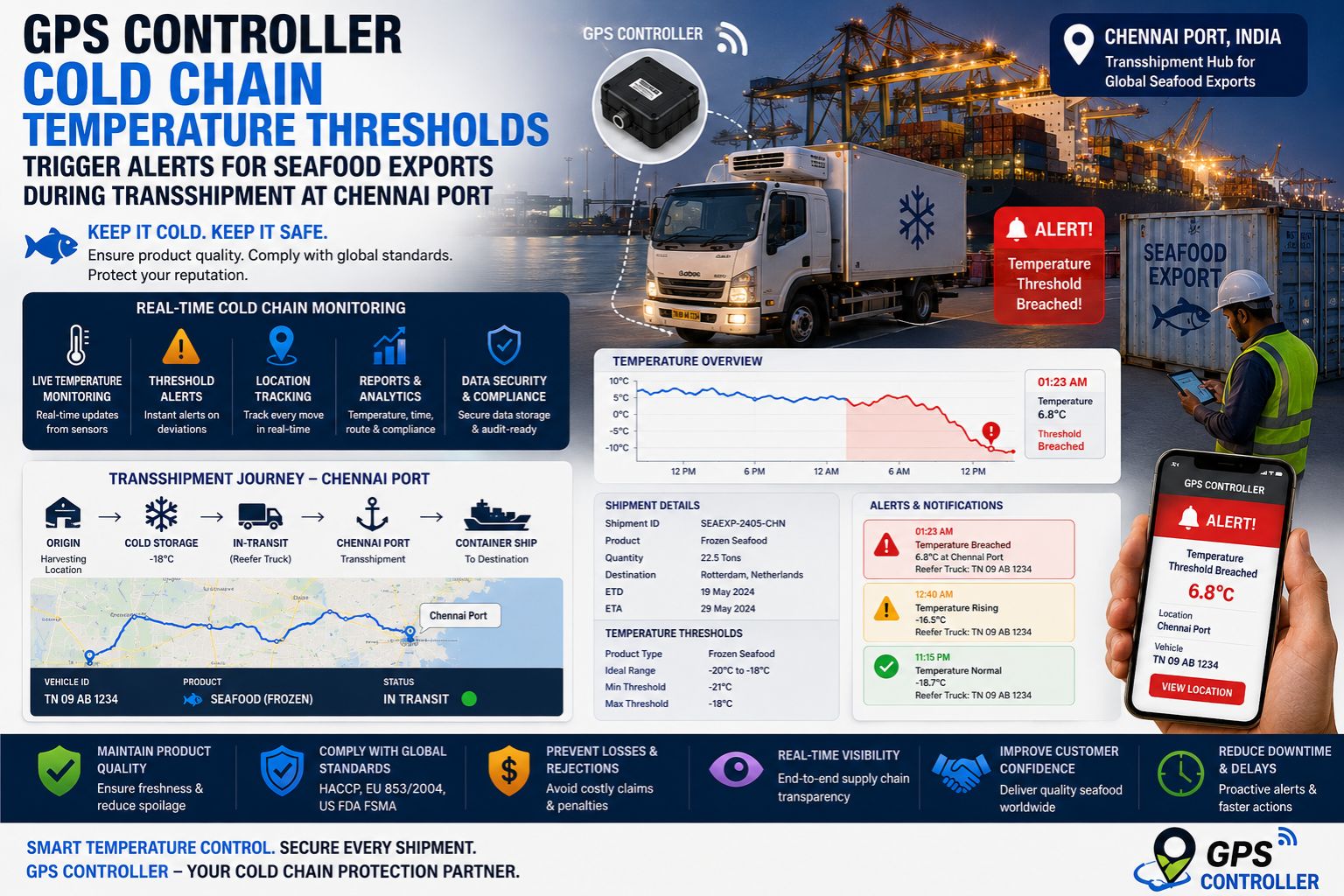
GPS Controller Cold Chain Temperature Thresholds Trigger Alerts for Seafood Exports During Transshipment at Chennai Port
When a GPS controller cold chain temperature threshold triggers an alert for seafood exports during transshipment at Chennai Port, the immediate assumption is a refrigeration malfunction, but the real culprit is often a location data delay caused by dense port infrastructure and container stacking, which creates a false positive that can halt an entire shipment.
How Temperature Threshold Alerts Manifest in Chennai Port Transshipment
During transshipment, a container moving from a feeder vessel to a mother ship passes through zones with extreme temperature variations, and the GPS controller relies on precise geofence triggers to differentiate between a legitimate cooling breach and a temporary exposure, but signal jitter inside the steel-reinforced port terminal frequently causes the system to misinterpret a two-minute sun exposure as a full-threshold violation, generating an alert that requires manual verification.
The Operational Reality of Seafood Export Compliance at Scale
At Chennai Port, a single transshipment operation can involve over two hundred containers of frozen seafood, and each alert demands a documented response for audit trails that customs and health authorities review, so a fleet tracking system that generates excessive false positives due to geofence latency forces logistics managers to either accept the compliance risk of ignored alerts or suffer costly delays that miss the weekly shipping window to European markets.
Common Misunderstandings That Escalate Cold Chain Failures
One frequent mistake is assuming that raising the temperature threshold eliminates false alerts, but this approach masks real failures when a refrigeration unit loses power during the eight-hour hold inside the container freight station, and a non-obvious detail is that the GPS controller's temperature sensor is often mounted on the reefer unit itself rather than inside the cargo, meaning a partial thaw near the door goes undetected until the shipment is opened at destination, creating an irreversible compliance gap that no alert system can fix.
Decision Boundary for Tuning vs. Redesigning Cold Chain Alerts
When your fleet tracking system generates a temperature threshold alert during transshipment, the decision point is whether to tune the geofence radius and delay timer to filter out transient exposure or to redesign the entire alert hierarchy with multi-sensor validation that cross-references reefer power status and container position data, and the boundary emerges when internal fixes stop working because the port's cellular signal coverage degrades under the vessel's steel structure, at which point only a hardware change or signal repeater installation resolves the alert noise, and a gps controller configuration review becomes necessary to distinguish between a port environment limitation and a systemic sensor failure.
FAQ
Question: Why does my GPS controller show a temperature alarm when the reefer unit is running normally?
Answer: This usually happens because the cold chain temperature threshold is tied to geofence entry and exit events at the transshipment zone, and signal jitter inside the Chennai Port terminal causes the GPS controller to record a brief location outside the safe zone, triggering a false alert even though the actual cargo temperature remained stable.
Question: Can I change the temperature threshold without invalidating my export compliance logs?
Answer: Adjusting the temperature threshold may reduce false alerts, but it risks creating a compliance gap if a real refrigeration failure occurs at a temperature below the new limit, so any tuning must be documented in your fleet tracking audit trail to pass customs review at the destination port.
Question: How does container stacking affect GPS controller signal reliability during transshipment?
Answer: When containers are stacked four high on the vessel deck, the GPS receiver inside the lower container loses satellite lock, and the controller then relies on dead reckoning or last known position, which can delay geofence alerts by several minutes and cause temperature threshold triggers that are actually signal latency problems.
Question: What is the first step when cold chain alerts cause a transshipment delay at Chennai Port?
Answer: The first step is to verify whether the alert corresponds to a real temperature excursion by cross-referencing the reefer unit's internal data log with the GPS controller's location history, and if the cargo temperature never deviated, the issue is likely a workflow dependency on flawed geofence parameters that require redesign rather than surface-level tuning.


Comments
Post a Comment