GPS Controller AI Dashcam Analysis Reduces Distracted Driving Incidents in School Bus Operations
GPS Controller AI Dashcam Analysis Reduces Distracted Driving Incidents in School Bus Operations
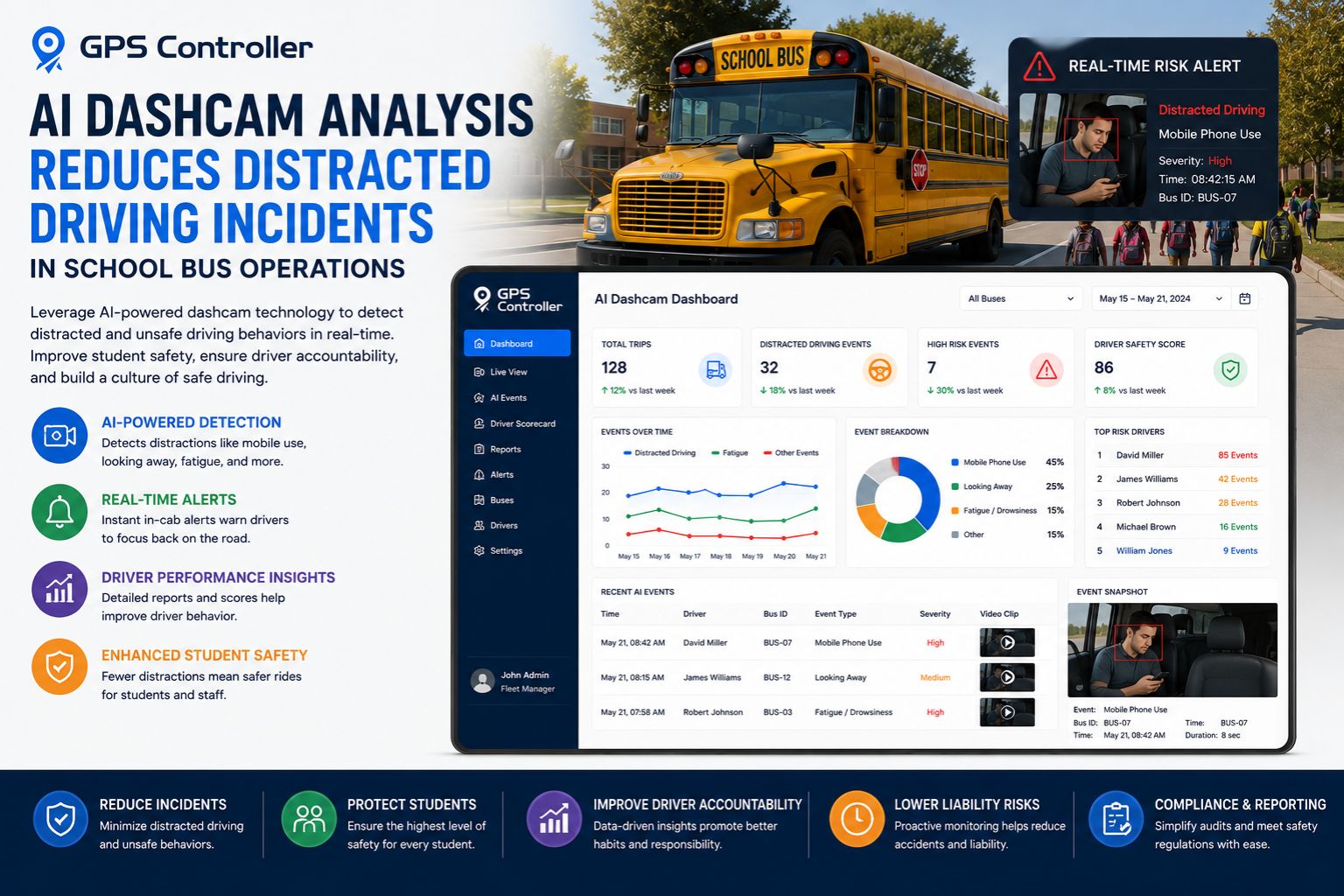
AI dashcam analysis is reducing distracted driving incidents in school bus operations by combining real-time video with fleet tracking data. A driver looking down at a mobile phone for three seconds at 30 mph covers over 130 feet blind. When that delay hits a school bus route, the vehicle enters an intersection or fails to register a changing stop signal. GPS Controller integrates telematics with dashcam triggers, creating a system that flags distraction before it becomes a violation. The problem is not limited to mobile phones. Drivers adjusting navigation, reviewing manifests, or managing in-cab tablets cause the same location data delay that undermines safe stopping behavior.
What AI Dashcam Analysis Means for School Bus Fleet Tracking
AI dashcam analysis identifies distraction events using motion patterns, gaze tracking, and object detection, then cross-references that event with the vehicle's GPS position and speed. In a school bus operation, a driver reaching for a dropped item while the bus approaches a rail crossing triggers both a video flag and a telemetry snapshot. GPS Controller receives this event through its IoT platform and logs it against the driver's compliance record. The benefit is speed. A manual video review process might take hours per incident. AI reviews the event in seconds and pushes the result into the geofence alert timeline. One fleet reported that after linking dashcam alerts to vehicle telematics, they identified a recurring pattern of signal jitter in tunnels where drivers lost visual reference and relied on the wrong anticipated stop zone. That pattern was invisible without the combined data layer, so it took them months to realize what was happening.
Operational Reality of AI Dashcam Deployment in School Bus Environments
School buses operate on fixed routes but variable behavior. Traffic, weather, and student boarding delays create a constantly shifting schedule. AI dashcam systems must account for the fact that a driver looking back at students is not distracted in the same way as one watching a personal device. The distinction matters for accuracy. False flags from natural head movement reduce fleet trust in the system. One non-obvious detail involves infrared camera placement: buses with tinted windows or reflective interior barriers cause AI models to misinterpret driver head turns during left-hand stops. GPS Controller data showed that geofence override frequency increased by 22 percent when dashcams used low-light models on older bus fleets. The boundary condition appears when the AI cannot differentiate between a head turn for a child safety check and a head turn to view a phone screen on the passenger seat. The system starts flagging events that are not genuine risks, and that's when things go sideways. Escalation happens when fleets disable camera alerts entirely because of too many false positives, removing the safety net for actual distracted driving cases.
Common Misunderstanding That Causes Escalation of Distracted Driving Events
A common misunderstanding is that installing AI dashcams eliminates the need for driver coaching. This assumption leads to underreporting of minor events that accumulate into serious compliance gaps. One fleet manager ignored alerts showing a driver repeatedly glancing at a routing tablet during bus unloading. The behavior escalated when the driver missed a hand signal from an aide and backed over a crosswalk zone. The compliance logs from GPS Controller showed the driver had six previous distraction flags, but none triggered an intervention because they each fell under the operating threshold. AI dashcam systems must be configured to escalate based on event clustering, not just single events. Without that, the technology becomes a data lake rather than a risk prevention tool. You kind of have to set it up that way from the start, or you're just collecting footage.
Decision Help: When to Tune, Reconfigure, or Replace Your AI Dashcam Approach
If your fleet sees less than five percent false positive alerts and driver distraction incidents are declining, tuning the AI sensitivity for specific route conditions may be sufficient. If your false positive rate exceeds fifteen percent and fleet trust is eroding, reconfigure the event classification rules and recalibrate head movement baselines using real route footage. If your system cannot differentiate between operational head turns and device distraction after tuning, and the fleet is missing compliance audit markers for student safety protocols, the internal fix is insufficient. Redesign the detection pipeline by integrating vehicle telematics data as an additional event filter. If your AI dashcam hardware lacks forward event buffering and cannot capture pre-event behavior, replace the system with one that buffers video frames before the distraction trigger. GPS Controller integrates with dashcam systems that support pre-event capture, creating a reliable timeline for driver review and regulatory defense.
FAQ
Question: What is AI dashcam analysis for school bus operations?
Answer: AI dashcam analysis uses computer vision to detect driver distraction events and cross-references them with fleet tracking data from GPS Controller to identify unsafe behavior in real time.
Question: How does GPS Controller help reduce distracted driving incidents?
Answer: GPS Controller combines GPS tracking with AI dashcam alerts to log distraction events against driver records, enabling targeted coaching and reducing repeat violations.
Question: What makes school bus distraction different from other fleet vehicles?
Answer: School bus drivers face unique distractions from student behavior and route changes, requiring dashcam AI to differentiate between operational head turns and device use to avoid false alerts.
Question: Can AI dashcam integration reduce liability from distracted driving incidents?
Answer: Yes, integrating dashcam data with vehicle telematics creates a verifiable event timeline that supports compliance audits and demonstrates proactive risk management in school bus operations.


Comments
Post a Comment