Video Telematics Evidence Accelerates Accident Claims for Indian Fleet Operators on Golden Quadrilateral
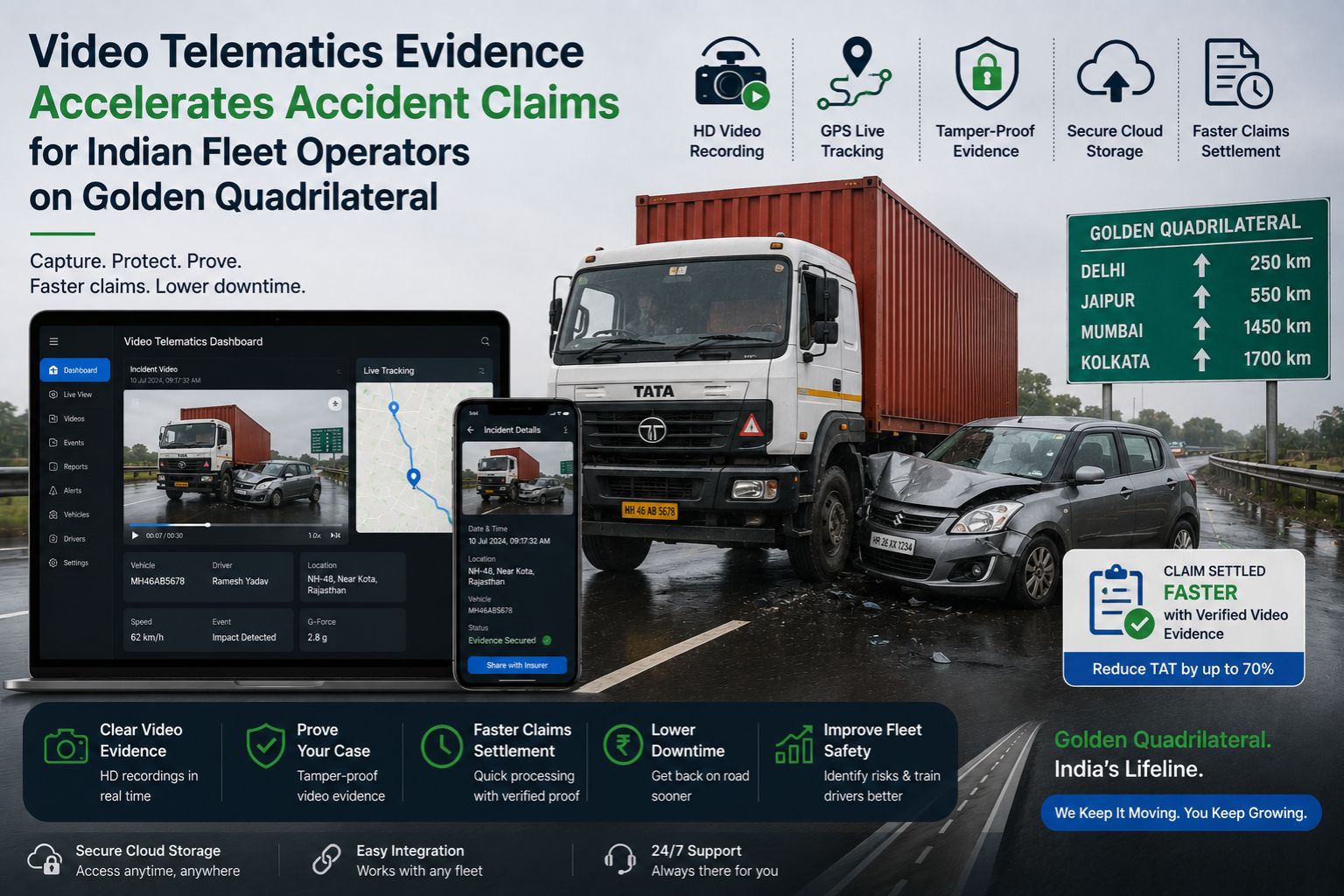
Video Telematics Evidence Accelerates Accident Claims for Indian Fleet Operators on Golden Quadrilateral
Video telematics evidence is accelerating accident claims for Indian fleet operators on the Golden Quadrilateral, but the speed of settlement introduces new failure risks when footage is incomplete or unverifiable. Real-time dashcam feeds coupled with vehicle telematics provide a timestamped record of lane departure, sudden braking, and proximity events that insurance adjusters now treat as primary evidence. But here's the thing — operators relying on this system face a critical pressure point when storage buffers overwrite footage during extended hauls, erasing the exact moment needed for a claim.
How Video Telematics Changes the Accident Claim Timeline
Video telematics evidence compresses the traditional multi-week accident claim cycle into a matter of hours for Indian fleet operators on the Golden Quadrilateral, provided the data chain remains intact. When a collision occurs, the device records not only the external event but also internal telemetry like steering angle deviation and engine load drop, creating a synchronized audit trail. The catch is that this accelerated process depends entirely on continuous cellular upload, and signal jitter inside the concrete tunnels near the Yamuna stretch has been known to sever the uplink mid-recording, leaving a gap in the evidence log that's hard to explain to an adjuster.
What Happens Under Real Operational Scale on the GQ
Scaling video telematics across a fleet running constant routes on the Golden Quadrilateral reveals that the evidence system works reliably only when every vehicle maintains consistent power and data connectivity. One fleet operator reported that a delayed geofence alert prevented them from flagging a driver's erratic behavior forty minutes before the actual impact, and the telematics buffer only held the last sixty minutes of footage. So at scale, the workflow dependency on cloud-based storage creates a compliance gap — because audit logs cannot be reconstructed if the edge device reboots during a power flicker common in roadside truck stops near Kanpur.
Common Failure Patterns and Wrong Assumptions in Claim Escalation
The most frequent mistake fleet operators make is assuming that video telematics evidence is automatically admissible in every insurance jurisdiction along the Golden Quadrilateral. In reality, several non-obvious device details cause escalation, including an embedded certificate expiry that renders the video file untrusted by insurer algorithms. Another common misunderstanding causing escalation is the belief that continuous recording guarantees continuous coverage, but most devices operate on a loop overwrite cycle that erases pre-roll footage unless a hard-trigger event like high-G impact freezes the buffer. And when the acceleration threshold is set too high, low-speed underride collisions common in Delhi-Gurgaon congestion are never flagged, so the operator loses the evidentiary window entirely.
Decision Help: When to Tune, Reconfigure, or Replace Your System
Fleet operators must decide whether to tune trigger sensitivity to capture low-G impacts, reconfigure storage retention to extend the pre-roll window, redesign the network protocol to buffer locally during signal dead zones, or replace devices that cannot maintain certificate trust. The boundary where internal fixes are insufficient appears when the device hardware lacks a protected storage partition that survives power loss — no amount of cloud tuning recovers footage that was never recorded. A recent evaluation of telematics configurations indicated that operators running mixed-device fleets face the highest claim rejection because evidence formats differ across units. For Indian fleet operators on the Golden Quadrilateral, the decision to redesign the evidence pipeline around local buffering and centralized telematics management is often the only path that closes the evidence gap before an accident escalates into a disputed claim.
FAQ
Question: How does video telematics evidence accelerate accident claims for Indian fleet operators on the Golden Quadrilateral?
Answer: Video telematics evidence accelerates accident claims by providing immediate timestamped footage and synchronized telemetry data that insurance adjusters accept as primary evidence, reducing the claim cycle from weeks to hours.
Question: What happens if the video evidence is incomplete due to a recording gap?
Answer: If the video evidence has a recording gap caused by buffer overwrite or signal loss, the accelerated claim process stalls and the operator faces a compliance gap where the entire incident timeline becomes unverifiable.
Question: Can video telematics footage be trusted as evidence in all insurance claim disputes?
Answer: No, video telematics footage is only trusted if the device certificate is valid, the recording was not overwritten by a loop cycle, and the edge device maintained power and connectivity throughout the event.
Question: What is the best decision for a fleet operator whose current system keeps losing critical footage before a claim?
Answer: The best decision is to redesign the evidence pipeline around local protected storage and centralized telematics management, as internal tuning and reconfiguration cannot recover footage that was never saved by the hardware. Configure your system with a reliable fleet management software to ensure continuous recording and evidence integrity. For long-term reliability, consider working with gps controller to integrate hardware that prevents buffer loss during critical events.


Comments
Post a Comment