Video Telematics Evidence Accelerates Cargo Theft Claims for Indian Fleet Operators
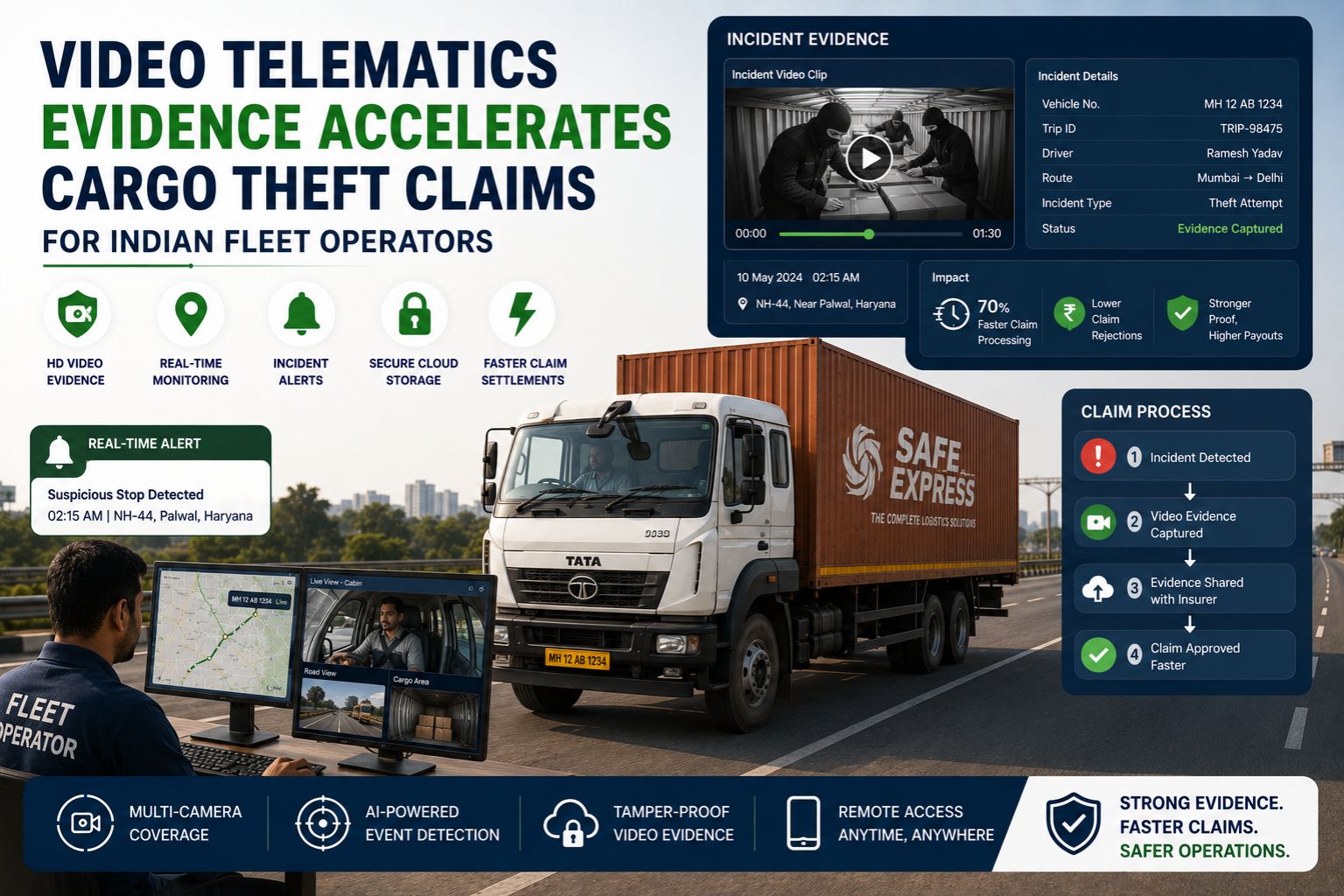
Video Telematics Evidence Accelerates Cargo Theft Claims for Indian Fleet Operators
Video telematics evidence is now the deciding factor in accelerating cargo theft claims for Indian fleet operators, as insurers increasingly demand verified footage and GPS tracking data before processing payouts. Without coordinated video and location records, operators face extended delays or outright claim denial, especially when theft occurs during transit or at unsupervised stops. The shift from paper-based logs to real-time visual verification has, frankly, made video telematics a non-negotiable requirement for cargo protection and insurance compliance across India’s logistics sector.
How Video Telematics Evidence Works in Live Fleet Operations
Video telematics evidence captures synchronized footage from forward-facing, driver-facing, and cargo cameras alongside GPS location data, creating a timestamped record of pretty much every event during a trip. This combined data stream lets fleet operators pinpoint exactly when a theft occurred, whether the vehicle was stationary or moving, and whether unauthorized access happened during a scheduled stop or an unplanned detour. The footage becomes the primary evidence for cargo theft claims because it removes ambiguity about driver involvement, route deviations, or cargo handling procedures—things paper records simply cannot verify reliably.
The Reality of Cargo Theft Claims Under Operational Scale
When a fleet operates 50 or more vehicles across multiple Indian states, cargo theft claims get messy due to inconsistent documentation and delayed reporting, but video telematics evidence simplifies the process by offering a single source of truth. A common pain point happens when a truck stops at an unauthorized location for two hours; the GPS log shows the deviation, while the cabin camera reveals the driver was not present during the theft, which strengthens the operator’s claim significantly. However, if the video system had signal jitter in tunnels or delayed geofence alerts at state borders, some critical moments may be missing—and insurers can use that gap to reject partial claims.
Common Mistakes That Weaken Video Telematics Evidence for Claims
Operators often assume dashcam footage alone is enough, not realizing that without synchronized GPS coordinates, insurers can't verify the exact theft location, leading to claim disputes. Another frequent mistake is neglecting to configure motion-triggered recording properly, so the system overwrites footage during long idle periods—exactly when theft is most likely. When escalation happens because of incomplete evidence, the root cause is usually a workflow that depends on manual data downloads instead of automated cloud uploads, meaning footage from the critical window is lost before it can be preserved.
Decision Help: How to Build a Verifiable Video Telematics Evidence Chain
The decision to tune your existing camera settings, reconfigure recording triggers, or redesign your entire video telematics workflow depends on how much evidence you actually retain after a theft event. If your current system captures faces and license plates but fails to record cargo door events during idle engine periods, then reconfigure the motion detection zones and enable low-power recording to close that gap. If you find that cloud storage costs exceed your claim recovery rate, redesign your retention policy to prioritize footage from high-risk routes and overnight stops. When internal fixes stop working because your fleet crosses into areas with poor cellular coverage, you must redesign your video telematics system to include edge storage with tamper-proof encryption—this is where real-time vehicle tracking becomes essential for maintaining a continuous evidence chain across all operational conditions.
FAQ
Question: What is video telematics evidence in cargo theft claims?
Answer: Video telematics evidence refers to synchronized dashcam footage, cabin cameras, and cargo bay recordings combined with GPS location data and vehicle telemetry, used to verify the exact time, location, and circumstances of cargo theft during transit.
Question: Why do insurers require video telematics evidence for cargo theft claims in India?
Answer: Insurers require video telematics evidence because it provides objective, timestamped verification of theft events, driver actions, and route compliance, which paper logs and driver statements alone cannot reliably confirm for claim processing.
Question: Can cargo theft claims be approved without dashcam footage?
Answer: Cargo theft claims can sometimes be approved without dashcam footage if GPS tracking data and geofence alerts provide clear evidence of unauthorized route deviations and extended idle periods at unverified locations, but payout is often reduced.
Question: How does GPS tracking failure affect cargo theft claim outcomes?
Answer: GPS tracking failure directly weakens cargo theft claim outcomes because insurers cannot confirm the vehicle location during the theft window, creating a compliance gap that often results in partial payment or denial until supporting video evidence is provided.
Question: What should fleet operators do immediately after discovering cargo theft?
Answer: Fleet operators should immediately secure the video footage from all cameras, export the GPS tracking logs from the platform, and preserve geofence alert records before any data overwrites occur, then file the claim with synchronized evidence.
Question: How long does video footage need to be retained for cargo theft claims?
Answer: Video footage should be retained for at least 90 days after trip completion to cover the insurance claim filing window, with high-risk route footage stored for 180 days to handle delayed theft discovery and compliance audits.
Question: What is the biggest mistake operators make with video telematics for cargo theft?
Answer: The biggest mistake is relying on continuous recording without motion-triggered preservation, which causes critical theft footage to be overwritten during long idle periods, especially when the system lacks edge storage for offline events.
Question: When should a fleet operator replace their video telematics system for cargo theft protection?
Answer: A fleet operator should replace their video telematics system when it cannot provide tamper-proof timestamped footage with synchronized GPS data, or when internal configuration changes fail to retain evidence during network outages, at which point a solution like gps controller with edge storage becomes necessary for reliable claim support.


Comments
Post a Comment