Route Optimization with Live Traffic Data Lowers Fuel Spend for E-Commerce Deliveries in Indian Cities
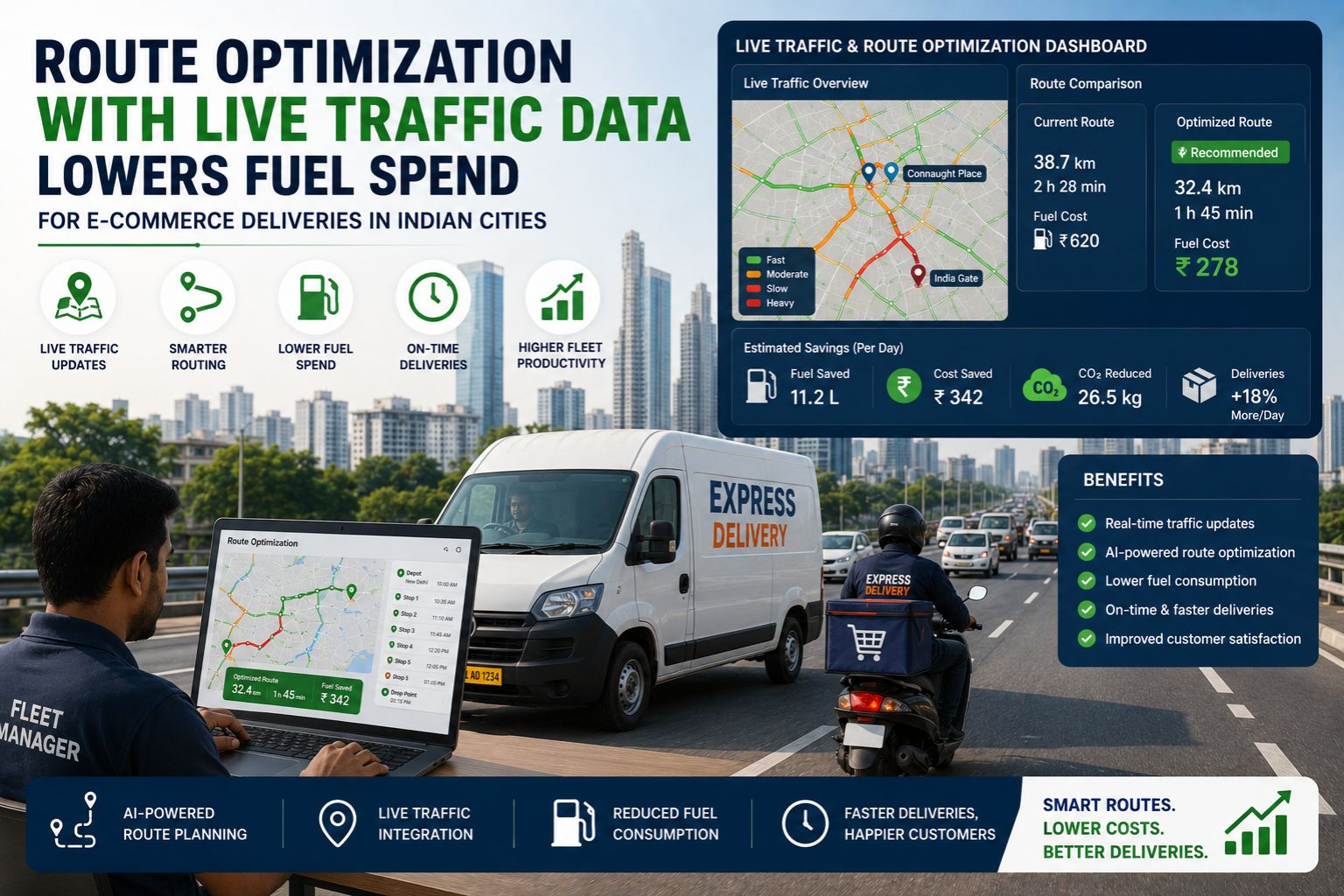
Route Optimization with Live Traffic Data Lowers Fuel Spend for E-Commerce Deliveries in Indian Cities
Route optimization with live traffic data lowers fuel spend for e-commerce deliveries in Indian cities by dynamically adjusting paths to avoid congestion, reducing idle engine time and unnecessary distance, which—when it works well—directly cuts fuel consumption per stop. But it rarely works perfectly the first time.
How Some Fleet Managers Misinterpret Route Optimization in Live Traffic Conditions
A fleet manager overseeing last-mile delivery in Bangalore once assumed that live traffic rerouting would automatically fix every delay, but they discovered that the system could not predict the sudden road closures common during monsoon season. That led to missed geofence alerts and compliance gaps in driver logs, not exactly the smooth operation they'd envisioned.
Where Signal Latency Creates Hidden Fuel Waste in E-Commerce Dispatch
When vehicle telematics data experiences a routing delay due to dense urban infrastructure, the location data becomes stale by the time it reaches the dispatch hub. The result: drivers sit in traffic that the system already cleared, which increases fuel spend without any operational benefit. It's a quiet waste—easy to miss on a dashboard.
Scale Constraints That Disrupt Fuel Savings in High-Volume Indian Fleets
As a delivery fleet expands beyond 50 vehicles in Mumbai, the reliance on a single traffic data source creates a workflow dependency where a feed failure causes all route calculations to use outdated congestion patterns. That instantly eliminates any fuel savings and—just as importantly—violates internal audit requirements for cost per delivery.
Deciding Between Reconfiguring Your Route Engine or Redesigning the Dispatch Workflow
You can tune the routing algorithm to prioritize fuel efficiency over speed, or reconfigure the geofence radius to avoid constant rerouting in narrow lanes. But when traffic data integration fails to match real-time conditions across multiple Indian cities, internal fixes become insufficient, and you must redesign the dispatch workflow around gps controller reliability or replace the entire telematics stack. There's no halfway solution here.
FAQ
Question: Does live traffic data really reduce fuel costs for e-commerce delivery vans?
Answer: Yes, live traffic data reduces fuel costs by avoiding congested routes that cause excessive idling, though the benefit depends on how accurately the system reflects real-time urban conditions. Accuracy isn't guaranteed.
Question: What causes routing delays in Indian city fleet tracking systems?
Answer: Signal latency from network congestion or tall buildings can delay location data transmission, making reroute decisions occur after the driver has already wasted fuel in a traffic jam. It's frustratingly common in dense neighborhoods.
Question: How often should we update the traffic data feed to keep fuel savings consistent?
Answer: Updates every one to two minutes are ideal for dense urban routes, but if the feed fails or lags for more than five minutes during peak hours, fuel savings disappear and compliance logs show incorrect stop times. We've seen it happen.
Question: When is a complete redesign of the dispatch workflow necessary for fuel cost reduction?
Answer: A redesign becomes necessary when the route optimization system cannot handle the frequency of traffic changes in cities like Delhi or Chennai, and re-tuning parameters no longer prevents fuel loss from delayed reroute decisions. At that point, incremental fixes stop making sense.


Comments
Post a Comment