Real-Time Fleet Health Dashboards Predict Engine Breakdowns for Indian Logistics Companies
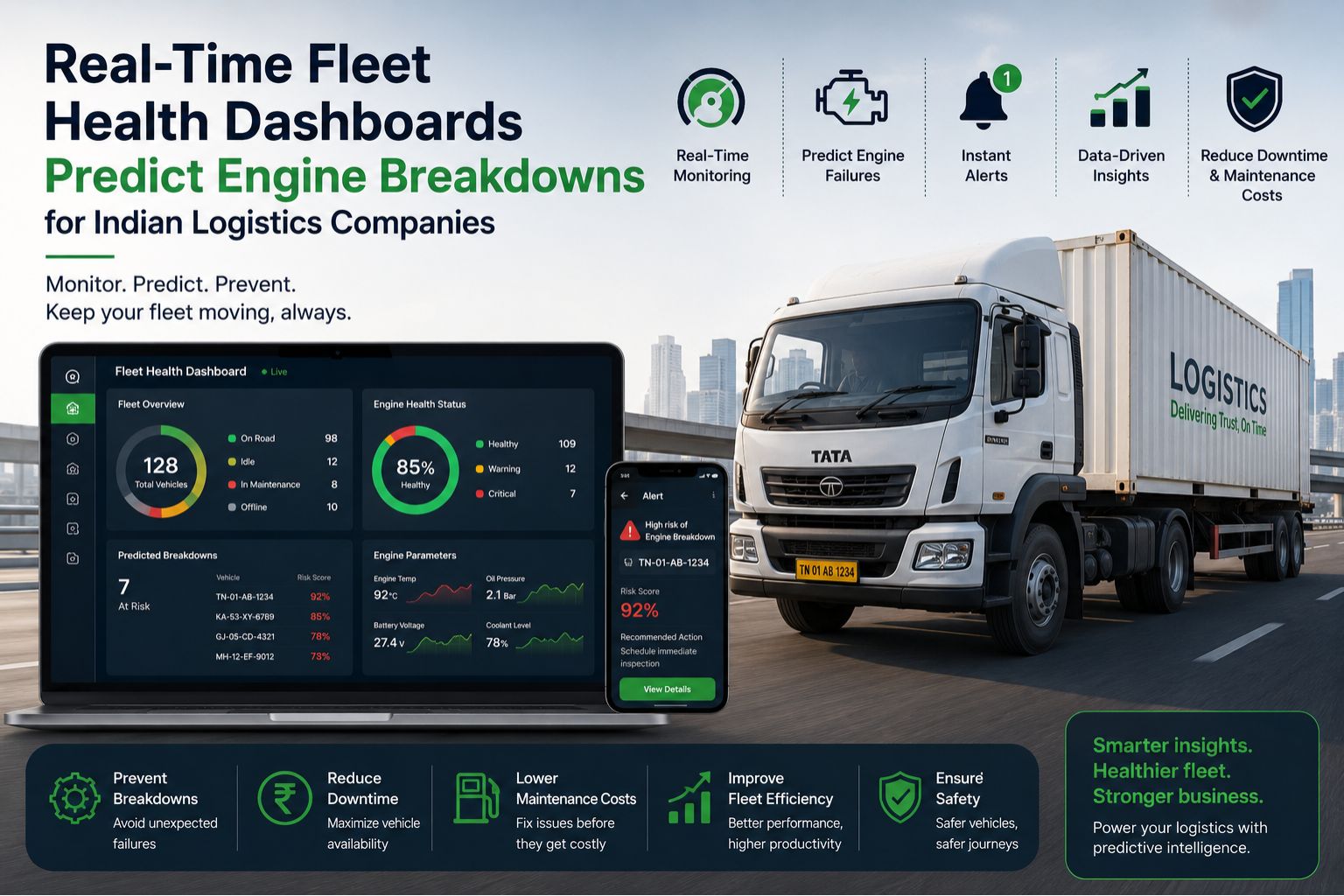
Real-Time Fleet Health Dashboards Predict Engine Breakdowns for Indian Logistics Companies
Real-time fleet health dashboards predict engine breakdowns for Indian logistics companies by combining GPS telemetry with machine learning, but delayed signal jitter in tunnels often causes false alerts that miss actual failures until it is too late for on-road repairs – or at least until a mechanic has to drive two hours out.
How Real-Time Fleet Health Dashboards Turn Telemetry Into Live Engine Status
A real-time fleet health dashboard pulls data from the vehicle telematics unit, converting raw engine parameters such as coolant temperature, RPM, and battery voltage into a live status display that fleet managers can monitor from a single screen, yet the accuracy of this status depends entirely on the refresh rate of the real time vehicle tracking system and the network latency between the truck and the cloud – and honestly, a five-second lag in a dusty highway can be the difference between catching a pre-failure signal and missing it completely.
Why Indian Logistics Operations Still Face Delayed Alerts During Peak Hours
Under real operational scale, a fleet of 200 trucks crossing multiple state borders faces geofence alerts that arrive thirty minutes after a vehicle has already left a designated halt zone, causing compliance logs to show incorrect idle times and preventing the dashboard from triggering an early engine warning before the driver notices vibration in the cabin – you'd think the system would catch it, but the delay makes it a somewhat hit-or-miss affair during evening rush when networks get congested.
The Critical Mistake That Turns Predictive Alerts Into False Noise
The most common mistake is assuming that a dashboard alert about high engine temperature always means an imminent breakdown, but in Indian conditions the alert might be triggered by a faulty temperature sensor that corroded due to dust ingress, and by the time a mechanic reaches the truck the actual failing part is the alternator, not the cooling system, escalating a simple repair into a towing event – the real failure gets buried under noise, and you start ignoring alerts altogether.
When Should You Tune, Reconfigure, or Redesign Your Fleet Health Dashboard
If your dashboard generates more than three false engine alerts per week per vehicle, you need to reconfigure the threshold parameters to match the specific engine model and regional fuel quality, but when the telematics unit itself consistently drops connectivity on routes through forested or mountainous areas of Karnataka and Tamil Nadu, internal reconfiguration stops working and you must redesign the entire hardware selection to include a backup cellular module or satellite fallback, or replace older devices with units that support dual network bands – that's the point where gps controller hardware decisions become unavoidable for accurate engine prediction, and you basically have to bite the bullet on new hardware.
FAQ
Question: What is a real-time fleet health dashboard and how does it predict engine breakdowns?
Answer: A real-time fleet health dashboard collects live engine data from a vehicle telematics unit, such as coolant temperature and RPM, and applies threshold-based or machine learning algorithms to detect abnormal patterns that indicate an imminent engine failure before the driver notices any symptom – though in practice the patterns need to be pretty distinct to avoid false alarms.
Question: Can a fleet health dashboard work on older trucks that do not have modern CAN bus systems?
Answer: Yes, older trucks can be retrofitted with an aftermarket telematics device that reads analog sensor data from the engine control unit or even directly from the battery and alternator wires, though the accuracy of the prediction will be lower than with a CAN bus enabled vehicle because the data resolution is coarser and refresh rates are slower – you might get a general trend but not a precise failure time.
Question: What is the risk of relying entirely on a cloud-based dashboard without an onboard local alarm?
Answer: If the cloud connection drops in a remote stretch of highway in Madhya Pradesh or Rajasthan, the driver will not receive any dashboard alert inside the cabin, and the back office will only see the warning after the trip ends, missing the critical window to prevent a breakdown and causing unnecessary towing costs and delivery delays – essentially you're gambling on consistent connectivity, which is rarely reliable there.
Question: For an Indian logistics company operating 500 trucks, when is it better to redesign the entire telematics system instead of tuning dashboard settings?
Answer: Redesign the telematics system when your dashboard consistently fails to detect engine overheating because the telematics unit lacks a direct connection to the engine temperature sensor and only estimates temperature from alternator load, or when network coverage drops on more than 20 percent of your route kilometers, making any cloud dependent prediction unreliable for real time decision making – if you're losing connectivity on every fifth kilometer, tuning the dashboard is kind of pointless.


Comments
Post a Comment