Predictive Engine Diagnostics Minimize Breakdowns on Golden Quadrilateral for Indian Transporters
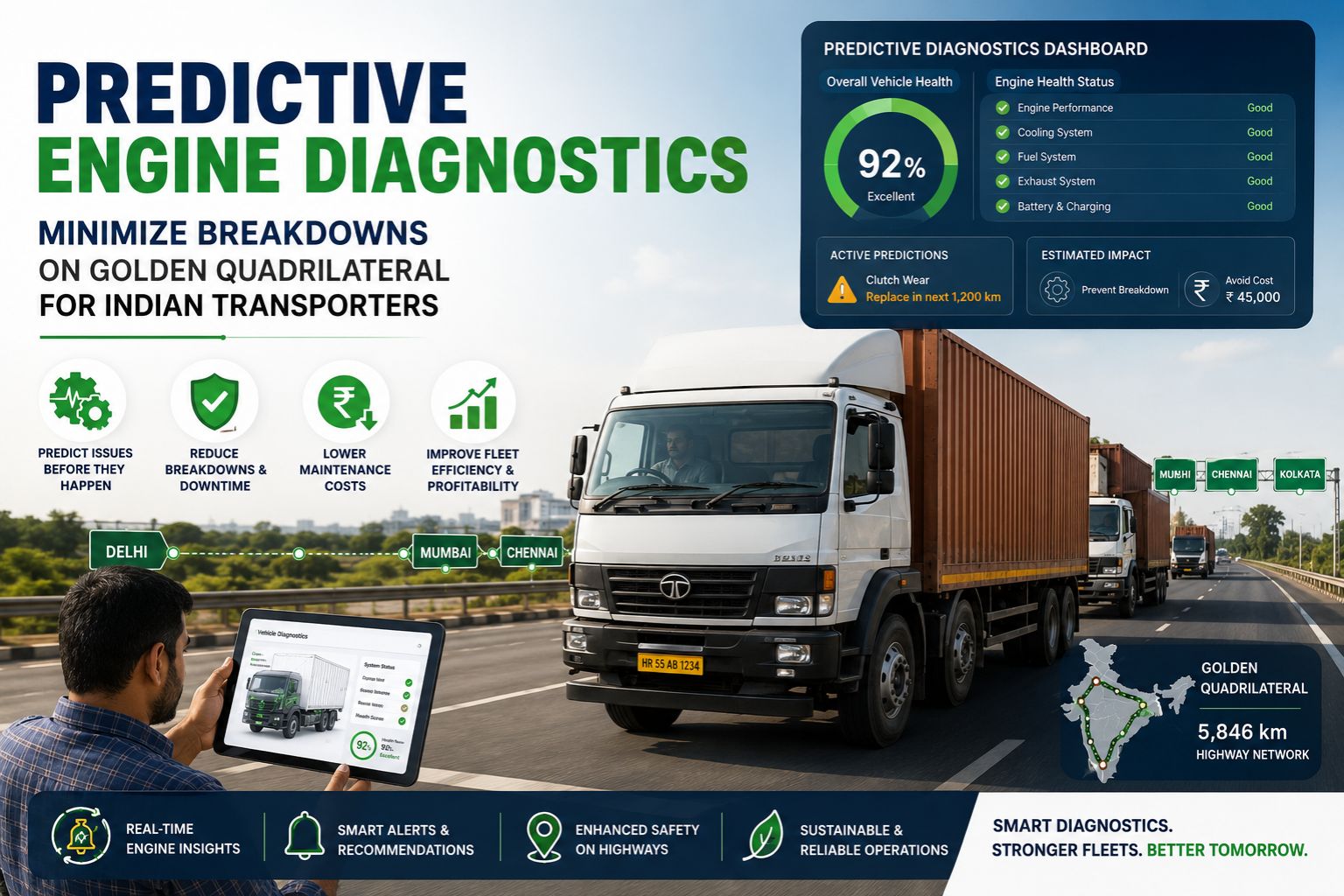
Predictive Engine Diagnostics Minimize Breakdowns on Golden Quadrilateral for Indian Transporters
Predictive engine diagnostics minimize breakdowns on Golden Quadrilateral for Indian transporters by converting raw telemetry data into actionable failure warnings before a vehicle stops moving. Many fleet managers only realize how critical this warning window is after absorbing the cost of a roadside halt—one that could have been avoided if the signal analysis had come in sooner.
How Predictive Diagnostics Work in Live Fleet Tracking
Predictive engine diagnostics use vehicle telematics to monitor parameters like coolant temperature, RPM variance, and fuel pressure against rolling baselines. When a subtle shift shows up in the signal pattern, the system flags a potential failure before the driver notices any performance drop. A common real-world observation? Delayed geofence alerts often line up with undetected engine strain, which suggests that telemetry lag directly cuts into diagnostic accuracy.
What Happens Under Real Operational Scale
Under the scale of a fleet running daily on the Golden Quadrilateral, a single breakdown during a tight delivery window triggers cascade effects: missed unloading slots, penalty clauses, and driver downtime. Signal latency from a weak cellular handoff near industrial zones can cause a critical fault code to arrive hours late, turning what was a minor sensor drift into a major repair. That workflow dependency means scalable diagnostics really depend on consistent network coverage and low-latency data relay.
Common Failure Patterns and Wrong Assumptions
A frequent misunderstanding is assuming a clean check engine light means the engine is healthy, when in reality initial sensor degradation can stay silent for hundreds of kilometers. One non-obvious detail: vibration harmonics from bad road surfaces can mask early bearing wear readings. Many transporters escalate minor sensor alerts prematurely, ignoring that boundary condition where internal fixes—like tightening connectors or updating firmware—stop being enough and component replacement becomes necessary.
Decision Help: Tune, Reconfigure, Redesign, or Replace
The critical decision boundary for Indian transporters is knowing when to reconfigure diagnostic thresholds versus when to replace a failing component. If the diagnostic system generates false positives more than three times in a week, the threshold tuning parameters need adjusting rather than a fleet-wide hardware swap. But if coolant temperature readings climb steadily across multiple trips despite recalibration, no internal tuning will fix a failing water pump. At that point, integrating a reliable GPS tracking platform with engine data—like the systems offered by gps controller—gives you the real-time visibility needed to make that replacement call before a breakdown hits. For transporters running compliance logs, the audit trail of diagnostic events is only useful if the data shows up without routing delays.
FAQ
Question: What does predictive engine diagnostics do for a truck on the Golden Quadrilateral?
Answer: It detects early signs of engine failure by analyzing telemetry data against normal operating ranges, allowing the fleet manager to schedule maintenance before the truck breaks down on a highway.
Question: How soon does the diagnostic system warn about a potential breakdown?
Answer: Warning timing depends on signal latency and the sensor's sampling rate. Faults from sensors like coolant or oil pressure can trigger alerts up to 500 kilometers before a failure under ideal network conditions.
Question: Can predictive diagnostics prevent breakdowns caused by driver behavior?
Answer: No, it cannot prevent breakdowns from hard acceleration or overspeeding unless those behaviors directly affect engine parameters monitored by the telematics system.
Question: What is the biggest risk of ignoring a predictive diagnostic alert?
Answer: The biggest risk is a complete engine failure that stops the vehicle on the Golden Quadrilateral, causing costly towing, missed delivery penalties, and compliance gaps in the fleet's audit trail.


Comments
Post a Comment