Navigating Thailand’s 2026 Fuel Crisis: A Strategic Guide for Fleet Cost Resilience
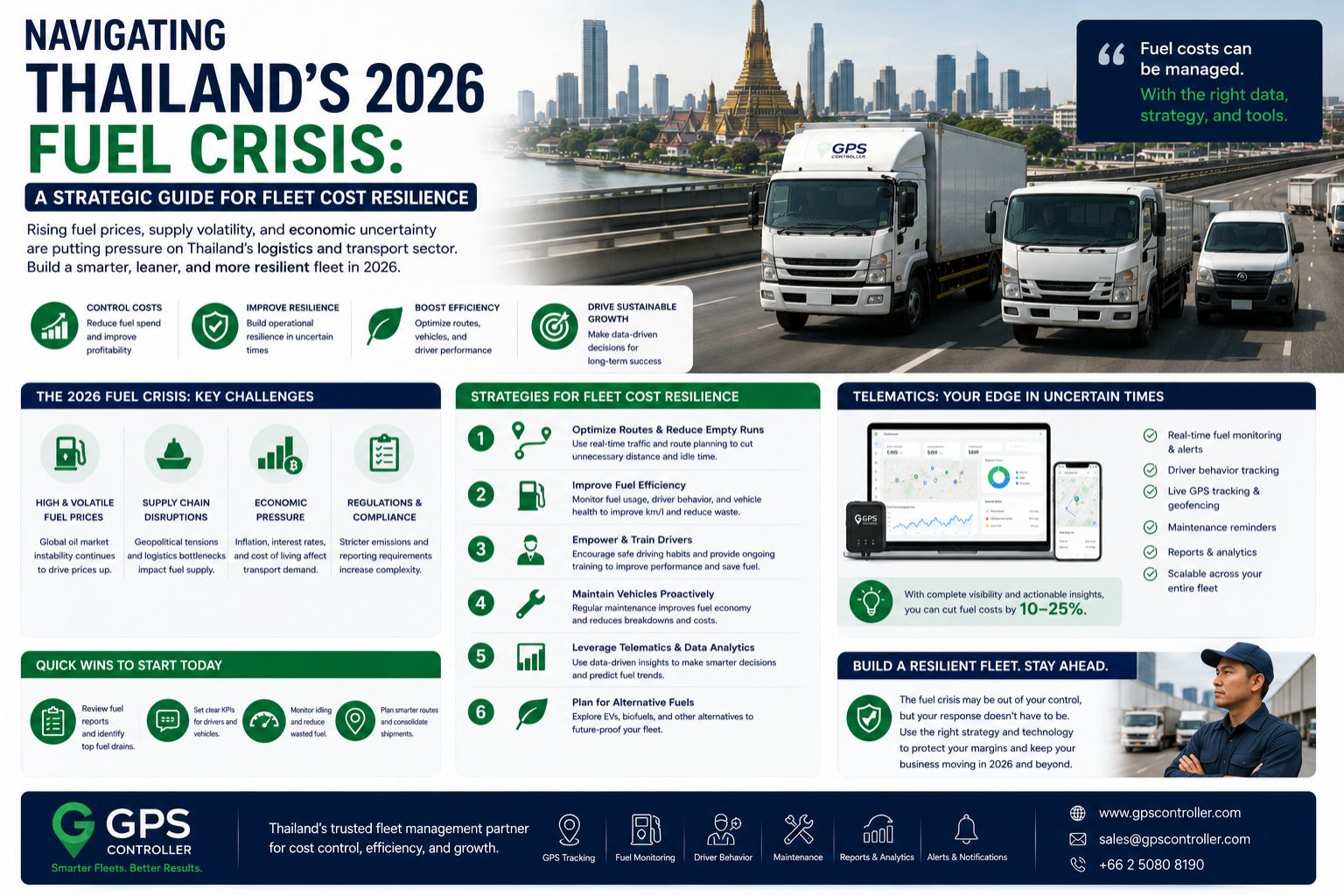
Navigating Thailand’s 2026 Fuel Crisis: A Strategic Guide for Fleet Cost Resilience
Navigating Thailand’s 2026 fuel crisis requires a strategic guide for fleet cost resilience that moves beyond simple fuel budgeting. For fleet managers in Thailand, the sharp increase in diesel prices is not a temporary fluctuation but a structural pressure that will erode operational margins if unaddressed. The real challenge is that most cost-cutting measures fail because they are implemented based on delayed or inaccurate telematics data—a problem we see firsthand when geofence alerts arrive minutes after a vehicle has already entered a restricted, fuel-costly zone.
What Fuel Volatility Means for Fleet Operating Margins
The immediate impact of fuel price spikes is a direct hit to your operating margin, but the deeper issue is the lack of real-time visibility into consumption patterns across your fleet. When fuel prices rise by five baht per liter, the cost to run a single refrigerated truck on a Bangkok-to-Chiang Mai route can jump by over three thousand baht per trip. Without granular data on idle engine time and route efficiency, fleet managers are forced to make reactive decisions—like reducing service frequency—which honestly ends up damaging customer trust and contract compliance more than just eating the fuel cost.
Why Traditional Cost-Cutting Measures Fail Under 2026 Conditions
Standard approaches like reducing vehicle usage or enforcing stricter driver policies often backfire because they don't fully account for the scale constraints of operating in Thailand’s mixed infrastructure. A common misunderstanding is that reducing speed always saves fuel, but in stop-and-go traffic around Bangkok, maintaining a steady 40 km/h can actually burn less fuel than aggressive acceleration from a full stop. Fleet managers escalate frustration by applying a blanket speed limit across all routes, ignoring that some hilly routes in the north require different engine load management. The boundary condition where internal policy changes stop working is when the data used to set those policies is three days old—based on manual logbooks rather than real-time telemetry.
Critical Failure Patterns in Fuel Management Systems
One of the most dangerous failure patterns is relying solely on pump receipts for fuel accounting, which introduces a significant time delay and masks issues like fuel theft or inefficient routing. Another non-obvious detail is that signal latency from older GPS devices in tunnels or under dense canopy can cause the fleet tracking system to record idle time incorrectly—leading to false fuel consumption reports. This is a compliance risk because if you're audited by a client for fuel surcharges, you cannot justify costs based on corrupted data. The escalation happens when a fleet manager installs a third-party fuel monitoring app that doesn't integrate with the existing vehicle telematics, creating double data entry and workflow dependency that slows down decision-making even further.
How to Build a Resilient Fuel Cost Strategy
Building a resilient fuel cost strategy for 2026 requires you to make a clear decision: tune your existing systems, reconfigure your routing logic, or redesign your monitoring infrastructure. Start by tuning your geofence alert sensitivity to catch unnecessary detours that add mileage and fuel waste. Next, reconfigure your route optimization software to prioritize fuel efficiency over shortest distance, particularly for long-haul trucks. The boundary where internal fixes become insufficient is when you realize you simply cannot track fuel consumption per vehicle per route without integrated telematics data. At that point, you must replace your ad-hoc reporting with a unified platform like gps controller that links fuel data directly to driving behavior and route performance—giving you the decision boundary clarity needed to protect margins.
FAQ
Question: How does the 2026 fuel crisis in Thailand specifically impact fleet operating costs?
Answer: The crisis significantly increases per-kilometer fuel expenses, directly reducing profit margins on every delivery. Without precise consumption data from vehicle telematics, managers cannot accurately forecast costs or pass them through to clients, leading to a compliance gap in contract billing.
Question: What is the most common mistake fleet managers make when trying to reduce fuel consumption?
Answer: The most common mistake is imposing a uniform speed limit across all routes without analyzing route-specific elevation changes or traffic patterns. This often increases fuel use on hilly terrains where gear changes are necessary, and it ignores that drivers may idle longer to avoid penalties, which also wastes fuel.
Question: Can real-time GPS tracking solve fuel cost problems during the crisis?
Answer: Real-time GPS tracking is essential, but it must be paired with location data on engine idle time and geofence alerts. The solution fails if signal latency is high, as delayed alerts prevent immediate intervention, making the data useful only for post-hoc analysis rather than active cost management.
Question: What is the decision boundary for when a fleet should stop trying to manage fuel costs internally and seek external technology?
Answer: The decision boundary is when you have no integrated system that links fuel consumption to specific drivers, routes, and vehicle performance. If you are seeing a gap of more than 10% between estimated and actual fuel use, a platform like gps controller can provide the unified data workflow necessary to enforce real cost discipline.


Comments
Post a Comment