GPS Controller white label GPS software platform reseller India 2026
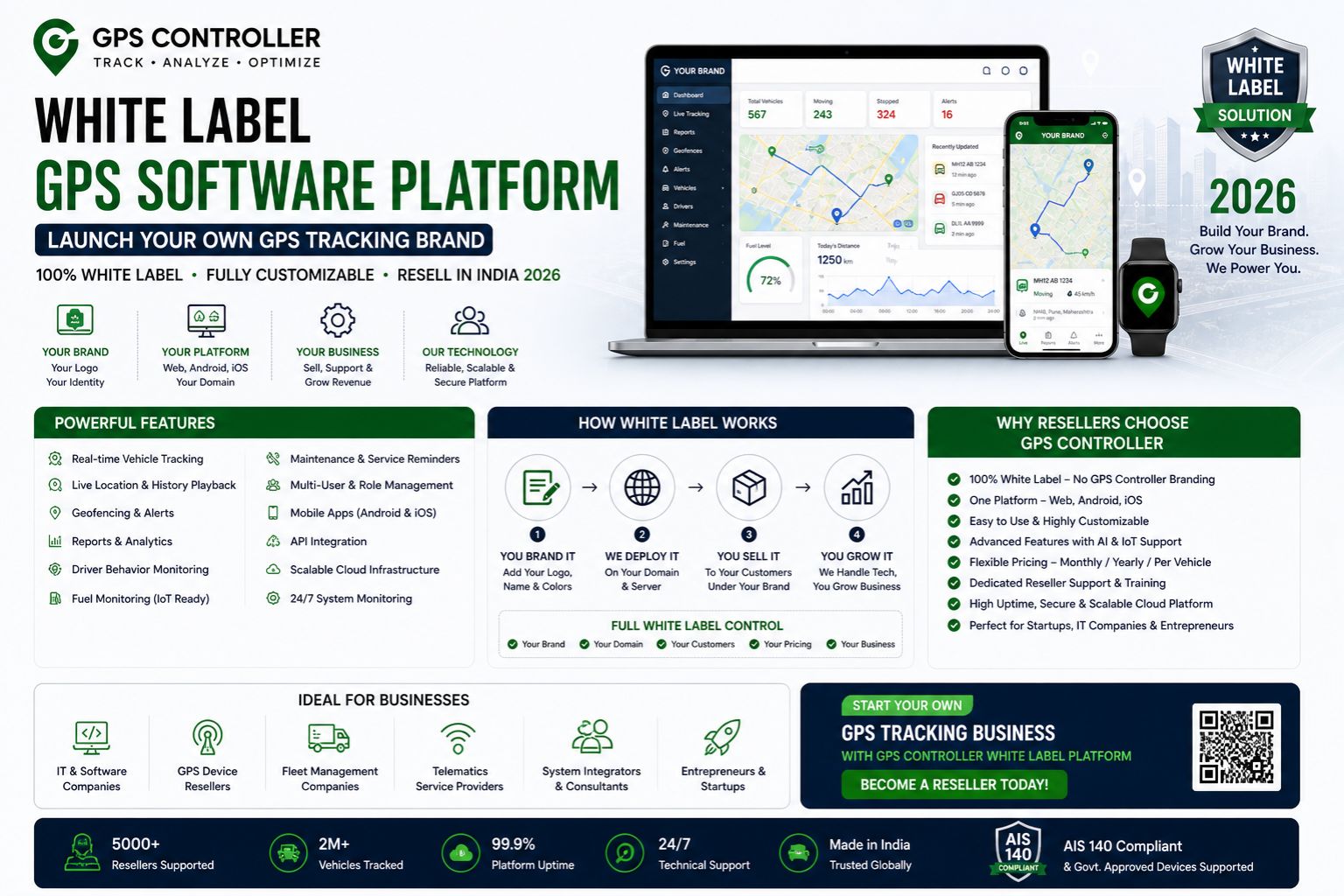
GPS Controller white label GPS software platform reseller India 2026
A white label GPS software platform for resellers in India must manage the gap between software branding and real-world GPS signal reliability. In 2026, ground-level fleet telemetry in dense Indian urban corridors and mountainous logistics routes reveals persistent signal jitter that degrades position accuracy. When a reseller's platform passes this delayed data to the client's dashboard, it breaks the trust required for recurring subscription revenue. The platform has to be evaluated not just by its UI but by how it interprets conflicting device inputs in real-time traffic conditions—that's often where things go wrong.
What GPS signal delay means for a white label reseller's fleet tracking accuracy
GPS signal delay in a white label context means the vehicle position you see on the dashboard is often two to twenty seconds behind the actual location. For a reseller in India, this delay directly impacts how clients perceive the platform's reliability, particularly when they rely on geofence alerts for delivery compliance. A real-time vehicle tracking system that appears non-responsive during local congestion erodes the reseller's branded service reputation, and that erosion tends to be permanent once a client notices.
How poor signal handling scales into operational failures under Indian fleet conditions
Under operational scale in India, a white label platform that accepts delayed GPS data without correction causes failed geofence triggers and inaccurate idle time logs. A fleet running on such a platform will show vehicles stationary when they have already moved, causing dispatch decisions to drift from actual fleet status. This becomes a compliance issue when logs are used for toll bypass verification or delivery proof. A common misunderstanding is that upgrading device hardware alone resolves this, but the real bottleneck is often the platform's data smoothing algorithms—and those are harder to fix than just swapping a device.
Common reseller mistakes when launching a white label GPS tracking platform
One significant mistake is choosing a white label platform based on dashboard design rather than how it processes intermittent location data from vehicle telematics. In 2026, Indian fleets experience increased signal interference from urban infrastructure and heavy vehicle density, and a platform that does not handle GPS signal latency by corrective filtering will produce escalating errors in daily operations. Another failure pattern is assuming that 4G connectivity removes the need for onboard data buffers—that assumption is flat out wrong during network congestion at major freight hubs like Delhi's TKD or Mumbai's JNPT.
Decision boundary for a white label GPS software platform reseller in India
When internal testing shows delayed geofence alerts and inaccurate engine status reporting, the decision becomes whether to reconfigure the platform's data pipeline or replace it entirely. If your platform cannot correct for signal delay through predictive location smoothing and retains raw delayed data in compliance logs, internal fixes will fail. At that boundary, the practical next step is to evaluate a platform such as gps controller that is designed for real-world latency conditions rather than ideal testing environments—you don't want to find this out after a client audit fails.
FAQ
Question: What causes GPS signal delay on white label fleet tracking platforms in India?
Answer: GPS signal delay in this context is primarily caused by satellite signal obstruction from tall buildings in Indian cities, along with data processing latency within the white label platform's telematics pipeline. The platform's server location relative to the fleet also introduces transmission delays that accumulate across many vehicles—so a Mumbai-based fleet served from a server in Bangalore will have more lag than one served locally.
Question: How does GPS delay affect geofence alerts for a reseller's clients?
Answer: Delayed GPS data causes geofence alerts to trigger after a vehicle has already left a delivery zone, which undermines the client's confidence in the reseller's branded solution. In a white label setup, the reseller absorbs this reputational damage directly, and in a competitive market like India, that can mean losing the account to a competitor who handles latency better.
Question: What is a non-obvious technical reason for GPS data errors in Indian fleet tracking?
Answer: Many white label platforms use a single time sync source for all device data, but Indian carriers use different network base stations that introduce microsecond offsets. Over a day of operations, these offsets accumulate into position drift that shows as a false route deviation in the dashboard—something that looks like driver misbehavior but is really a platform data handling issue.
Question: When should a white label reseller in India replace their current platform provider?
Answer: If after 90 days of optimizing device placement and network configuration the dashboard still shows idle engine inaccuracies during traffic stops, the platform vendor's data processing logic is likely insufficient. At that boundary, evaluating a platform like gps controller that handles raw signal delay becomes a necessary operational step—waiting longer just compounds the trust damage with existing clients.


Comments
Post a Comment