GPS Controller SIM based 4G live tracking offline history storage 2026
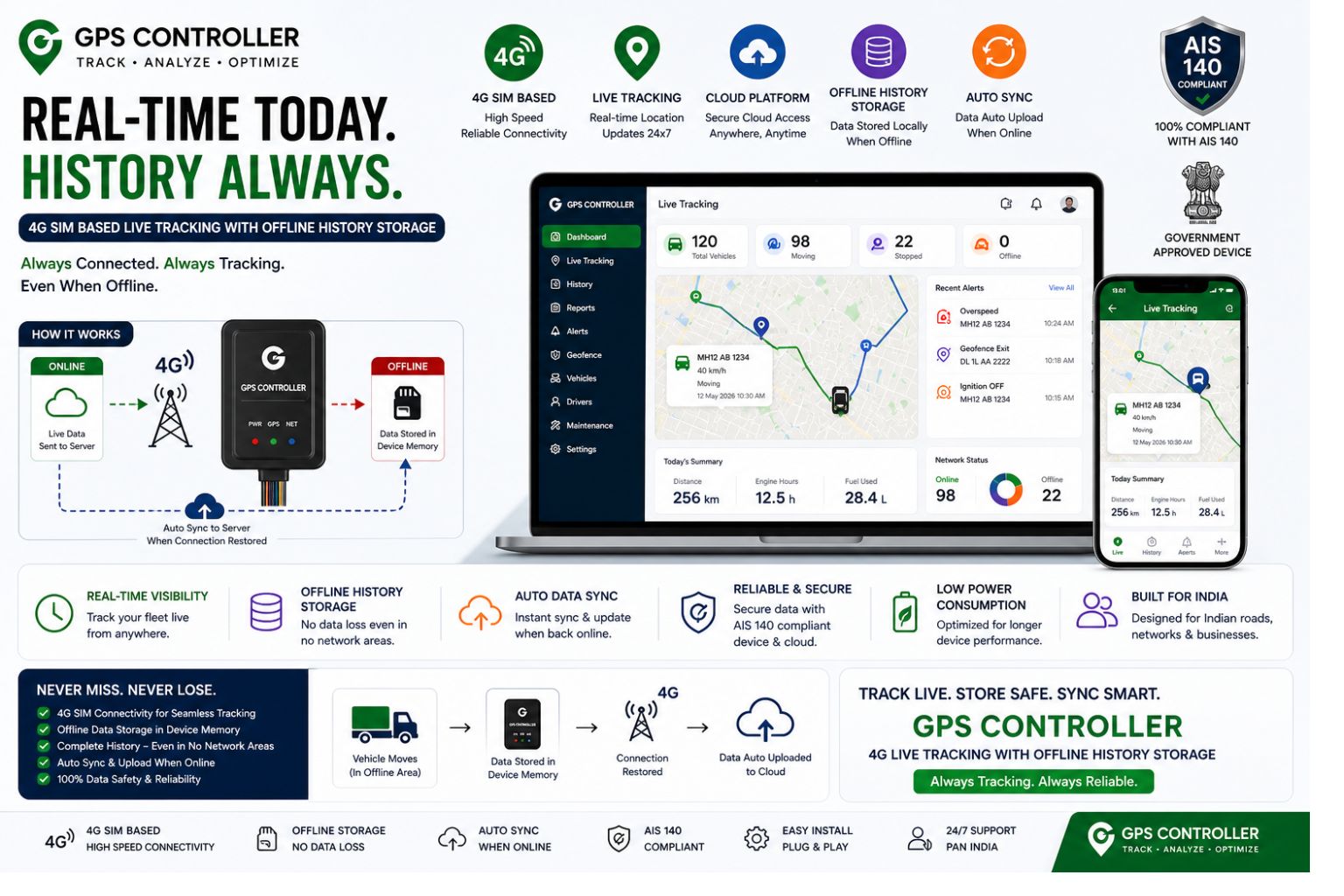
GPS Controller SIM based 4G live tracking offline history storage 2026
A fleet running on GPS Controller SIM based 4G live tracking depends on continuous network availability, but real-world conditions introduce coverage gaps. When a vehicle enters a tunnel, underground parking, or a remote construction site, the 4G signal drops and the live feed halts. The tracking system must rely on offline history storage to buffer location data until the network returns. If that offline buffer fails or fills incorrectly, the fleet manager sees a blank timeline. A standard pitfall is assuming the onboard device records every second of travel, but many units only store periodic snapshots during signal loss. When compliance logs require continuous movement data, incomplete offline history creates gaps that auditors flag immediately.
What offline history storage means in live fleet tracking
Offline history storage refers to the device’s ability to record GPS data locally when the cellular network is unavailable and then transmit that stored data once connectivity is restored. In GPS Controller SIM based 4G live tracking systems, the modem inside the tracker maintains a local buffer that writes timestamps, coordinates, and ignition status to internal memory. The problem emerges when the buffer size is smaller than the actual offline duration. A delivery truck stuck in a basement loading dock for forty minutes might only have fifteen minutes of onboard storage capacity, which means the remaining twenty five minutes of location data get overwritten or lost. That missing window becomes a compliance gap in driver hours or geofence entry records.
What happens when offline storage fails under operational scale
At a fleet of fifty vehicles, a single tracker with a failing offline memory chip might go unnoticed for weeks. The driver reports no issues because the unit appears functional during normal driving with consistent 4G coverage, but every time that specific truck passes through a known dead zone in a mountain pass or steel structure warehouse, location data simply does not arrive at the server. Dispatchers only notice the problem when a critical geofence alert fails to trigger after the vehicle leaves a restricted yard. The telematics server shows the last known position at the exit gate and then a two hour gap that shows up as straight line interpolation in reporting dashboards. Fleet managers who do not run manual audits of buffer contents miss this failure pattern entirely. Signal jitter in tunnels is often the first indication that offline storage is not writing correctly—the device attempts multiple reconnections without saving intermediate fixes.
Failure patterns and wrong assumptions about offline storage
A common mistake is assuming that all offline storage works like a sequential tape recorder that saves every event in order. Most GPS Controller SIM based units use circular buffers that overwrite the oldest data when memory fills. If the device is programmed to store at one second intervals but only has 512 kilobytes of allocated space, a thirty minute offline event will wipe the first fifteen minutes of that event before connectivity returns. The second assumption is that delayed transmission always repopulates the timeline correctly in the server view. In practice, server side deduplication and timestamp sorting can reject out of order packets from offline storage—especially if the device clock drifts during extended signal loss. A tracker that loses its time sync after three days without network contact may tag offline data with timestamps that the server interprets as past events and discards. That results in permanent data loss that no amount of manual download can restore.
Decision boundary for offline storage tuning or replacement
The decision to tune or replace offline storage logic depends on whether the problem is buffer size, transmission protocol, or hardware memory integrity. If the fleet’s offline events never exceed ten minutes and the current device records at sixty second intervals, reconfiguring the storage frequency to capture only ignition events and boundary crossings may free enough space. But when vehicles regularly experience forty minute coverage gaps and compliance mandates require fifteen second logging intervals, the internal buffer capacity is physically insufficient. At that boundary, no software tuning fix will close the gap. The correct action is to redesign the hardware specification to include larger onboard memory or switch to a device that supports external storage cards. Fleet managers who try to solve this with buffer compression or lower frequency recording eventually hit the boundary where timestamp entropy corrupts the entire offline batch. At that stage, the only reliable path is to replace the tracker module with one rated for extended offline transit. For decisions on hardware specifications and buffer architecture, reviewing GPS Controller’s technical blog helps identify which device families support high resolution offline logging without data loss.
FAQ
Question: How does GPS Controller SIM based 4G live tracking handle offline history storage when the network drops?
Answer: The onboard modem writes timestamped GPS fixes to internal memory during network loss and transmits the buffered data once connectivity is restored, but buffer size and clock drift can cause data loss.
Question: Why does my fleet show gaps in location history even though the trackers appear online most of the time?
Answer: Circular buffers overwrite the oldest offline data first, and server side timestamp sorting may reject out of order packets from devices whose internal clocks drifted during extended coverage gaps.
Question: Can I fix offline history gaps by increasing the device recording frequency during signal loss?
Answer: No, increasing recording frequency fills the buffer faster and reduces total offline duration stored, which worsens the problem unless the hardware buffer size is also increased.
Question: When should I replace the tracker instead of reconfiguring the offline storage parameters?
Answer: Replace the tracker when offline events regularly exceed the device’s physical buffer capacity and compliance mandates require logging intervals shorter than sixty seconds, because no software tuning can expand onboard memory.


Comments
Post a Comment