GPS Controller agentic AI auto creates work order when engine fault triggers 2026
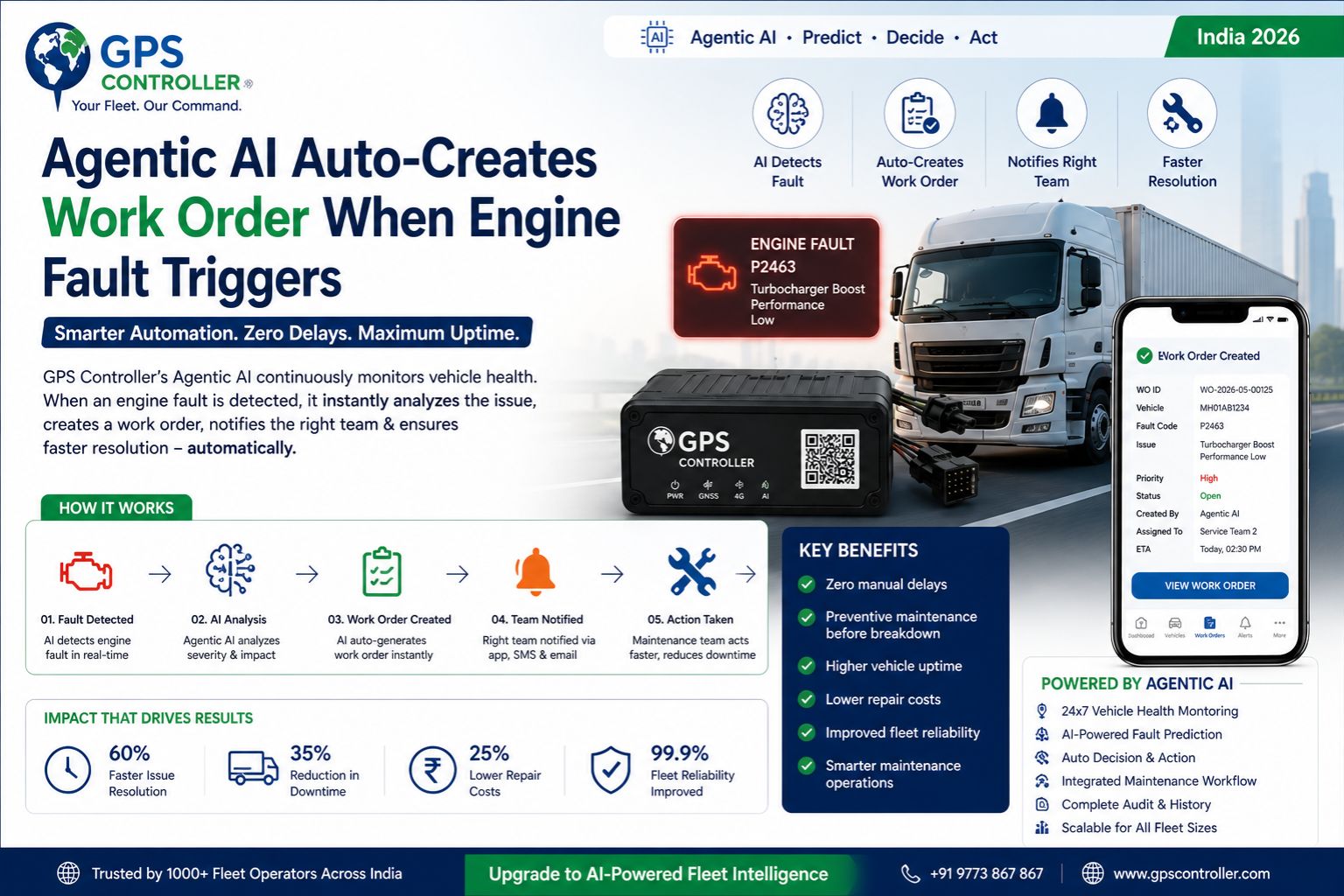
GPS Controller agentic AI auto creates work order when engine fault triggers 2026
When an engine fault triggers in a fleet vehicle, the expectation is that a work order gets created automatically, closing the loop between telemetry and maintenance. GPS Controller agentic AI auto creates work order when engine fault triggers 2026—but only if the data chain stays intact from the vehicle's ECU through the telematics gateway to the backend server. In live fleet tracking, a delayed or corrupted fault code can break that chain, leaving the work order uncreated and the vehicle still on the road with a component that's slowly degrading.
What agentic AI work order creation means for fleet tracking
In a real fleet environment, the agentic AI doesn't wait for a human dispatcher to spot the check engine light on a dashboard. Instead, it monitors the incoming stream of J1939 fault codes from the vehicle telematics unit. When a fault threshold is crossed, the system generates a work order with the fault code, timestamp, GPS coordinates, and vehicle ID, then assigns it to the nearest available technician. The key vulnerability here is that the entire workflow depends on the GPS signal delay being under a few seconds—if the location data is stale, the work order might get routed to the wrong service bay, creating a compliance gap in the maintenance log.
The operational reality of fault-driven workflows at scale
Under real operational scale with hundreds of vehicles, the agentic AI has to handle overlapping fault events from different vehicle segments simultaneously. One common misunderstanding is that the AI can simply create a work order for every fault code it receives. However, in practice, a non-obvious device detail is that many fault codes are transient or ghost codes that clear on the next ignition cycle. If the agentic AI creates a work order for every single fault trigger without a validation step, the maintenance queue gets flooded with unnecessary entries. This leads to idle engine inaccuracies being flagged as real failures, wasting technician hours and inflating compliance logs with false positives.
Common failure patterns and wrong assumptions in automated work orders
The most expensive failure pattern occurs when the agentic AI relies entirely on the GPS timestamp from the vehicle's telematics unit. In some urban environments with tunnel sections or heavy interference, the GPS signal jitter can cause the fault event timestamp to be off by several minutes. This creates a workflow dependency where the work order is created but references the wrong location, causing the technician to drive to a service point that the vehicle has already passed. The boundary condition where internal fixes stop working is when the network itself introduces latency in the telemetry stream—no amount of tuning on the AI logic can correct for a fault code that arrives at the backend five minutes after the engine fault actually occurred.
Decision boundary: tune, reconfigure, or replace the workflow
When your fleet experiences consistent work order misrouting or missed fault triggers, the decision boundary is clear. You can tune the fault threshold parameters to reduce false positives, or you can reconfigure the agentic AI to include a validation window that waits for a second fault confirmation before creating the work order. However, if the root cause is a persistent GPS signal delay caused by outdated telematics hardware or a congested cellular network, then internal fixes aren't enough. At that boundary, you have to redesign the telemetry architecture or replace the telematics units to ensure that fault codes arrive with accurate location data in real time. A GPS Controller integration can provide the necessary telematics gateway to reduce signal latency, but the fleet manager must evaluate whether the current hardware can support the agentic AI workflow at all.
FAQ
Question: How does agentic AI know an engine fault has occurred in a fleet vehicle?
Answer: The agentic AI monitors the continuous stream of fault codes transmitted from the vehicle's ECU through the telematics unit. When a fault code crosses a predefined severity threshold, the system triggers the work order creation workflow.
Question: Can GPS signal delay cause a work order to be created for the wrong vehicle?
Answer: Yes, if the GPS signal delay is significant, the fault event may be associated with the wrong timestamp or location, leading the work order to be assigned to an incorrect vehicle or service bay.
Question: What happens if the agentic AI creates a work order for a transient fault code?
Answer: The work order remains in the maintenance queue as a false positive, consuming technician time and cluttering compliance logs. This is why some fleets add a validation window that requires a second fault confirmation before finalizing the order.
Question: When should a fleet consider replacing its telematics hardware instead of tuning the AI?
Answer: When the root cause of missed or misrouted work orders is a persistent GPS signal delay due to outdated hardware or a congested network, the telematics units must be replaced to restore real-time fault data accuracy.


Comments
Post a Comment