EV Fleet Battery Monitoring Extends Range for Last-Mile Electric Vans in Indian Urban Deliveries
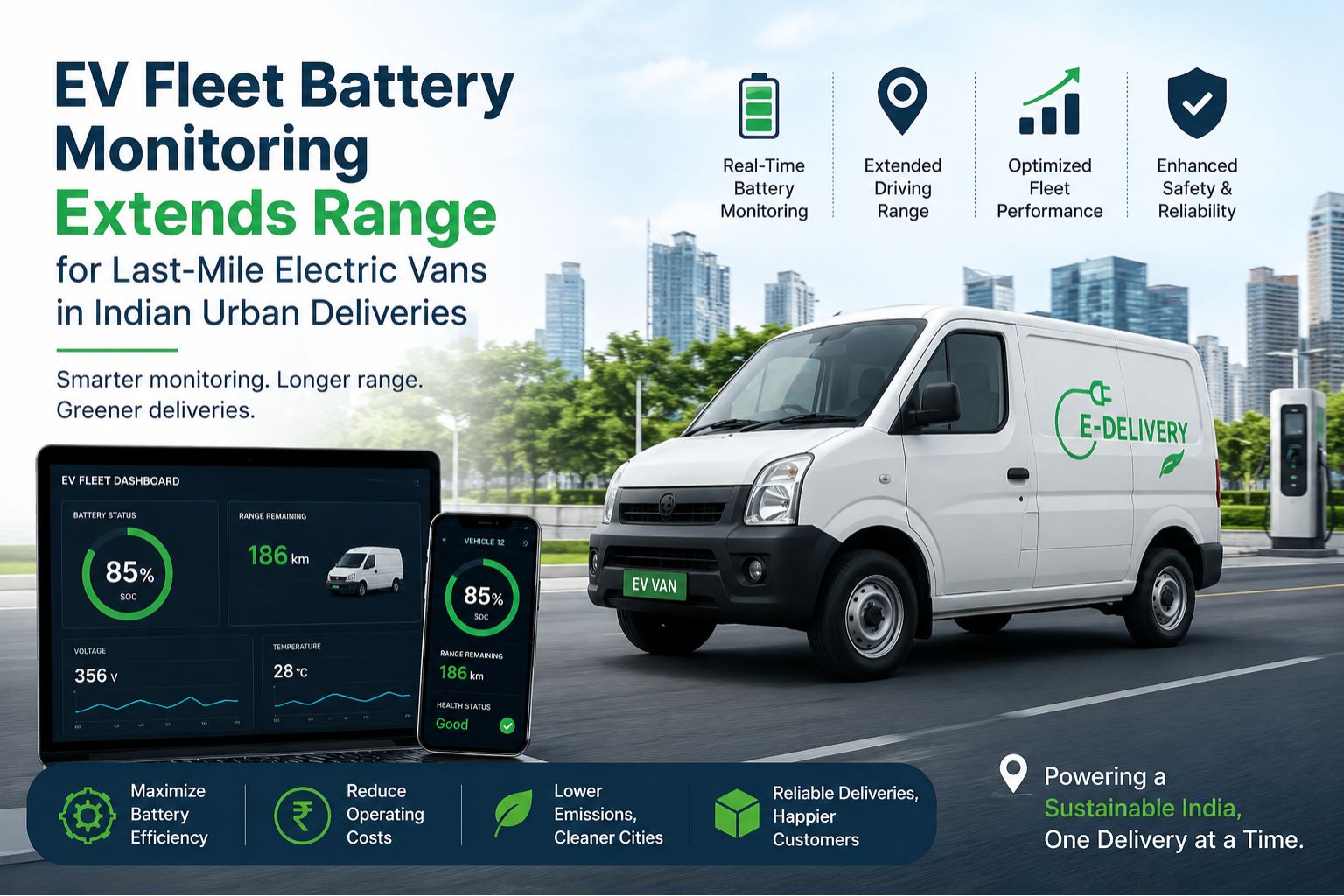
EV Fleet Battery Monitoring Extends Range for Last-Mile Electric Vans in Indian Urban Deliveries
Accurate EV fleet battery monitoring is the critical factor determining whether last-mile electric vans complete their delivery routes in dense Indian cities or fall short, triggering costly recovery operations. Real-world fleet data shows that battery state-of-charge readings from vehicle telematics can drift by up to 8% during a single shift due to temperature sensor lag and regenerative braking estimation errors in stop-start traffic typical of Delhi, Mumbai, and Bengaluru. This discrepancy creates a dangerous gap between planned range and actual available energy—one that directly impacts delivery compliance and fleet utilization, sometimes in ways that are only obvious after the van's already stranded.
Defining Battery Monitoring Accuracy in Real Fleet Conditions
In operational electric van fleets, battery monitoring is not simply a dashboard percentage but a complex calculation involving cell voltage balancing, temperature compensation, and discharge curve modeling. The standard battery management system in many last-mile vans underestimates energy consumption during high-load events like climbing flyovers or running air conditioning in 40°C heat. Fleet managers in Indian urban settings report that the battery indicator often shows 15% remaining when the vehicle is actually at 7%, leading to unexpected shutdowns kilometers from the delivery zone and creating a fleet tracking blind spot that nobody really accounts for until it happens twice in a week.
Operational Scale Impact on Range Prediction Failure
When a fleet scales beyond ten electric vans, the cumulative error from individual battery monitoring systems compounds into a systemic range prediction failure. Route optimization software assumes consistent energy draw, but urban delivery patterns with 80 to 120 stops per shift introduce regenerative braking inefficiencies and auxillary power drain from lighting and telemetry units. One fleet operator in Pune observed that their vans averaged 18% less real-world range than the battery monitoring system indicated—a gap that forced them to reduce daily delivery targets by 25%. This error margin is not a calibration issue you can tweak away; it's a fundamental limitation of how standard BMS algorithms handle dynamic urban load profiles, especially when drivers are hitting the brakes every few hundred meters.
Common Misunderstandings About Battery Data Reliability
The most frequent mistake fleet managers make is treating battery monitoring as a direct fuel gauge equivalent. Unlike a fuel tank, lithium-ion battery capacity changes with temperature, discharge rate, and cell age, meaning a 50% reading does not represent half the energy. A common escalation occurs when a driver reports 20% battery on the dashboard, the dispatcher assumes 20 kilometers of range remains, but the van stops after 6 kilometers due to cell voltage sag under load. This misunderstanding leads to blaming the driver or the vehicle when the root cause is the inability of standard monitoring to project usable energy under real driving conditions with multiple stops and varying terrain—and honestly, that blame game just wastes everyone's time.
Decision Help: Configure or Replace Battery Monitoring Systems
Fleet managers facing persistent range shortfalls must decide between reconfiguring existing battery monitoring parameters or redesigning their telematics architecture to include direct cell voltage and temperature data from each module. Reconfiguration works when the error is consistent and relates to correction factors for temperature or regenerative braking, but this approach fails when battery cells degrade unevenly or when the fleet operates across different climate zones. The boundary where internal fixes become insufficient is clear: when range prediction error exceeds 10% and causes missed delivery windows, the only solution is to redesign the monitoring layer with a dedicated battery health tracking system that feeds raw data into the route planning engine. For Indian last-mile operations using electric vans, integrating a solution like gps controller that processes real-time battery telemetry against actual driving patterns is the threshold where staying with faulty monitoring becomes a compliance and operational risk you can't really afford to ignore any longer.
FAQ
Question: Why does my electric van battery percentage drop faster than expected during delivery routes?
Answer: The battery percentage displayed in most electric vans is an estimation based on voltage and historical discharge curves, not actual remaining energy. In stop-start urban traffic with air conditioning running, the BMS underestimates power draw by up to 12%, causing the displayed percentage to fall faster than linear predictions, especially in the last 30% of the charge cycle where voltage curves flatten—and frankly, that's when you really need the accuracy most.
Question: Can temperature affect EV battery monitoring accuracy in Indian summers?
Answer: Yes, ambient temperatures above 40°C increase internal battery resistance and reduce usable capacity, and many BMS units do not correctly compensate for this. Fleet data from Chennai shows that battery monitoring overestimates available range by 15% on days above 38°C compared to 25°C conditions, leading to regular range failures on long delivery shifts that nobody planned for.
Question: What causes battery monitoring data to drift differently between vans in the same fleet?
Answer: Cell imbalance due to manufacturing variance and unequal charging cycles causes each battery pack to behave differently under load. Two identical vans on the same route can show a 6% difference in state-of-charge readings, and this variance increases as batteries age, making fleet-wide range predictions unreliable without per-vehicle calibration—which most operators just don't have time to do manually.
Question: How do I know if my battery monitoring system is accurate enough for delivery planning?
Answer: You need to compare dashboard battery readings against actual kilowatt-hours consumed per route using a telematics unit that logs energy draw directly from the motor controller. If the difference between predicted and actual range exceeds 8% consistently, your monitoring system is introducing unacceptable risk, and you should reconfigure the energy models or upgrade to a system that tracks real-time cell-level data—before the next van gets stuck on a flyover during peak traffic.


Comments
Post a Comment