Cold Chain Temperature Alerts with GPS Controller Prevent Vaccine Spoilage During India's Monsoon Logistics
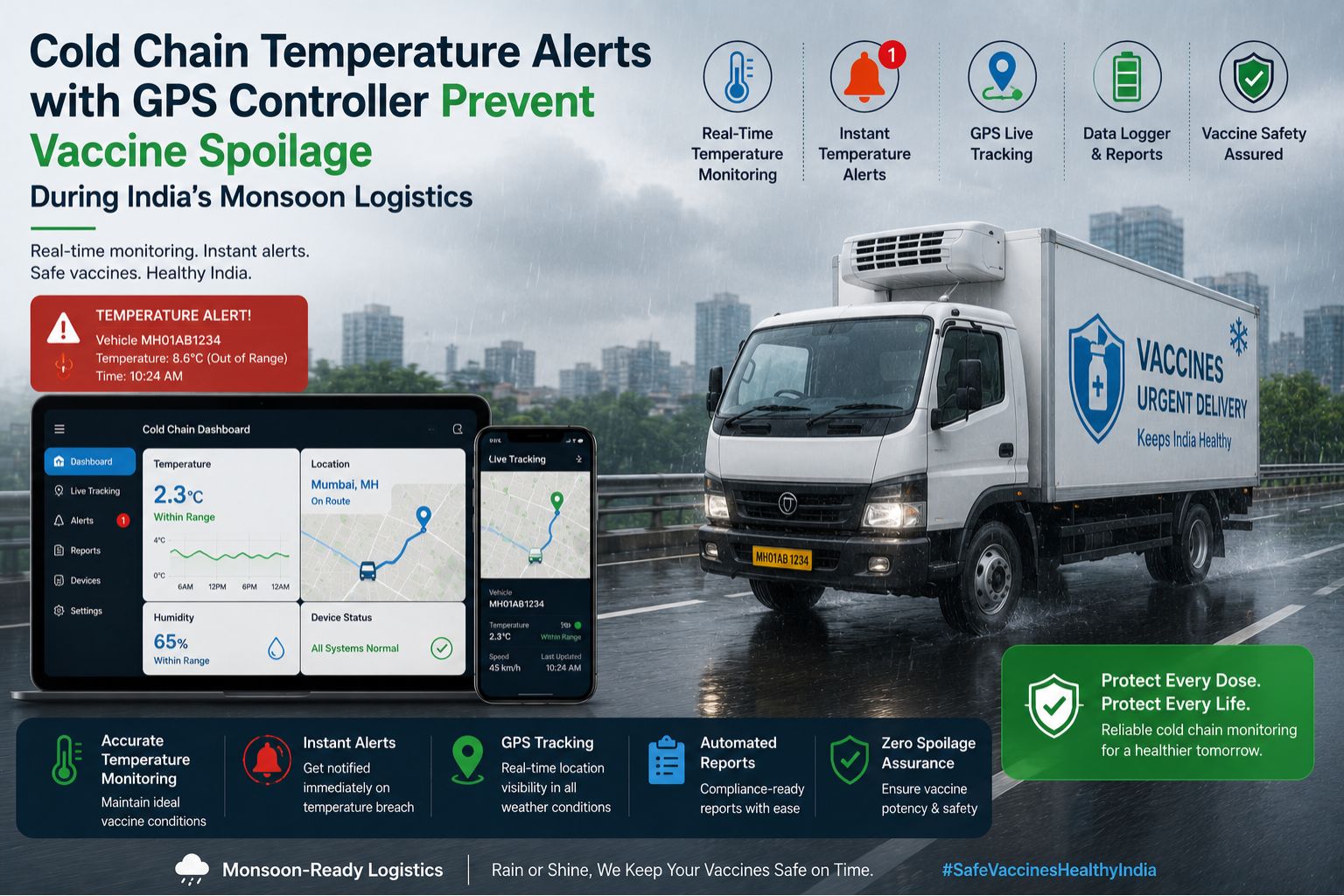
Cold Chain Temperature Alerts with GPS Controller Prevent Vaccine Spoilage During India's Monsoon Logistics
Cold chain temperature alerts with GPS controller prevent vaccine spoilage during India's monsoon logistics by catching real-time deviations before they reach compliance thresholds. In live fleet tracking, a two-degree spike inside a refrigerated van might go unnoticed for hours if the telemetry update interval lags behind actual road conditions. The monsoon introduces humidity and erratic power that delay normal signal transmission, so the difference between a valid vaccine batch and a rejected load can come down to a few minutes of data.
What Temperature Alert Delay Means for Cold Chain Compliance
A temperature alert delay in cold chain logistics means the reported cabin temperature could already be five degrees higher than the last uploaded value. In India's monsoon terrain, vehicle telemetry often experiences signal jitter inside tunnels and under heavy cloud cover, delaying geofence alerts that would normally trigger immediate corrective action. Fleet managers rely on these alerts to maintain compliance logs required by regulatory bodies like the WHO and CDSCO, but if the location data delay compounds with temperature reading latency, the compliance window closes before anyone can act.
Real Operational Scale of Vaccine Distribution During Monsoon
Under real operational scale, a fleet delivering vaccines across Uttar Pradesh or West Bengal can deploy over forty vehicles at once, each carrying multiple cold chain payloads with different temperature stability requirements. A non-obvious device detail here is that many GPS tracking units rely on satellite fix intervals that lengthen during sustained rainfall, causing idle engine inaccuracies and misreported door-open statuses. One fleet observation showed that delayed geofence alerts during monsoon season caused a two-hour gap before a refrigerated unit's door seal failure was detected, risking thousands of doses in a single run.
Common Misunderstanding That Escalates Cold Chain Risk
The common misunderstanding causing escalation is the assumption that temperature data stored onboard the device will sync once the signal returns. In practice, onboard buffers overwrite older entries when network lag exceeds the device memory capacity, leaving the fleet manager with a partial record that cannot prove temperature compliance during the critical transit window. This failure pattern is especially dangerous when multiple vehicles arrive at a district cold storage facility without verifiable continuous temperature logs, which forces full batch rejection regardless of the actual vaccine condition.
Decision Boundary Between Internal Fixes and Replacement
The decision boundary for cold chain temperature alerts with GPS controller during India's monsoon logistics comes down to whether the current setup can deliver sub-minute alert latency under sustained cloud cover. Fleet managers must choose to tune the existing telemetry interval, reconfigure the geofence alert threshold to account for signal latency, redesign the alert escalation workflow, or replace devices that cannot maintain connectivity during heavy rainfall. The boundary where internal fixes become insufficient is crossed when devices regularly miss temperature deviation windows longer than the vaccine's stability margin at that ambient temperature. In those cases, the operational failure is no longer just a configuration problem – it's a hardware limitation that no software adjustment can fix. GPS controller provides the necessary device-level infrastructure to maintain continuous telemetry under these extreme conditions, but without network redundancy and hardened signal acquisition modules, internal adjustments alone will not close the compliance gap.
FAQ
Question: How does monsoon rain affect GPS tracking for cold chain vehicles?
Answer: Heavy rainfall and cloud cover reduce satellite signal strength, increasing location data delay and lengthening the interval between temperature readings. This delay can cause temperature alerts to arrive too late for any corrective action.
Question: What is the biggest cold chain risk during vaccine transport in India?
Answer: The biggest risk is sustained temperature deviation going undetected due to signal latency or device buffer overwrites, which results in lost compliance logs and forced batch rejection at the storage facility.
Question: Can a GPS controller prevent vaccine spoilage in monsoon logistics?
Answer: Yes, a GPS controller with real-time telemetry and geofence alerts can detect temperature spikes and door events faster than standard trackers, but only if the device maintains sub-minute update intervals even under degraded signal conditions.
Question: When should a fleet manager replace instead of reconfigure cold chain tracking devices?
Answer: Replacement is necessary when devices consistently lose signal coverage for longer than the vaccine stability margin at ambient temperature, or when onboard memory overwrites temperature logs before they sync to the cloud.


Comments
Post a Comment