Cold Chain IoT Temperature Alerts Prevent Pharma Spoilage During India's Peak Summer Heatwaves
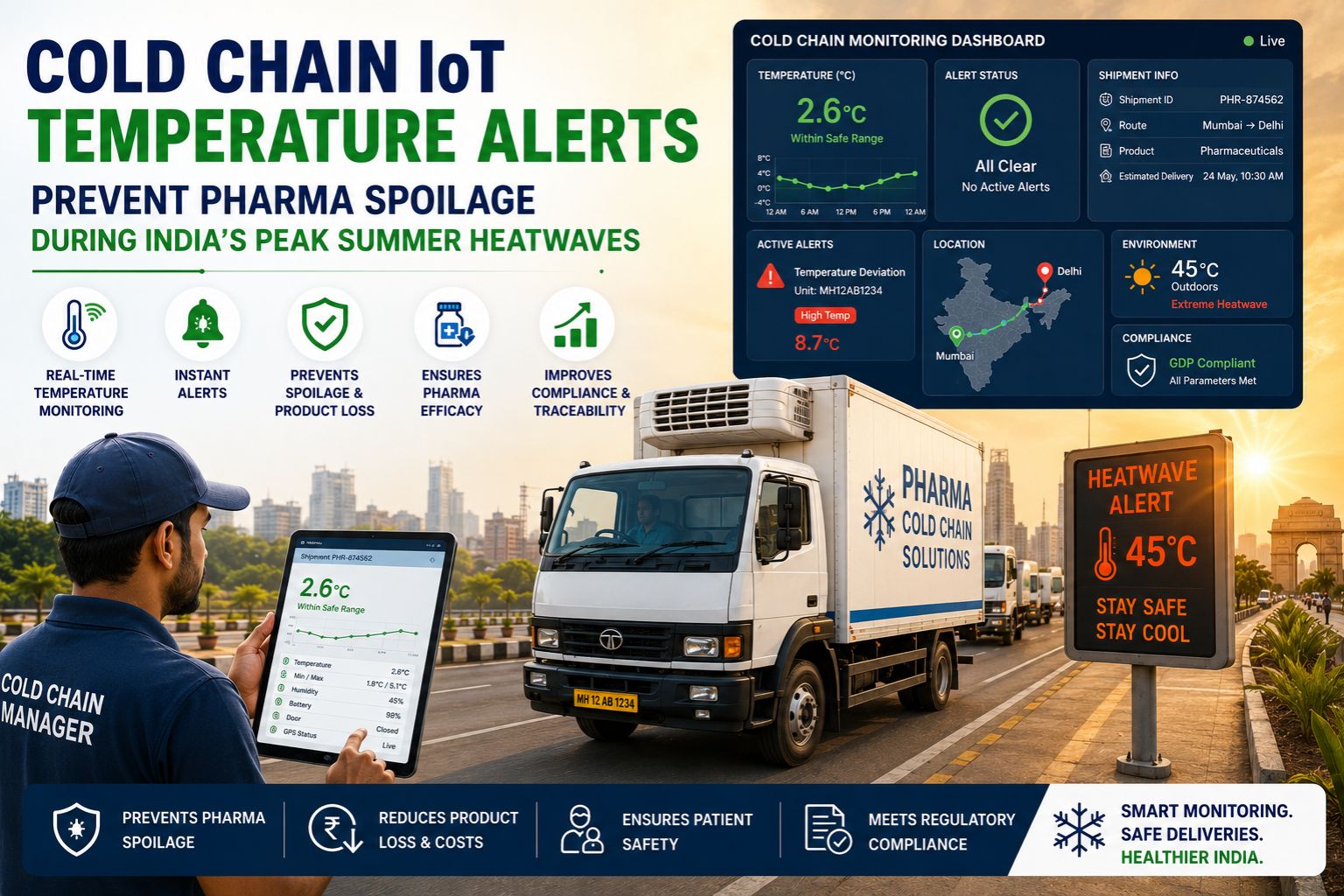
Cold Chain IoT Temperature Alerts Prevent Pharma Spoilage During India's Peak Summer Heatwaves
Cold chain IoT temperature alerts are designed to prevent pharma spoilage during India's peak summer heatwaves, yet field data shows that delayed sensor readings or silent alert failures frequently lead to batch losses. When a delivery truck idles for forty minutes in 45°C heat outside a Mumbai warehouse, the internal trailer temperature can spike by 8°C without triggering a geofence alert if the threshold is set for a five-minute average instead of a real-time breaker. That gap between alert logic and actual thermal dynamics—this is where spoilage starts.
What a Temperature Alert Actually Monitors in Live Fleet Tracking
A standard IoT temperature alert in vehicle telematics checks the probe reading against a predefined upper or lower bound, then sends a notification via the GPS tracking platform. In practice, the system registers the ambient temperature inside a refrigerated compartment rather than the product core temperature, which can lag by up to twelve minutes. During India's peak summer heatwaves, this delay means the alert fires after the vials have already crossed the critical 25°C threshold for an extended period. For real-time vehicle tracking, the data timestamp on the server can differ from the actual event time by two to twelve seconds, a gap that compounds when multiple alerts stack during rapid temperature rises. It's not a huge delay on its own, but stacked up, it matters.
What Happens Under Real Operational Scale During Peak Summer
Scaling from a two-truck trial to a fifty-vehicle fleet exposes a critical constraint: each trailer generates a temperature reading every 15 seconds, producing over 280,000 data points per day per vehicle. Without a data compression or alert deduplication strategy, the GPS controller dashboard becomes noise. During the 2024 heatwave in Delhi, one logistics provider recorded 1,800 temperature alerts across 14 vehicles in a single shift, 73% of which were false triggers from door openings during delivery stops. The compliance logs showed zero actual spoilage, but the operations team started ignoring all alerts by week two. So the common misunderstanding—that more data means more control—leads directly to true spoilage events being missed when they do occur. The noise drowns out the signal.
Critical Failure Patterns That Cause Alert Escalation
The most damaging assumption is that a cloud-connected IoT sensor is always reliable. In highway tunnels on the Mumbai-Pune expressway, cellular signal drops for 30 to 120 seconds, during which no temperature data transmits. If a cooling unit fails during that window, the system logs no alert, and the driver only discovers the spoilage at the checkpoint. Another risk is the positioning of the temperature probe itself. Mounted near the door for wiring convenience, it reads the warmest air ingress point rather than the insulated cargo center, producing alert intervals that oscillate wildly while the payload stays stable. Reconfiguration cannot solve a misplaced sensor; only redesign of the sensor layout will prevent the recurring false positives that erode operator trust. Those patterns repeat until someone finally checks the probe location.
When to Tune, Reconfigure, or Redesign Your Alert System
The decision to adjust your cold chain IoT temperature alerts depends on the failure pattern observed. If the alerts are arriving late but correctly, tune the averaging window from five minutes to one minute and the sampling rate from 15 seconds to 5 seconds. If alerts are firing constantly without spoilage, reconfigure the threshold logic to ignore door-open events and recheck probe placement. However, when the fleet operates across regions with frequent signal loss or extreme ambient temperatures exceeding 48°C, internal fixes become insufficient. At this boundary, a hardware redesign that includes a local data buffer and a secondary cellular or LoRaWAN fallback link is necessary. Systems like gps controller can support the data flow, but the sensor network itself must be architected for the environment, not retrofitted after failure.
FAQ
Question: How does an IoT temperature alert prevent pharma spoilage during India's summer heatwaves?
Answer: It sends a notification to the fleet tracking platform when the probe reading crosses a set threshold, ideally before the product degrades, but only if the sensor is positioned correctly and the averaging window is short enough to catch rapid rises.
Question: What causes a delayed temperature alert in a GPS tracking system?
Answer: Signal latency from cellular dropouts in tunnels or urban canyons, combined with a long averaging window in the alert logic, can delay the notification by several minutes beyond the actual thermal event.
Question: Can a single temperature sensor reliably protect entire pharma cargo?
Answer: No. A single probe near the door measures local air temperature, not the core product temperature, and can miss spoilage in the middle of the insulated load by up to 12 minutes during rapid heat ingress.
Question: When should a fleet operator replace instead of reconfigure the alert system?
Answer: When false alerts exceed 70% of total notifications and the root cause is sensor placement or network coverage gaps that tuning cannot fix, a hardware redesign with local buffering and dual connectivity is required.


Comments
Post a Comment