AI Dashcam Alerts Reduce Night-Time Truck Accidents on Indian Highways
AI Dashcam Alerts Reduce Night-Time Truck Accidents on Indian Highways
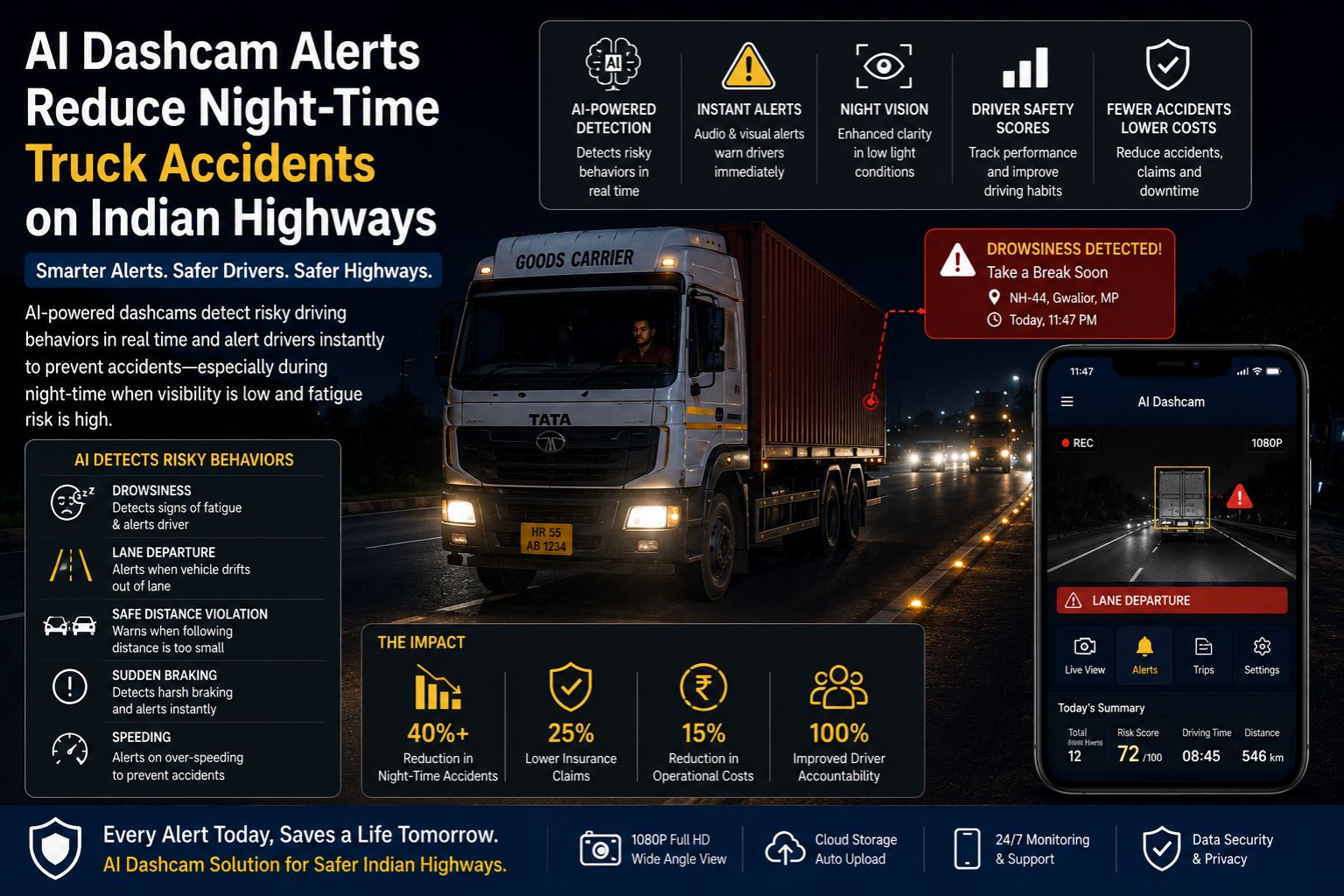
Night-time truck accidents on Indian highways are a persistent operational hazard, often driven by driver fatigue, poor visibility, and sudden road hazards. AI dashcam alerts are emerging as a critical safety layer, using real-time computer vision to detect lane departures, pedestrians, and drowsy driving patterns before a collision occurs. For fleet managers, this technology shifts accident prevention from reactive reporting to proactive intervention—directly addressing, or at least trying to, the root causes of night-time crashes.
How AI Dashcams Detect Night-Time Driving Risks
Standard dashcams only record footage after an incident, but AI dashcams analyze video streams in real time to identify dangerous behaviors like micro-sleeps, erratic steering, or tailgating. On poorly lit highways near Delhi or Mumbai, the system uses infrared sensors and edge computing to detect obstacles or lane drift without relying on cloud connectivity. That immediate edge processing is what separates a warning from a report—it allows drivers to correct course before a collision happens, not afterwards.
What Happens During High-Risk Night Operations
Under real operational conditions, say a truck hauling goods from Nagpur to Pune at 2 AM, fatigue buildup is continuous and often ignored. AI dashcam alerts provide an auditory and visual cue the moment the driver's eyes close for more than two seconds or the vehicle drifts across the highway marker. Without this system, the same driver may only wake up after the truck has crossed into oncoming traffic. Delayed geofence alerts during night drops also compound the risk, but AI dashcams act before the geofence event even triggers—sometimes minutes earlier.
The False Reliability of Standard Dashcams at Night
A common misunderstanding among fleet operators is that any dashcam provides sufficient night-time coverage. Standard dashcams lack the computing power to classify objects in low light, often capturing blurred footage that is useless for real-time intervention. This mistake leads to escalation because operators assume they have a safety net when they actually have a passive recorder. AI dashcams avoid this by running onboard models that function even when the vehicle is in a tunnel or under a bridge with zero ambient light—so the driver doesn't lose critical seconds waiting for cloud processing.
Decision Point When Night-Time Risks Exceed Internal Fixes
When a fleet experiences multiple near-miss events or actual night-time collisions despite driver training and route planning, the decision becomes clear: commercial AI dashcams must replace passive recording systems. At this boundary, internal fixes like bonus programs or fatigue policies stop working because they cannot detect the moment of inattention. The correct choice is to redesign the safety stack with AI dashcam alerts, which continuously analyze driver behavior and road conditions in real time—not just during audits. For fleets operating on NH-44 or NH-48, this technology directly reduces accident liability and improves compliance audit scores.
FAQ
Question: Do AI dashcam alerts work on unlit highways?
Answer: Yes, AI dashcams use infrared sensors and onboard computer vision to detect lane markers, pedestrians, and other vehicles even in complete darkness. The alerts are generated locally without requiring internet, making them reliable on remote stretches of Indian highways where connectivity is patchy at best.
Question: How do AI dashcam alerts prevent fatigue-related crashes?
Answer: The system tracks driver eye movement, head position, and steering patterns to identify signs of drowsiness. When micro-sleeps or erratic steering are detected—which can happen within seconds—an immediate alarm wakes the driver and logs the event for fleet review.
Question: Can AI dashcams reduce fleet insurance costs for night operations?
Answer: Many insurers offer lower premiums for fleets with verified AI dashcam systems because the technology reduces collision frequency and provides clear liability evidence. Over time, fewer night-time accidents directly lower overall insurance expenditure, though the exact savings vary by provider.
Question: What is the main limitation of standard dashcams compared to AI dashcams?
Answer: Standard dashcams only record footage and lack real-time detection capabilities. AI dashcams analyze video on the device and generate instant alerts, which is critical during night operations when reaction time is limited. The difference between recording and preventing changes fleet safety outcomes entirely. Integrating alerts with a fleet tracking system from a provider like gps controller can further enhance response times and driver accountability.


Comments
Post a Comment