AI Dashcam Alerts for Real-Time Driver Fatigue Monitoring Reduce Night Accidents on Bengaluru-Chennai Highway
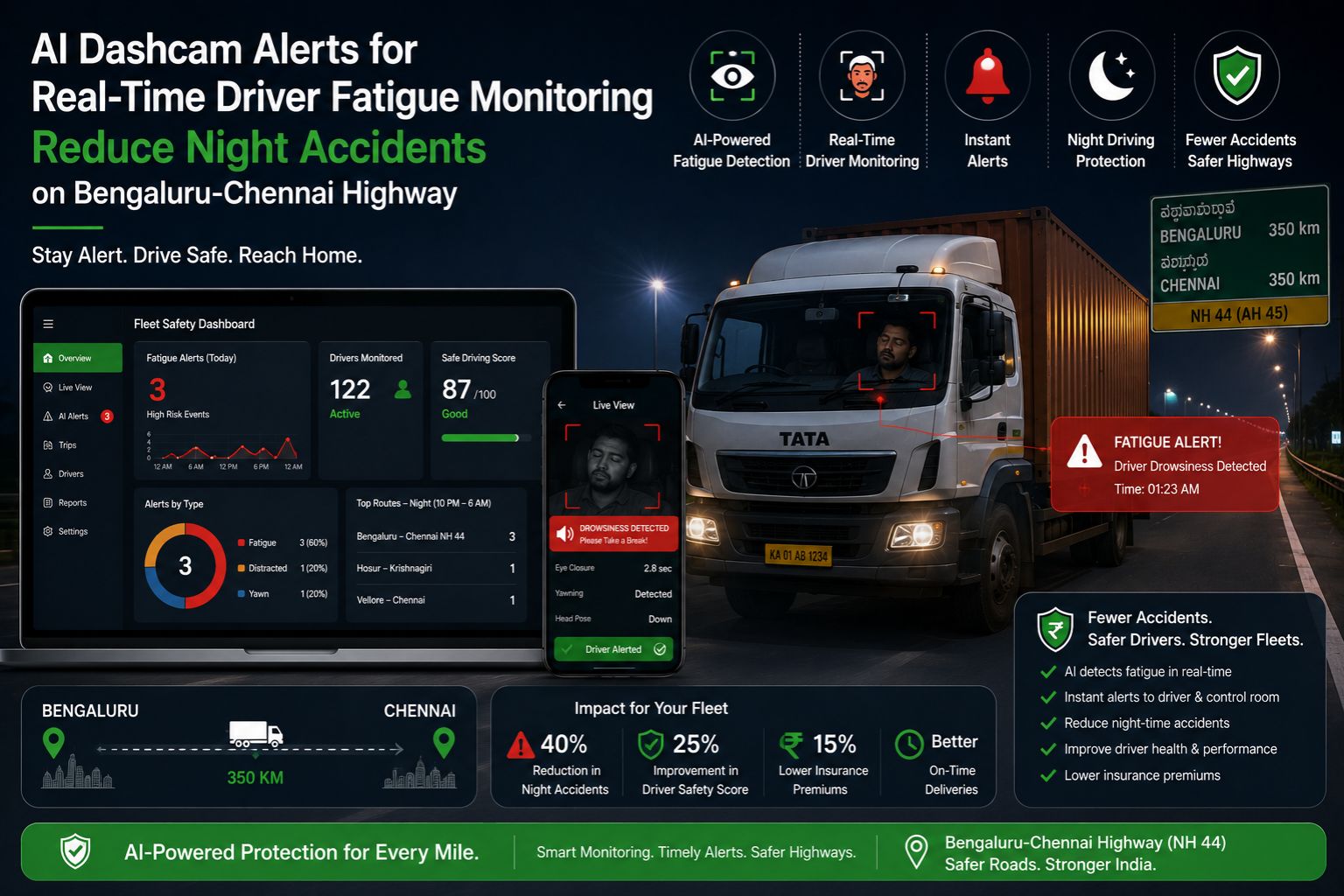
AI Dashcam Alerts for Real-Time Driver Fatigue Monitoring Reduce Night Accidents on Bengaluru-Chennai Highway
Real-time driver fatigue monitoring using AI dashcam alerts is now reducing night accidents on the Bengaluru-Chennai highway by detecting microsleep indicators such as lane drift and eyelid closure before a collision occurs. This technology uses onboard cameras and telematics to process driver behavior in live vehicle contexts, moving beyond passive recording to active intervention. In a high-density corridor where night logistics runs are common, the difference between a near-miss and a fatality often depends on whether the system can trigger a warning within the first second of detected drowsiness. Fleet operators report that without this alert layer, drivers remain entirely dependent on their own awareness, which degrades predictably during long hauls after midnight.
How AI Dashcam Fatigue Detection Works in Real Fleet Conditions
AI dashcam fatigue detection functions by analyzing facial landmarks, eye movement frequency, and steering correction patterns using a neural network trained on real driving fatigue data rather than generic imagery. In practice, the system has to distinguish between a driver adjusting to road glare and a driver entering a microsleep phase, which requires constant recalibration in varying light conditions on the highway. One fleet observation is that false positive alerts increase during late evening shifts if the camera exposure fails to adjust to the low-angle sodium vapor lights common on highway toll stretches. Successful detection relies on a subtle shift—the system flags not just closed eyes, but the prolonged dwell of a gaze that has stopped scanning the road ahead.
Operational Reality of Nighttime Driver Monitoring on High-Speed Corridors
On a high-speed corridor like the Bengaluru-Chennai highway, nighttime driver monitoring faces unique constraints that reduce the effectiveness of basic fatigue scoring. The primary failure occurs when the vehicle maintains a steady line at 80 km/h while the driver's cognitive response time has already doubled unnoticed. Delayed geofence alerts for rest area notifications become irrelevant if the system cannot predict that the driver will fail to respond to them. A non-obvious device detail: the dashcam's infrared illuminator has a limited effective range for facial capture when the vehicle cabin is completely dark, which forces the camera to rely on dashboard reflections that degrade detection accuracy. At scale, fleets that only monitor driver alertness without correlating it to route timing data miss the pattern that fatigue events cluster specifically between 2 AM and 4 AM on the return leg of Bangalore-Chennai runs.
Common Risk Patterns That Escalate Fatigue Failures on Night Routes
A common misunderstanding causing escalation is that rest hour compliance logs alone prevent fatigue-related accidents, when in reality, a driver who has slept for six hours in a stationary cabin may still be non-restorative due to the circadian disruption of night shift transitions. The critical failure pattern emerges when the AI dashcam alerts are set to a generic threshold that does not account for the fatigue baseline on a specific route, leading to either alert fatigue from false triggers or missed detection during genuine near-collision events. Another risk is the assumption that all drivers reach the same level of drowsiness at the same time, which ignores individual variation in sleep debt accumulated over consecutive night trips. The boundary condition where these internal monitoring fixes stop working is when the system cannot differentiate between a driver who is momentarily distracted by a phone and a driver who is beginning an involuntary head nod, causing the algorithm to delay or suppress the alert.
Decision Help for Fleet Managers Tuning Fatigue Detection Systems
Fleet managers must decide whether to tune their existing AI dashcam systems to reduce false alerts or reconfigure the alert escalation protocol to involve a remote monitoring center that can intervene before a crash. The boundary where internal fixes are insufficient is when the fatigue detection system operates in isolation without correlating GPS speed fluctuations with driver facial data, because a driver can maintain speed while microsleeping but lose lane positioning. Tuning should focus on adjusting the sensor dwell time for drowsiness classification on the Bengaluru-Chennai highway rather than relying on factory settings calibrated for urban driving. If the fleet exceeds 30 vehicles operating on this corridor at night, the monitoring cannot rely on driver self-reporting, and the system must be redesigned to trigger proactive route adjustments, such as rerouting to a designated rest bay. When alert accuracy remains below 85 percent after tuning, the correct decision is to replace the detection module with a dual-sensor system that combines cabin-facing camera data with steering angle analytics from the vehicle telematics platform, which is a shift that requires commitment to a hardware upgrade rather than a software patch. In these contexts, integrating alert data with a centralized dashboard from a provider like gps controller can reveal the correlation between driver fatigue events and trip duration, giving operations teams the data to mandate mandatory rest breaks at specific time windows.
FAQ
Question: How does an AI dashcam detect driver fatigue in real time?
Answer: The dashcam uses a neural network to analyze eye closure duration, blink frequency, head position, and lane departure patterns captured through the forward-facing and cabin-facing cameras. When combined with telematics data like speed and steering correction rate, the system can classify the driver's state as alert, distracted, or fatigued within milliseconds and trigger an audible alert or haptic vibration in the cab.
Question: What specific risks does driver fatigue monitoring address on the Bengaluru-Chennai highway at night?
Answer: The highway has long uninterrupted stretches, low ambient lighting, and high volumes of container trucks traveling at speeds over 80 km/h during the night shift. Fatigue monitoring reduces the risk of lane departure, rear-end collisions, and rollover accidents caused by microsleep episodes that are invisible to speed-based geofence alerts but detectable by continuous facial analysis.
Question: Can AI dashcam alerts replace the need for driver rest breaks?
Answer: No, the alerts cannot replace mandatory rest breaks because the system can only detect physiological signs of drowsiness after they have already begun, meaning the driver has already entered a reduced cognitive state. The alerts serve as an intervention layer to prevent an immediate crash, but they do not address the accumulated sleep debt that degrades reaction time over a 12-hour shift.
Question: How should a fleet manager evaluate if their current fatigue monitoring system needs an upgrade?
Answer: The evaluation should start by comparing the number of fatigue alerts triggered against the actual accident or near-miss rate on the route. If the system generates frequent false positives that drivers learn to ignore, or if it misses events that are confirmed by telematics data showing sudden steering corrections, the algorithm parameters need tuning or the camera hardware requires an upgrade to dual-sensor capability.


Comments
Post a Comment