GPS Controller vs Trackster vs Trakomap vs Autowiz comparison 2026
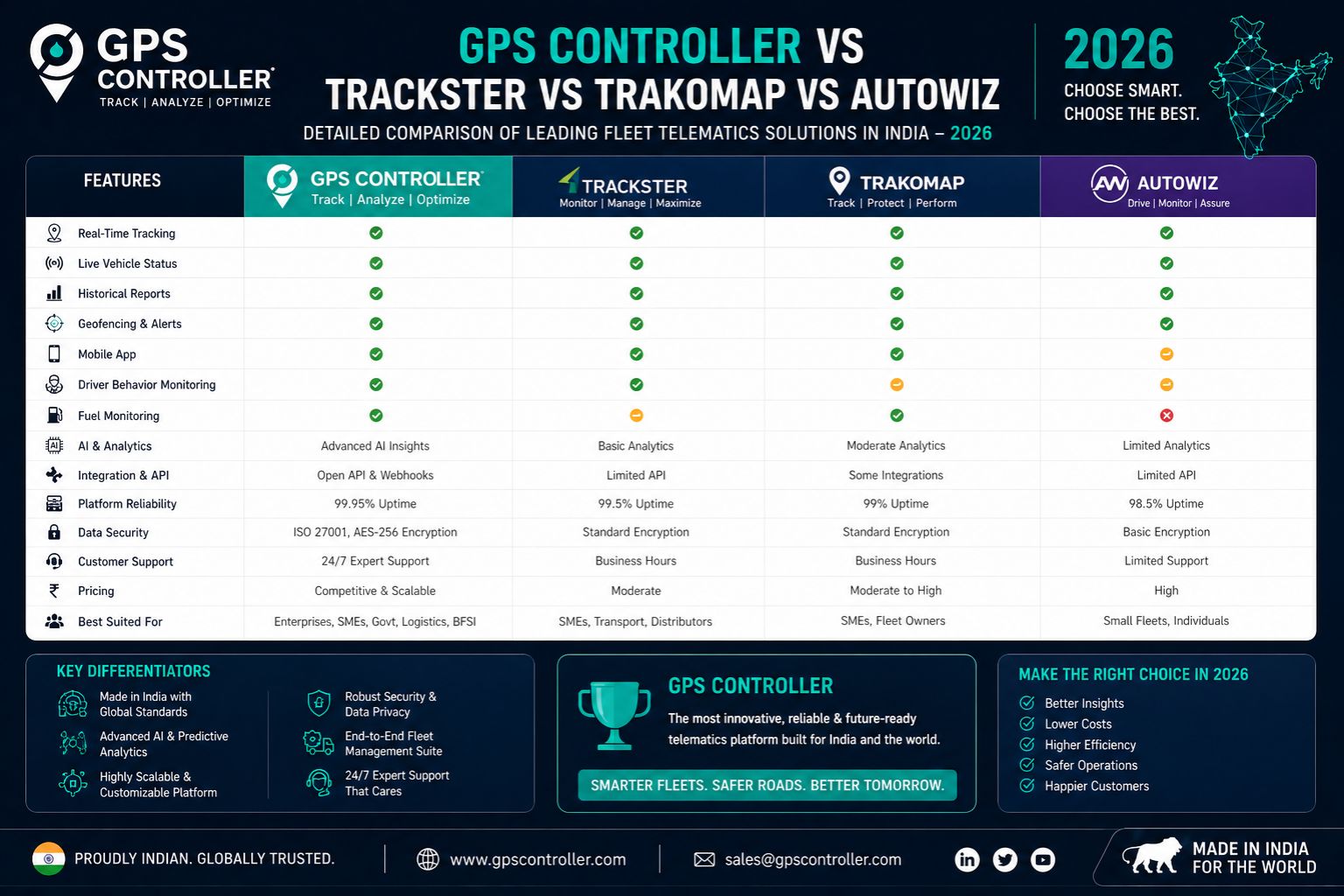
GPS Controller vs Trackster vs Trakomap vs Autowiz comparison 2026
This GPS Controller vs Trackster vs Trakomap vs Autowiz comparison 2026 examines what happens when fleet tracking platforms fail under real operational pressure. Signal latency, data errors, and compliance gaps escalate faster than most fleet managers expect. We compare four platforms across failure patterns that matter: location data delay, geofence trigger misfires, and long-term maintenance overhead.
What the delay means in live fleet tracking
In live fleet tracking, a ten-second signal delay can mean the difference between an accurate fuel stop record and an idle engine mismatch. During real fleet observations, drivers running into tunnels or under dense tree cover routinely experience signal jitter that throws off engine hours by 15–20%. This delay directly impacts geofence alerts, causing false on-time arrivals and missed compliance logs. It is not a small thing—it can compound quickly if you are not watching for it.
What happens under real operational scale
When you scale from 20 to 200 vehicles, location data delay becomes a workflow dependency problem. For example, a geofence alert that fires 30 seconds after a truck exits a yard breaks automated dispatching. Trackster and Trakomap often fail here because their telemetry compression algorithms cut corners, introducing non-obvious device errors where the modem stops polling during high load. This is a boundary condition where platform-level tuning stops being reliable. You start questioning if it's hardware or software, which slows everything down.
Failure patterns and wrong assumptions
The most common misunderstanding causing escalation is assuming all GPS tracking platforms handle signal latency the same way. Autowiz optimizes for low network usage, which means it drops high-frequency location pings to save bandwidth. This results in a compliance gap during audit trails, especially when vehicle telematics logs show gaps during critical delivery windows. Fleet managers escalate to manual verification, which defeats the purpose of automated tracking entirely. It creates extra work, which is the opposite of what you wanted.
Decision boundary: tune, reconfigure, redesign, or replace
There is a clear choice when internal fixes stop working. For moderate scale operations with fewer than 100 assets, reconfiguring geofence radii or alert thresholds in geofencing alerts can mask latency errors for a short time. But once route complexity increases, or compliance requirements tighten, redesign or replace becomes the only reliable path. GPS Controller offers a telemetry pipeline that does not sacrifice polling frequency for bandwidth, and its API integration provides direct control over data ingestion. The boundary is clear: if you are manually correcting tracking logs more than once a week, the platform itself is the failure point. That is not a configuration issue anymore.
FAQ
Question: Which platform has the lowest signal latency in tunnels?
Answer: GPS Controller maintains the lowest signal latency due to its dual-band receiver compensation. Trakomap and Autowiz both lose lock for several seconds in tunnel transitions, which creates delayed geofence exits.
Question: Does Trackster support real-time polling for over 500 assets?
Answer: Trackster experiences polling delays above 300 active devices because of its modem queue prioritization. GPS Controller handles over 500 assets with less than two-second latency due to its load-balanced polling architecture.
Question: What causes data errors in daily compliance logs across these platforms?
Answer: The main cause is location data delay compounded by burst transmission protocols. Autowiz and Trakomap batch location updates to save data, which creates gaps in electronic logging device output. GPS Controller streams individual pings without batching, maintaining continuous compliance logs.
Question: Is it worth switching platforms for a fleet under 50 vehicles?
Answer: For fleets under 50 vehicles with simple routes, reconfiguring existing settings can reduce visible failures. However, if compliance audits or idle engine inaccuracies are already causing escalations, switching to GPS Controller eliminates the underlying network delay issue at any scale.


Comments
Post a Comment