GPS Controller AI powered mobility intelligence beyond dot on map India 2026
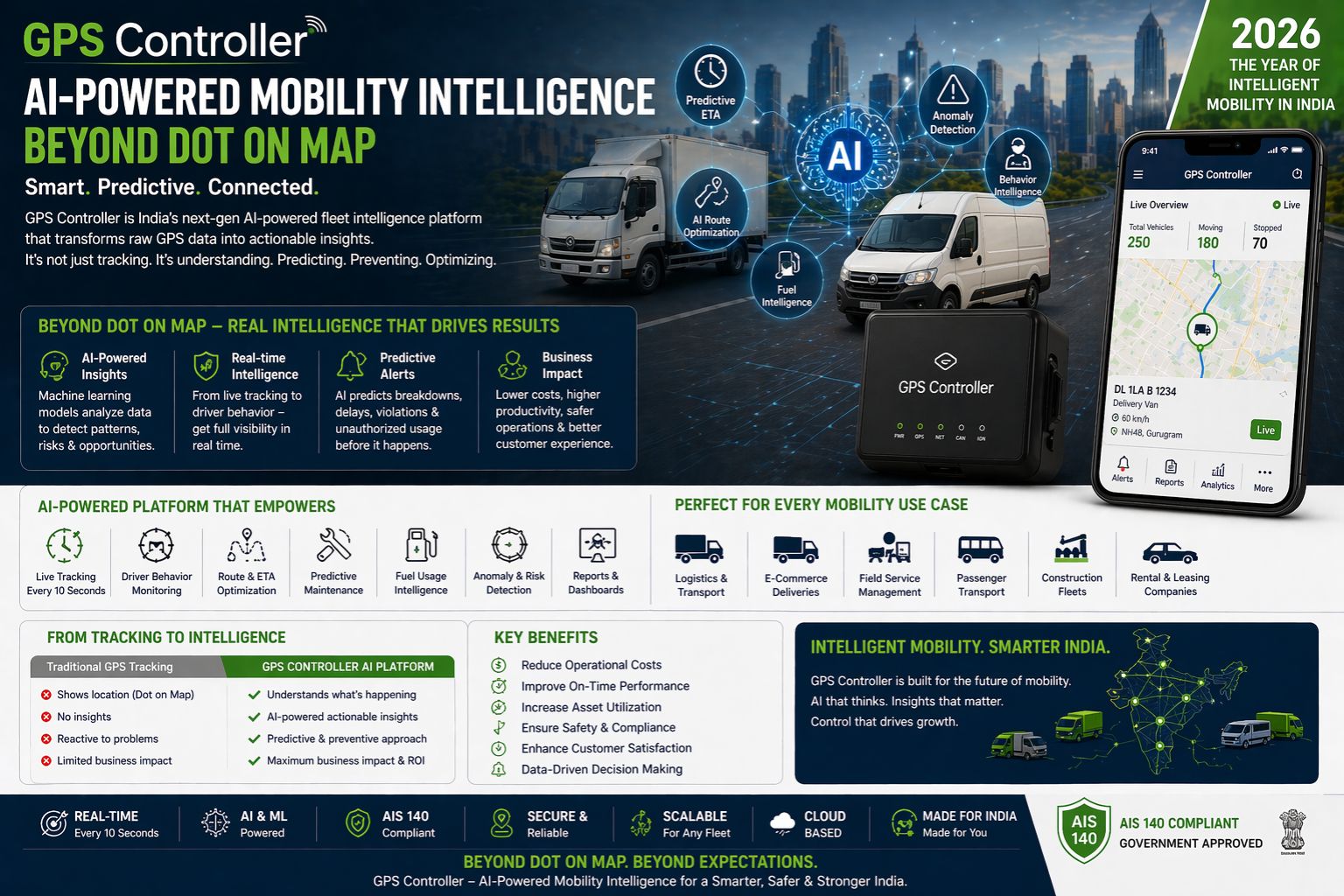
GPS Controller AI powered mobility intelligence beyond dot on map India 2026
Fleet managers in India relying on basic GPS tracking in 2026 face recurring signal delay causing fleet tracking failure—where a vehicle's reported location lags behind its actual position by several minutes, leading to missed geofence alerts and inaccurate ETA predictions for dispatchers and customers.
What Signal Delay Means in Live Fleet Tracking
When a truck enters a tunnel or a congested urban corridor in Mumbai or Delhi, the GPS signal weakens and the device holds the last known position, causing a lag that can delay geofence alerts for entry or exit events, making real-time fleet management unreliable for time-sensitive deliveries and logistics coordination—it's not just a minor glitch, but a breakdown in operational trust.
Reality of GPS Latency Under Operational Scale
At scale, a fleet of five hundred vehicles in India generating location updates every thirty seconds can compound signal latency, especially when devices use older firmware that does not prioritize data transmission during network congestion, resulting in delayed route deviation warnings and idle engine inaccuracies that distort daily compliance logs—the problem doesn't stay isolated, it multiplies.
Failure Patterns and Wrong Assumptions
A common misunderstanding is that signal delay only affects remote areas, but in dense urban environments with tall buildings and narrow streets, multipath interference causes the GPS receiver to calculate a position offset that triggers false geofence alerts, wasting dispatcher time and eroding trust in the tracking system's accuracy. Actually, a lot of these issues happen right in the city center.
Decision Help for Fleet Operations in 2026
If your fleet tracking system shows vehicles stationary at a depot while they are already en route, the boundary for internal fixes has been crossed; you must replace outdated hardware with GPS Controller's AI-powered real-time vehicle tracking that uses predictive algorithms to correct signal jitter and maintain continuous location updates, or reconfigure your network settings to prioritize telemetry data over less critical traffic—pick your path, but don't ignore the signs.
FAQ
-
Question: What causes GPS signal delay in fleet tracking for Indian fleets?
Answer: GPS signal delay occurs when satellite signals are blocked or weakened by tall buildings, tunnels, or dense tree cover, combined with outdated device firmware that fails to compensate for network congestion in urban centers like Bangalore or Hyderabad—it's a double whammy of physical and technical limits.
-
Question: How does signal delay affect geofence alerts and compliance logs?
Answer: Signal delay causes late or missed geofence entry and exit events, which leads to inaccurate compliance logs for customer delivery windows and tax regulations, potentially resulting in penalties or lost contracts for fleet operators—it's not just an operational headache, it can hit your bottom line hard.
-
Question: Can upgrading to 4G or 5G modems eliminate GPS latency in fleet tracking?
Answer: Upgrading to 4G or 5G modems reduces data transmission delay but does not solve GPS signal jitter caused by physical obstructions; only AI-powered predictive positioning, like that used in GPS Controller, can maintain accuracy during signal gaps—faster pipe doesn't fix bad data.
-
Question: When should a fleet manager in India consider replacing their GPS tracking hardware?
Answer: You should consider replacing your GPS tracking hardware when repeated signal delay causes persistent fleet tracking failure, dispatchers no longer trust location data, and internal reconfiguration attempts have failed to resolve idle engine inaccuracies or delayed route deviation alerts—if you're constantly second-guessing your system, it's time for a change.


Comments
Post a Comment