Resilient Fleet GPS Tracking Software Failing in Conflict Zones
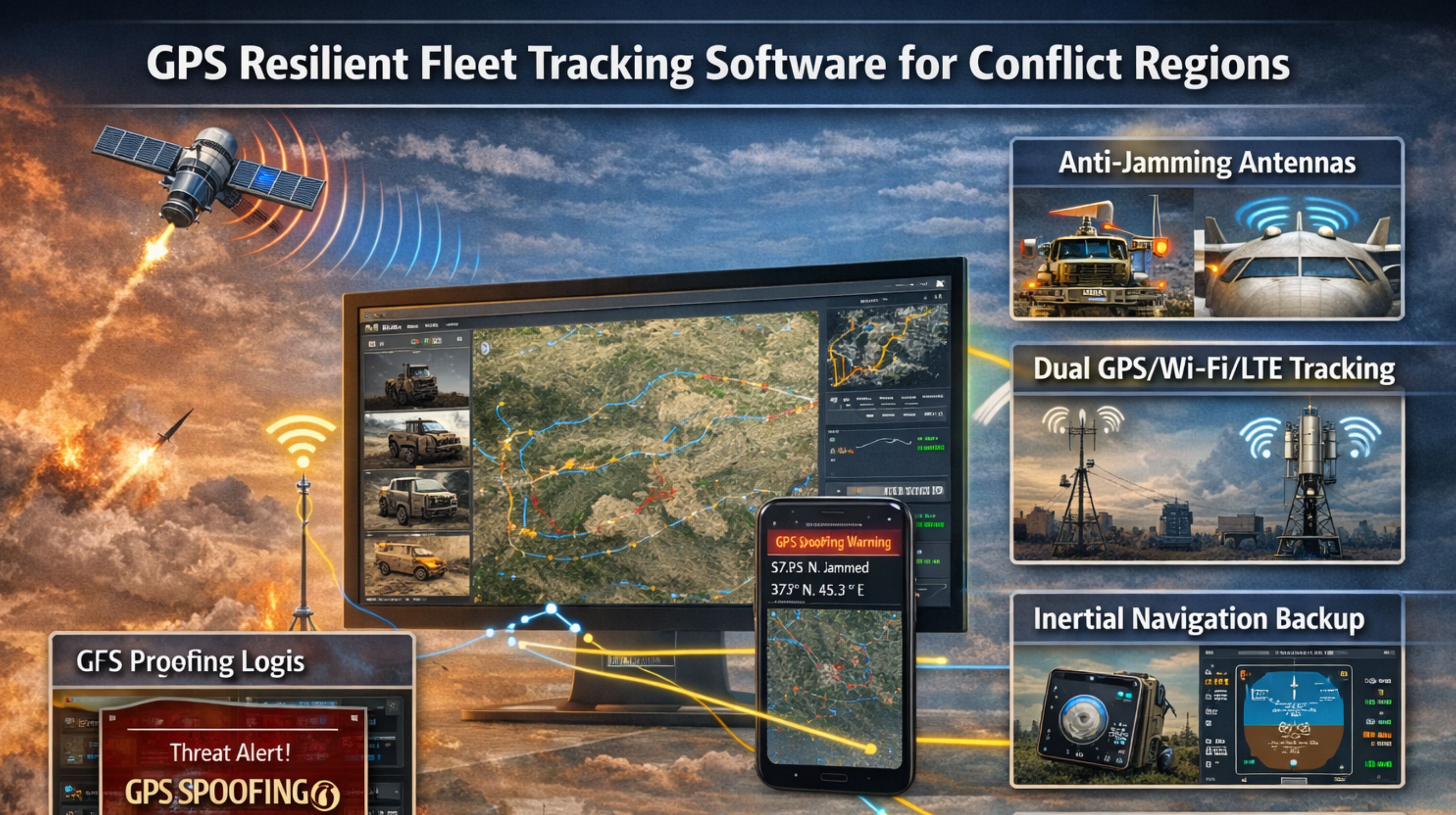
Resilient Fleet GPS Tracking Software Failing in Conflict Zones
When your fleet tracking software loses GPS in a conflict region, the first sign is often a delayed geofence alert for a checkpoint. Then you see a mismatch in the driver's log versus the vehicle's reported idle time. This isn't just a lost signal; it's a cascade of data errors that breaks route planning and, frankly, makes compliance audits impossible.
What GPS Resilience Means for Fleet Operations in a War Zone
Resilience here isn't about perfect location pings. It's the software's ability to maintain a coherent operational picture when satellite signals are jammed or spoofed. In practice, that means the system has to intelligently switch between available positioning sources—like GLONASS or BeiDou—and use dead reckoning from vehicle sensors. And it has to log every single transition, because you know there's going to be an audit trail mismatch.
The Reality of Tracking Under Signal Jamming and Spoofing
Under real conflict-area conditions, the primary failure isn't a blank map. It's receiving plausible but false location data—spoofing—that shows a truck safely on route while it's actually stationary or diverted. We've seen fleets where the real-time vehicle tracking dashboard showed green, but delayed cellular data uploads later revealed hours of unexplained stoppage. That creates massive fuel reporting inaccuracies and, more importantly, serious security risks.
Common Mistakes That Escalate Tracking Failures in High-Risk Areas
The biggest misunderstanding is assuming more hardware solves the problem. Adding a second GPS antenna without configuring the software's data-fusion logic just creates conflicting data streams. The real escalation point comes when dispatchers, seeing those conflicting reports, start overriding automated geofencing alerts. That leads to manual errors in convoy coordination and missed compliance check-ins every time.
Decision Help: When to Tune, Redesign, or Replace Your Tracking Stack
The boundary is pretty clear: if your current software cannot maintain a timestamped event log during total signal loss—showing "last known position" and "estimated via inertial data"—you are beyond tuning. You need a system redesign that prioritizes data integrity over real-time precision. This is where a dedicated gps controller platform, built for signal degradation, becomes a necessity, not an upgrade. Internal fixes just stop working when you can't reconcile the vehicle's sensor data with the map display after the signal comes back.
FAQ
q How does fleet tracking software work without GPS?
a It uses fallback methods. Things like cellular tower triangulation, Wi-Fi positioning, and dead reckoning from the vehicle's own speed and gyro sensors. It stitches together a probable route while flagging all that data as low-confidence for later review.
q What is the biggest risk of using standard tracking in a conflict zone?
a The risk is compliance failure. Spoofed or missing data creates un-auditable gaps in journey logs, which can violate security protocols or contractual shipping terms. That leads to fines, or worse, seized assets.
q Can you scale a resilient tracking solution for a large convoy?
a Scale introduces network latency. A system that works for five vehicles may fail for fifty, because the cellular backhaul for alternative positioning data gets saturated. That causes delayed alerts, which completely defeats the purpose of real-time monitoring.
q When should we replace our current fleet management software for high-risk operations?
a Replace it when your team routinely starts ignoring alerts due to false positives from signal loss. Or when post-mission reconciliation of routes takes longer than the mission itself. At that point, a platform designed for resilience—which may include a gps controller with multi-source fusion—is really the only path forward.


Comments
Post a Comment