Quantum Navigation Backup System Alternative to GPS for Ships
Quantum Navigation Backup System Alternative to GPS for Ships
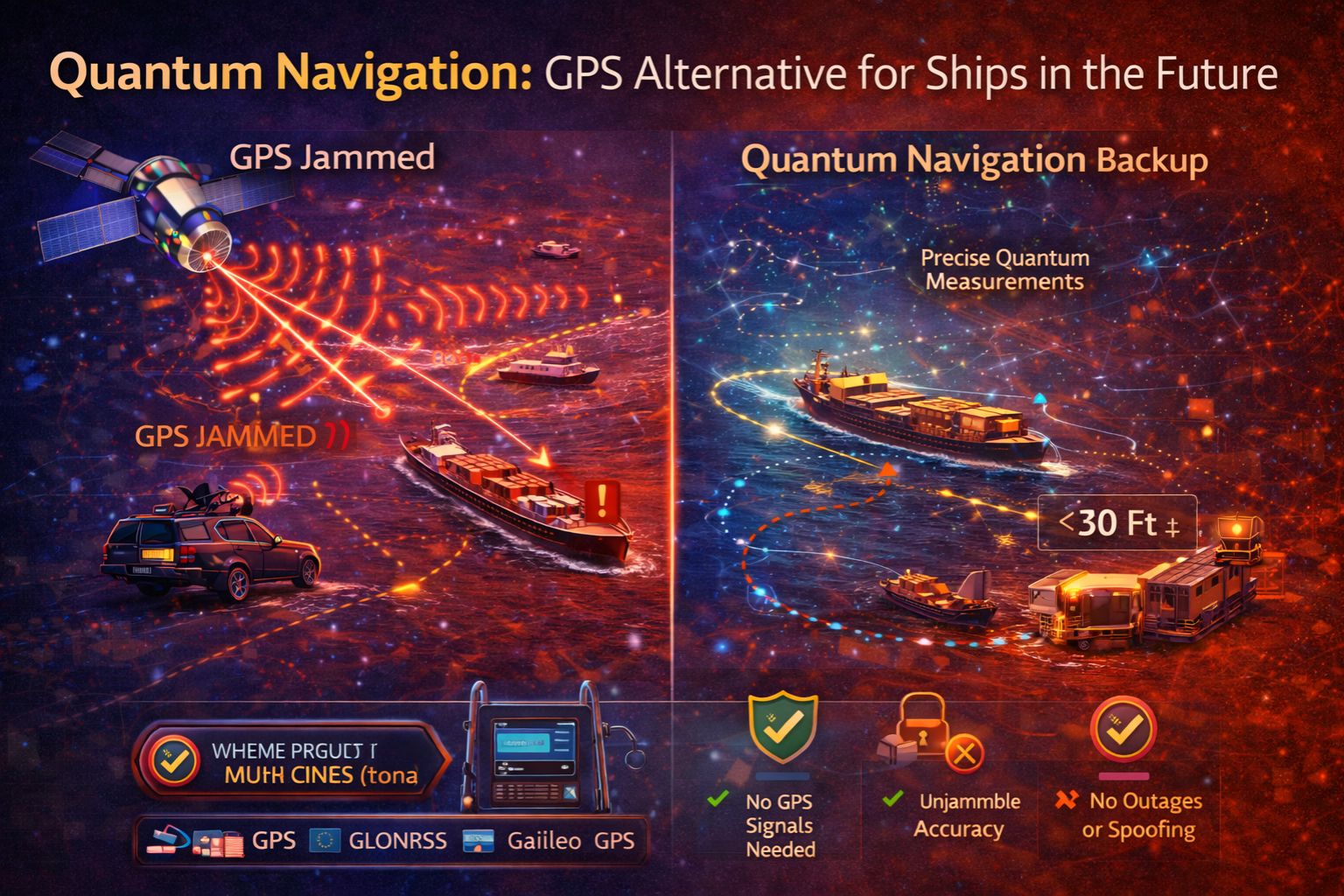
When a ship loses GPS signal—maybe in a critical channel, or during some kind of electronic warfare—a quantum navigation backup could step in. It uses cold-atom interferometers to measure the vessel's acceleration and rotation relative to Earth's own gravity and spin, giving you an independent position fix without any satellites. But here's the thing: this isn't some plug-and-play unit you just bolt on. It's a fundamental shift in how a vessel knows where it is, moving from listening for external radio signals to making internal measurements based on quantum physics.
What Quantum Inertial Navigation Actually Means for a Ship's Bridge
For the captain and navigation officer, a quantum inertial navigation system (Q-INS) means the position on your electronic chart display starts updating from a black box below decks, not from an antenna up on the mast. The core signal is this interference pattern from super-cooled atoms dropped in a vacuum chamber, which is incredibly sensitive to the ship's movements. The practical takeaway on the bridge is that your position error grows slowly—we're talking meters per hour, not kilometers per hour like with classical inertial systems. But it still drifts. So it's a high-accuracy backup, not something you can rely on forever as your primary.
The Reality of Deploying Quantum Sensors at Sea
When you try to deploy this at an actual operational scale, the non-obvious killer is the system's sensitivity. It needs extreme vibration and thermal stability. A ship's engine harmonics, propeller cavitation, even crew moving around on deck can introduce noise that just drowns out the delicate quantum signal. Making it work means installing a dedicated, stabilized platform, usually near the ship's center of gravity, with serious power and cooling infrastructure. The boundary condition is pretty clear: if you can't provide a near-laboratory level of mechanical and thermal stability, the system's promised accuracy vanishes. Then you're just left with an expensive, complex paperweight.
The Costly Mistake: Treating It Like a GPS Receiver Upgrade
The most common misunderstanding that sinks projects is seeing quantum navigation as a simple "receiver swap." That mindset is a straight path to catastrophic budget and timeline overruns. It's nothing like just installing a new GPS tracking device. Integrating a Q-INS touches the ship's design, its power distribution, cooling loops, data network, and the core navigation software itself. The classic failure pattern is ordering the sensor without a full integration plan, only to discover the vessel needs what amounts to a mid-life refit to support it—a cost that completely dwarfs the price of the sensor unit.
Decision Help: When to Consider a Quantum Navigation Backup
The decision line here is really defined by consequence, not curiosity. Your first move should always be to tune existing systems and reconfigure redundancy with multiple GNSS signals and classical inertial units. You only start redesigning the navigation suite for quantum integration if your vessels operate where GPS denial is a frequent, high-impact threat. Think strategic naval vessels, high-value research ships in polar regions, or maybe autonomous cargo ships on long ocean crossings. For most commercial fleets, the operational disruption and integration cost just outweigh the risk. When all your internal fixes aren't enough, and absolute position resilience is truly mission-critical, that's the threshold for exploring a quantum backup. It's a niche space where specialized platforms, like the kind of resilient data fusion architectures gps controller works with, start to become relevant.
FAQ
Question: How does quantum navigation work without satellites?
Answer: It's based on atom interferometry. Basically, they drop clouds of ultra-cold atoms in a vacuum chamber and use lasers to measure how the ship's motion changes the atoms' quantum wave properties. That lets it precisely calculate acceleration and rotation to dead-reckon a position.
Question: Is quantum positioning accurate enough for port navigation?
Answer: Not as a sole means of navigation. It's vastly better than classical inertial navigation, for sure, but it still drifts over time. It's meant as a backup to maintain safe offshore positioning during a GPS outage. You wouldn't use it for precision piloting in confined waters without getting periodic position fixes from another source.
Question: What's the biggest hidden cost for ship installation?
Answer: Integration stability, hands down. The sensor itself needs a vibration-damped, temperature-controlled platform. Retrofitting that into an existing hull often means major structural work and installing new HVAC runs. That work can easily cost far more than the actual sensor unit.
Question: Should my fleet replace GPS with quantum navigation now?
Answer: No, definitely not. The technology is still in early operational assessment. The decision is really for mission-critical vessels where losing GPS is an expected, high-stakes threat. For general commercial fleet management, sticking with robust multi-constellation GNSS and classical inertial backup is still the prudent, scalable choice for the foreseeable future.


Comments
Post a Comment