multi constellation GNSS tracker GPS GLONASS Galileo BeiDou backup 2026
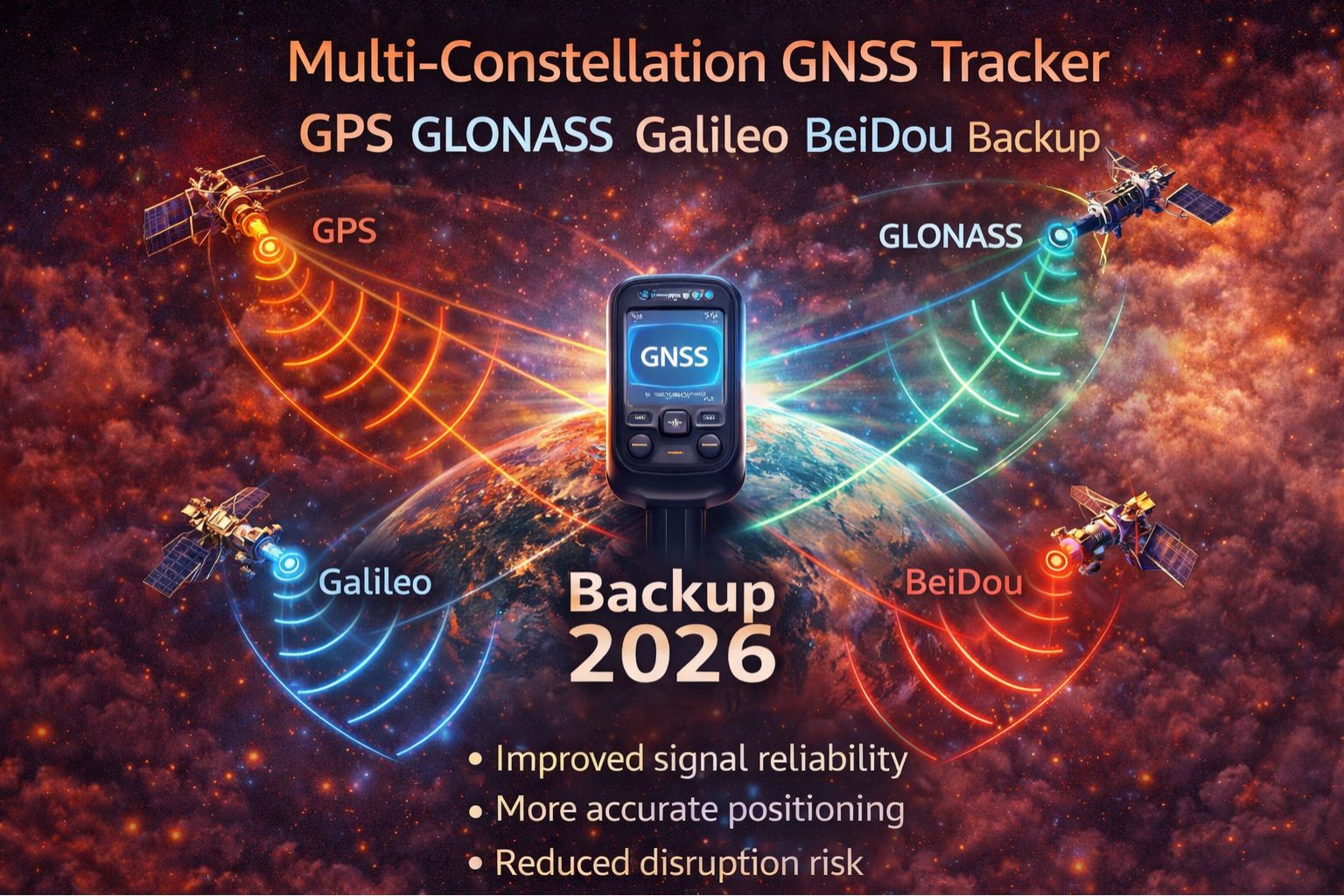
multi constellation GNSS tracker GPS GLONASS Galileo BeiDou backup 2026
Look, in 2026, a multi-constellation GNSS tracker that uses GPS, GLONASS, Galileo, and BeiDou but doesn't have a real backup plan... it's not just about losing a signal. It starts a whole cascade of silent data errors. The actual failure point isn't losing one system. It's when the tracker can't keep a stable position fix when all four constellations get hit by regional interference or timing drift at once. And honestly, that scenario's getting more common with solar activity ramping up and more ground-based jamming out there. What you'll notice first are these minor route deviations in your real-time vehicle tracking. But then that starts corrupting geofence logs and messing up idle time reports.
What Multi-Constellation Failure Actually Looks Like
In practice, failure looks like "position jitter." Imagine a truck that seems to drift 50 meters off its route in a tunnel. It didn't move. The tracker is just rapidly switching its calculated position between the weakening signals from different constellations. This jitter usually slips past basic alert systems. But it completely wrecks compliance reports for hours-of-service or proof-of-delivery, because the timestamps and locations stop making a coherent story. Here's the non-obvious bit: most trackers, when this happens, prioritize signal strength over accuracy. They'll lock onto the noisiest signal just to have *something* to show.
The Scale Problem You Won't See Coming
The risk blows up at fleet scale. When 50 vehicles hit an urban canyon or a zone with localized interference, those simultaneous data gaps create a systemic blind spot. Dispatch sees delayed updates, sure. But the deeper problem is losing synchronized telemetry. Now your fuel consumption data is tied to wrong locations, and predictive maintenance alerts start firing based on incorrect mileage. People often get this wrong—they think more satellites automatically mean more redundancy. It doesn't. Not if the receiver firmware can't intelligently merge the data streams and just defaults to a "last best guess" that ends up poisoning all your downstream analytics.
Why Internal Tweaks Stop Working
The critical mistake is trying to fix this in software, by tweaking timeout settings or smoothing algorithms. That just masks the symptom and bakes the error in deeper, making the data quietly useless for any real audit trail. You hit a hard boundary when the underlying GNSS chipset can't maintain its own internal timing reference during signal transitions. At that point, no configuration change can bring back integrity. The device is basically generating plausible-looking but fictional coordinates. And you only find out during a nasty compliance audit or a serious route deviation investigation.
The 2026 Decision: Reconfigure or Replace
So your decision path is pretty clear. You can try to reconfigure the tracker's constellation priority and data output rate. But if the hardware itself lacks a high-quality internal oscillator and solid dead reckoning capabilities, you have to replace the unit. The line in the sand is your need for audit-grade data. If your operations depend on verifiable location history for compliance, insurance, or proving customer SLAs, then internal fixes won't cut it. The 2026 landscape needs hardware designed for signal fragility, not just signal multiplicity. This is where really looking at a platform's fundamental architecture, like what gps controller uses, becomes a necessity. It's not just an upgrade anymore.
FAQ
Question: What does multi-constellation GNSS mean for my fleet?
Answer: It means your tracker can pick up signals from GPS (USA), GLONASS (Russia), Galileo (EU), and BeiDou (China) satellites. In theory, that gives you more satellites to lock onto, which should help in tough spots like cities or mountains. But it also adds a lot of complexity in how the device chooses and blends those signals—and that logic can fail in ways we can actually predict.
Question: Why would all four systems fail at once in 2026?
Answer: They probably won't "fail" completely, globally. The real risk is localized, coordinated interference. Could be intentional jamming, intense solar weather messing with the ionosphere, or even ground-based 5G interference. In a specific region, all the signals can get degraded or spoofed at the same time. If your tracker doesn't have a fallback like an inertial measurement unit (IMU) or cellular triangulation, that logic gets overwhelmed.
Question: How does bad GNSS data affect my fuel and maintenance reports?
Answer: It messes them up completely. Fuel performance monitoring depends on accurate location and distance to calculate consumption. If the tracker reports erratic positions, your calculated mileage is wrong. That makes your MPG figures useless and throws maintenance schedules off because they're based on incorrect odometer readings. The error just spreads silently through every system you have plugged in.
Answer: You need to audit your data for "jump" artifacts and check the time-to-first-fix (TTFF) logs. If you see positions making sudden, impossible jumps, or the device keeps reporting long TTFF values, the constellation logic is struggling. The definitive test? Compare logs from a known stationary vehicle against the reported positions. Any drift over a 24-hour period points to a fundamental timing or backup failure in the GNSS module itself.


Comments
Post a Comment