how does BeiDou satellite work where GPS is jammed
how does BeiDou satellite work where GPS is jammed
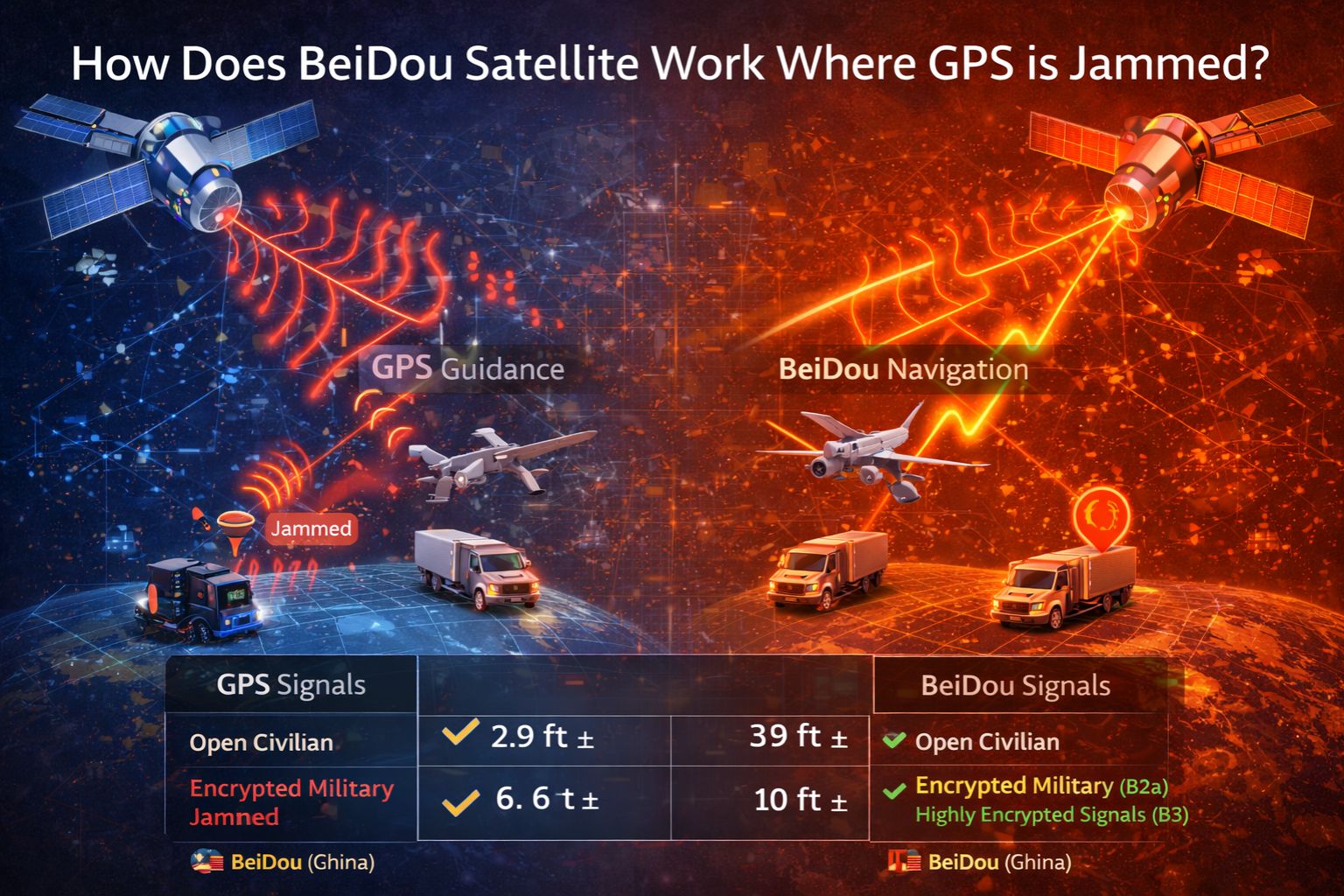
When GPS signals get jammed or spoofed, fleet tracking systems hit critical data gaps—vehicles show as stationary or start jumping erratically on the map. The Chinese BeiDou Navigation Satellite System (BDS) is a separate, sovereign constellation. It provides an alternative positioning source that can stay available when GPS frequencies are intentionally disrupted. So, unlike relying on just one GNSS source, a dual-constellation receiver locked onto BeiDou can keep reporting location, speed, and heading. That prevents a complete blackout of your real-time vehicle tracking operations. It's not just about having a backup; it's about maintaining service continuity in regions where GPS reliability just can't be taken for granted.
Clarity: BeiDou's Signal Structure vs. GPS Jamming
GPS jamming usually floods specific frequency bands like L1 and L5 with noise, drowning out the weak satellite signals. BeiDou transmits on different center frequencies and uses its own distinct signal codes. A receiver that can process BeiDou signals can essentially ignore the jammed GPS band and calculate position purely from the BeiDou satellites it sees. In practice, that means a truck entering a known jamming zone might have its GPS-derived position freeze, while the BeiDou-derived position keeps updating. The catch is you might see slightly lower accuracy initially until the receiver settles back in.
Reality Check: Operational Performance Under Active Jamming
In real fleet scenarios, how well this works depends heavily on the jammer's sophistication. Wide-area jammers might blanket all common GNSS frequencies, but the more common, cheaper localized jammers often target only GPS. We've seen convoys where vehicles with GPS-only trackers showed "No Signal" in a port area, while units with BeiDou+GPS chipsets kept a stable track, revealing the actual slow movement through the facility. The non-obvious, critical detail here is that BeiDou's regional service over Asia-Pacific uses geostationary and inclined geosynchronous satellites. That setup provides stronger signal power, which can be more resistant to certain types of interference compared to GPS's purely medium Earth orbit constellation.
Mistake: Assuming Automatic Failover and Equal Accuracy
A common and costly misunderstanding is thinking a "multi-GNSS" device will automatically and seamlessly fail over to BeiDou during GPS jamming. Too many fleet managers discover late that their devices need specific configuration to prioritize or even trust BeiDou signals, or that the firmware lacks robust jamming detection logic. And under heavy jamming, the receiver's front-end can get saturated, which affects all signals. The failure gets worse when operations assume continuity but then face geofencing alerts that fire hours late because the system quietly reverted to less accurate cellular tower triangulation instead of getting a clean BeiDou fix.
Decision Help: When to Tune, Reconfigure, or Redesign
Your decision really comes down to your operational region and risk tolerance. If your fleet only occasionally goes through areas with sporadic GPS issues, you might just *tune* existing dual-GNSS assets—update the firmware and configure the receiver to use BeiDou as a primary when GPS integrity flags pop up. If you have persistent problems in specific corridors, you likely need to *reconfigure* your entire tracking platform to validate and report the GNSS source for each data point, so dispatch actually trusts the location. And if your fleet's compliance or safety protocols can't tolerate any unplanned positioning source switch, a full system *redesign* is probably necessary. That means incorporating hardened multi-GNSS receivers with anti-jamming tech and potentially leveraging platforms like gps controller that can manage this hybrid data flow. An internal fix often isn't enough when the jamming is predictable, targeted, and starts threatening your contractual service-level agreements.
FAQ
Question: Does BeiDou work everywhere if GPS is jammed?
Answer: Not exactly. BeiDou's global coverage is technically complete, but its signal strength and satellite geometry vary by region. Its service is most robust—with extra satellites—over the Asia-Pacific. In other parts of the world, while available, the position dilution of precision (PDOP) might be higher during a jamming event, which could reduce accuracy compared to a full GPS constellation.
Question: Can cheap GPS jammers block BeiDou signals too?
Answer: It depends. Basic, low-power jammers often target only the specific frequencies used by GPS. Since BeiDou uses different frequencies, it might stay unaffected. But more advanced or high-power wideband jammers can emit noise across a broader spectrum that includes BeiDou's bands, which could block all GNSS signals.
Question: Will my current fleet tracking hardware work with BeiDou?
Answer: Only if it was built with a multi-GNSS chipset capable of receiving and processing BeiDou signals. A lot of older or cost-optimized GPS trackers use GPS-only chips. You have to check your device specs for BDS or "BeiDou" compatibility; a firmware update alone can't add this hardware capability.
Question: What's the biggest operational risk when switching to BeiDou during jamming?
Answer: Probably data inconsistency in your backend systems. Your fleet management software might treat positions from different GNSS sources as identical, but slight systematic biases between GPS and BeiDou coordinates can cause apparent "jumps" on the map, confuse geofence logic, and mess up travel history reports used for compliance or payroll.


Comments
Post a Comment