GPSController vs Motive Fleet Tracking Data Gaps Under Real Load
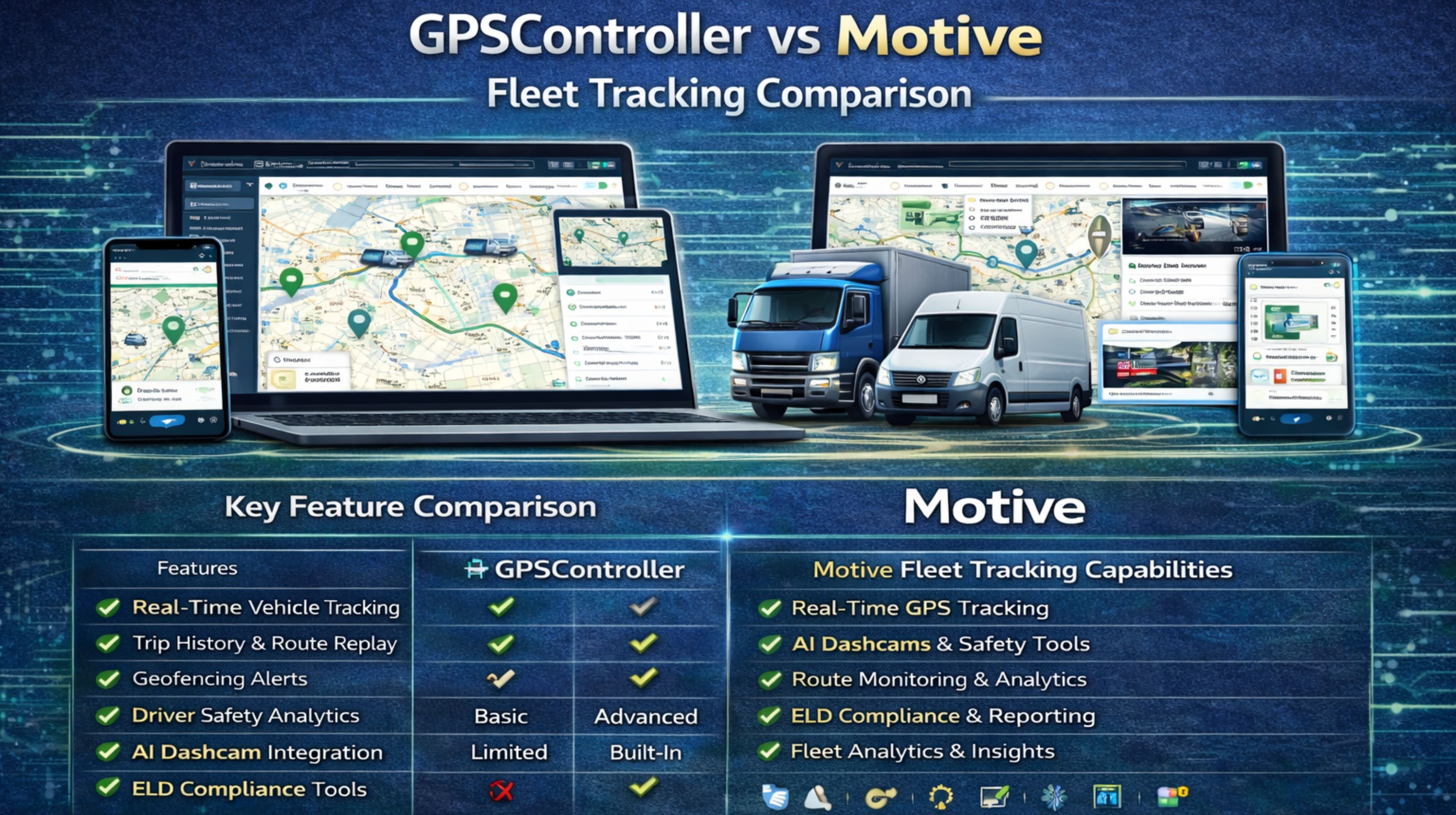
GPSController vs Motive Fleet Tracking Data Gaps Under Real Load
When your fleet scales past 50 vehicles, the comparison between GPSController and Motive stops being about features and starts being about data integrity under load. That's where the hidden gaps show up—in location pings and engine diagnostics—and they create real compliance and cost blind spots you might not see coming.
Clarity on the GPSController vs Motive Data Gap
This isn't a simple feature checklist. It's about the consistency of the data feed your operations and compliance reports absolutely depend on. The gap shows up in things like delayed geofence exit alerts, where one system reports a truck left a site 12 minutes after the other. Suddenly you've got discrepancies in driver logs and job costing that someone has to manually reconcile during an audit.
Reality Check at Vehicle Scale and Network Strain
Under real fleet load, network architecture is what dictates performance. You'll notice signal jitter in dense urban corridors or during simultaneous daily check-ins. One platform might batch and delay location transmissions to save on cellular data, while the other pushes real-time pings at a higher operational cost. That mismatch in real-time vehicle tracking visibility is something dispatchers feel immediately when they're trying to coordinate tight delivery windows.
The Mistake of Assuming Feature Parity Prevents Risk Mitigation
The critical failure pattern is assuming both platforms handle exceptions the same way. Take "engine on but idle." One might log it as productive time, another as non-compliant idling. That directly impacts fuel reports and regulatory compliance. This misunderstanding gets worse when finance uses one data set for billing and safety uses another for coaching. It leads to internal conflict and just erodes trust in having a single source of truth from your tracking system.
Decision Help: Tune, Reconfigure, or Redesign Your Stack
The boundary for internal fixes is crossed when your team spends more than 10 hours a month manually syncing data or explaining reporting discrepancies. If the core gap is in something fundamental like cellular latency or sensor fusion logic—like how harsh braking or PTO usage is interpreted—then no amount of tuning the existing platform will align the data. That's the point where a redesign becomes necessary. You might look at a consolidated fleet management software approach or a dedicated gps controller integration layer to finally eliminate the dual-system overhead and risk.
FAQ
q Which is more accurate for real-time location, GPSController or Motive?
a Raw GPS accuracy is pretty similar. The real difference is in transmission frequency and data integrity when the signal gets poor. One might hold and send batched points after a tunnel, while the other tries to stream in real-time. That affects how faithful the map trail looks.
q What's the biggest compliance risk in using both systems?
a Having conflicting electronic logging device (ELD) or hours-of-service (HOS) data between the two platforms. That's a major red flag during a DOT audit and forces you to prove which record is actually the authoritative one.
q How does the cost comparison change after 100 vehicles?
a The per-unit hardware or subscription cost becomes less relevant than the operational cost of managing two data streams. The real expense shifts to IT labor for integration, report reconciliation, and troubleshooting data mismatches in fuel or maintenance logs.
q When is it too late to switch from a dual-system setup?
a When the inconsistencies have been baked into annual contracts, driver settlement reports, or tax documentation. The migration and data historization effort at that stage is huge. It often requires a phased redesign, a process where a platform like gps controller would be evaluated for its native consolidation capabilities versus the headache of building custom APIs.


Comments
Post a Comment