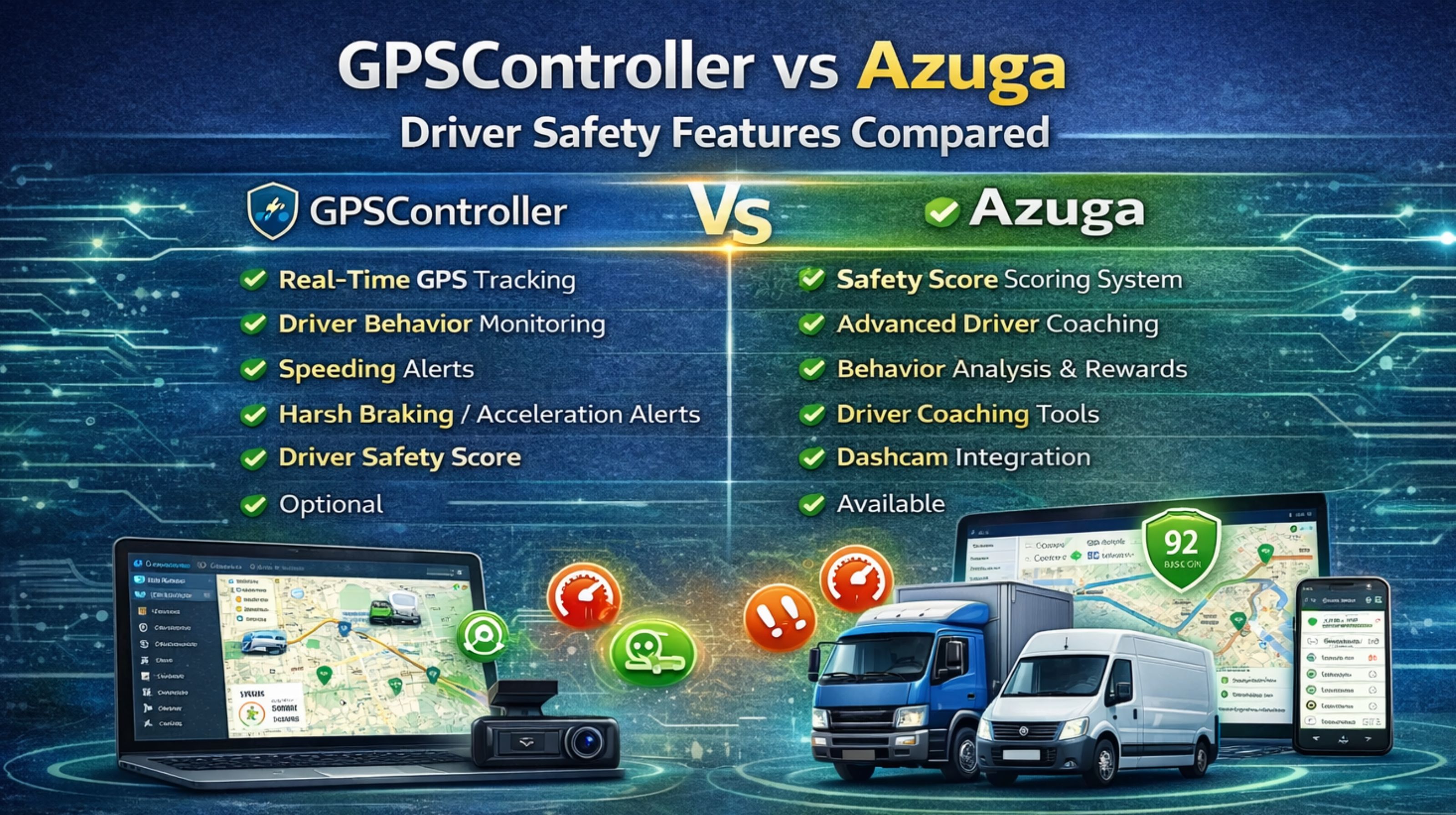
GPSController vs Azuga driver safety feature reliability gaps
GPSController vs Azuga driver safety feature reliability gaps
When a harsh braking event happens in a dense urban corridor, the difference between a real-time coaching alert and a delayed safety report can actually define your fleet's risk profile. The real comparison here isn't just about feature checklists. It's about signal integrity and alert latency under real-world network strain—where driver behavior data either allows for immediate intervention or just becomes a stale compliance artifact you file away.
Clarity on driver safety feature reliability
In live fleet tracking, driver safety features depend on continuous, high-frequency data streams from vehicle sensors. A common real-world observation is the "signal jitter" in urban canyons, where GPS and accelerometer data can get desynchronized. This causes a harsh event to be logged, but often without the precise location or contextual speed data you need for accurate scoring. It's not necessarily a missing feature; it's a data fidelity problem that quietly undermines the whole safety program's credibility with drivers.
Reality check under fleet scale and load
At scale, with hundreds of vehicles reporting simultaneous events, the system architecture determines what you actually see. Batch processing of safety events, even with a delay of 30-60 minutes, creates a critical gap where unsafe behavior can't be addressed mid-shift. I've seen fleets where idle-time violations logged by the engine control unit (ECU) don't trigger alerts until the driver is already home. That misses the coaching moment entirely and just creates friction later during review. This kind of scale constraint directly impacts the effectiveness of your fleet management software.
Mistakes in safety program assumptions
A major failure pattern is assuming a configured geofence or speed rule will fire an alert with 100% consistency. Network handoffs between cellular providers, common on long-haul routes, can cause a data packet containing a speeding event to get queued and delivered out of sequence. The safety dashboard might still show the event, but if the timestamp is off, it breaks the chain of evidence you need for a formal driver review or a solid compliance report. This misunderstanding leads managers to distrust the system and sometimes revert to manual, error-prone logs.
Decision help: tuning, redesign, or replacement
The decision boundary gets pretty clear: if your current system's alert latency exceeds the operational response window—say, alerts arrive after the driver's day ends—and the sensor data lacks the granularity to defend scoring during disputes, then internal tuning is probably insufficient. You're likely facing a core platform limitation. The choice then is between a costly, layered redesign that adds third-party alert engines, or a replacement that treats real-time data integrity as a first principle, not just a feature. A gps controller platform architected for deterministic data pipelines changes this whole equation.
FAQ
q Which platform has more reliable real-time harsh driving alerts?
a Reliability really hinges on data pipeline architecture, not just having an alert toggle. Test it by generating simultaneous events across a fleet segment and measure the latency variance; gaps over 2-3 minutes usually indicate a batch-processing backend that's unfit for live intervention.
q How does GPSController vs Azuga handle compliance reporting for safety audits?
a The critical difference is often in audit trail completeness. One system might log the *attempt* to send an alert, while the other logs the driver's *acknowledgment* on the mobile app. The latter is what you need for defensible audits, a detail that's often buried in the data models.
q Can I fix delayed geofence entry alerts on my current system?
a You can tune parameters, but the real boundary is network latency. If alerts rely on cloud-processed geofence calculations instead of onboard device logic, delays under 5G or Cellular IoT congestion are pretty much inherent. Fixing this usually requires a hardware or firmware redesign, not just a configuration change.
q When should we switch platforms due to safety feature gaps?
a The trigger is when data errors start causing coaching conflicts or audit findings. If drivers successfully dispute events due to missing contextual data—like a map snapshot that could prove a pothole—then your system is becoming a liability. At that point, evaluating a gps controller built for forensic-grade event logging becomes an operational necessity, not just an upgrade.


Comments
Post a Comment