GPS Tracker Failure During Electronic Warfare and Fleet Data Loss
GPS Tracker Failure During Electronic Warfare and Fleet Data Loss
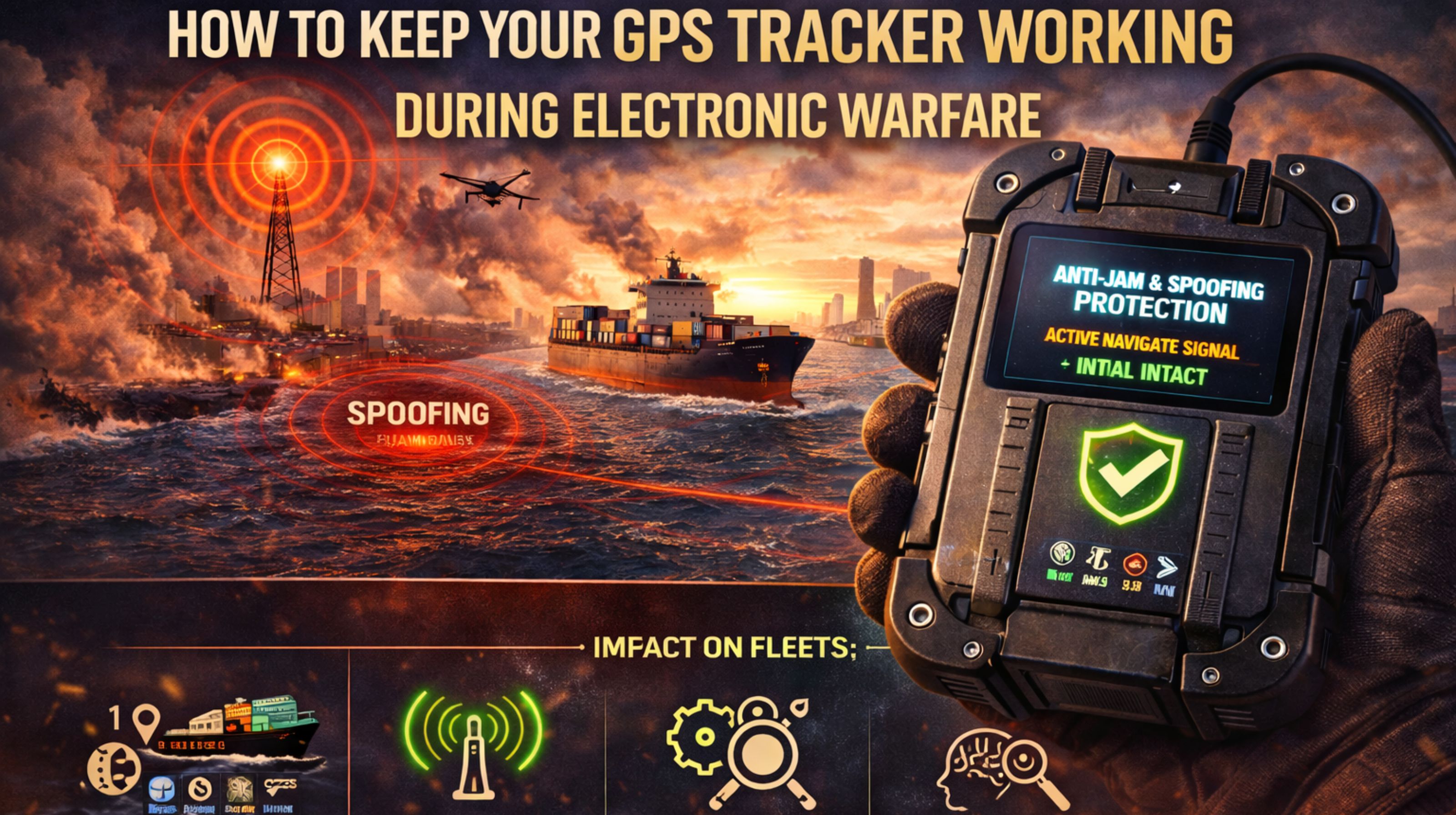
When electronic warfare (EW) hits an area, it's not just a lost signal. Your GPS trackers get confused, and that confusion can corrupt your real-time location data, leading straight to compliance reporting errors. You won't just see a "no GPS" icon. It's worse—a systemic failure where devices might keep reporting their last known position as current, or they'll inject impossible jumps into your telemetry. That flawed data feeds directly into your fleet management software dashboards, and then you're making decisions based on a fiction.
What GPS Jamming Means for Live Fleet Tracking
It boils down to signal dominance. EW jamming floods GPS frequencies with overpowering radio noise, drowning out those already-weak satellite signals. So in practice, your tracker's modem might show full cellular bars—it's online—while its GPS module sees zero satellites. That mismatch is dangerous. The device seems fine, but it's broadcasting stale or just plain wrong coordinates. For any system built on real-time vehicle tracking, that's a critical flaw.
Reality Check Under Real Vehicle Scale and Load
At a small scale, it's a problem. At fleet scale, it compounds into chaos. One jammed vehicle in a convoy creates a data blackout. But get ten vehicles with intermittent jamming, and you can generate hundreds of false "geofence exit" and "route deviation" alerts in minutes, completely overwhelming your dispatchers. We've seen cases where idle time reporting became useless because jamming made engines look like they were "on" for hours while the vehicle was stationary. That doesn't just annoy your team—it completely skews fuel performance monitoring and throws off maintenance logs.
Common Failure Patterns and Wrong Assumptions
The biggest mistake? Assuming newer hardware is immune. Modern trackers might have slightly better filters, but they're still listening for the same vulnerable satellite signals. Another dangerous assumption is that "cellular backup" solves it. It doesn't. It just gives your tracker a data path to send corrupted location data faster. And a critical misunderstanding is ignoring the audit trail. When jamming stops, devices often just pick up again without logging the gap. That creates compliance holes, especially in custom reports and analytics for regulated hours-of-service. The record looks clean, but it's missing time.
Decision Help: Tune, Shield, or Redesign Tracking?
The line here is pretty clear. If your fleet operates in known—or even potential—EW environments, internal configuration tweaks just aren't enough. Sure, you can tune alert thresholds to ignore brief outages. But you can't "fix" the physics of a civilian-grade GPS receiver. So your choice is between accepting the risk and creating procedural workarounds, or redesigning the tracking layer itself. That means incorporating things like inertial measurement units (IMUs) and secondary non-GPS positioning for dead reckoning during outages. It's a more robust approach, and it's a capability some of the more advanced gps controller platforms are actually built to integrate.
FAQ
q Can a GPS tracker be made immune to jamming?
a Not really, no. At least, not a civilian tracker. Military-grade anti-jam tech exists, but it's far too expensive for fleet use. The practical approach is resilience: using extra sensors and smarter logic to detect when jamming is happening and flag that data as unreliable, instead of just passing it off as good.
q How do I know if my fleet data was corrupted by jamming?
a Look for patterns that don't make sense. Sudden, impossible location jumps while engine data looks normal. Clusters of geofence alerts all from one known area. Or check the raw logs—if you see a complete lack of GPS satellites reported for a period while cellular connectivity was stable, that's a big red flag.
q Does jamming damage the GPS tracker hardware?
a Usually not. The jamming signal overwhelms the receiver, but it doesn't typically fry the circuitry. What it can do, though, is force the tracker to constantly search for a signal it can't find. That increased power draw can drain vehicle batteries faster than normal.
q When is it time to replace my trackers versus redesign the system?
a Swapping your old trackers for newer standard GPS models won't solve the core vulnerability. If operational continuity is truly critical for you, then a redesign is necessary. That means moving to hardware with multi-source positioning (like adding IMUs) and pairing it with a software platform—like a specialized gps controller—that can actually fuse all that data together and manage a proper "degraded mode" when GPS drops out.


Comments
Post a Comment