GPS Swarm Drone Coordination Failure and Tracking Software Limits
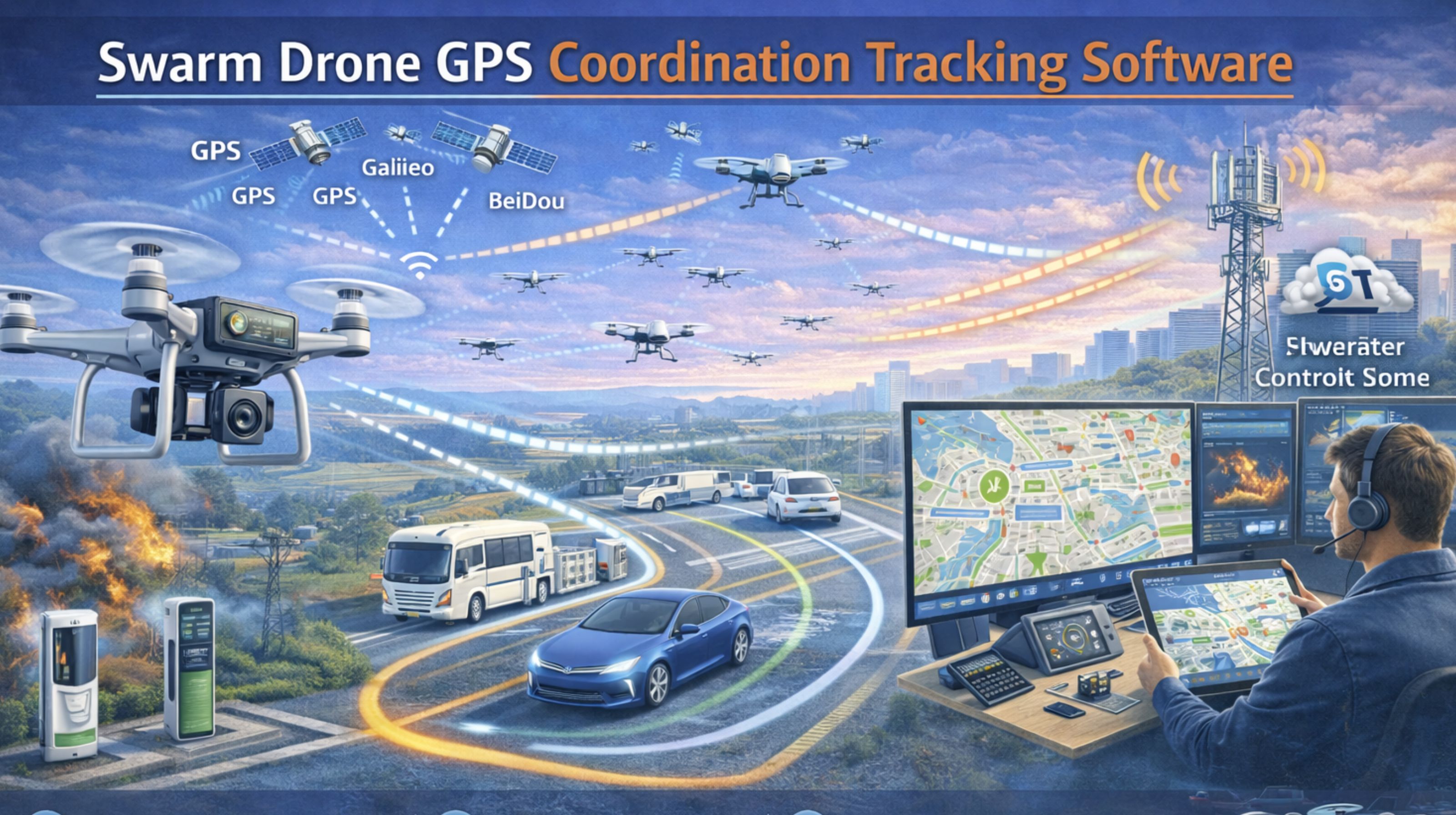
GPS Swarm Drone Coordination Failure and Tracking Software Limits
When your drone swarm tracking software loses real-time positional coherence, it's not a glitch—it's a fundamental system overload that risks mid-air collisions and mission failure. This failure shows up as delayed vector updates, which creates dangerous blind spots in your coordinated flight path.
What Swarm Coordination Failure Means for Live Drone Fleets
In live operations, coordination failure means your central controller gets GPS pings from drones out of sequence. So the software ends up plotting positions that are seconds old. We've seen it in agricultural mapping: the lead drone's turn signal arrives after the following drones have already calculated their own, narrower paths. That creates a compression wave risk in the formation.
Reality Check Under Real Swarm Scale and Mission Load
At scale—think 50+ drones doing a complex search pattern—the software's update latency just compounds. Each drone's telemetry (GPS, IMU, battery) floods the network. The tricky part is the CAN bus emulation inside the tracking platform; under load, it prioritizes battery alerts over positional data, silently degrading your real-time map. This is exactly where basic IoT asset monitoring logic falls apart for dynamic swarms.
Common Failure Patterns and Wrong Assumptions in Drone Tracking
The most costly misunderstanding is assuming "real-time" means simultaneous for all units. It doesn't. Software batches updates to manage server load, which creates a cascading delay. A real problem emerges in urban canyons or under dense tree cover: GPS jitter increases, and the software's smoothing algorithm can incorrectly "predict" a drone right into a building's path. That's a failure no internal tuning can fix after the fact.
Decision Help: When to Tune, Redesign, or Replace Your Tracking System
The line is pretty clear: if your mission needs sub-second, synchronous positional awareness for collision avoidance, and your current software introduces more than 500ms of inconsistent latency between drone reports, then internal tuning isn't enough. You're looking at a platform redesign or replacement. This is where evaluating a dedicated fleet management software architecture, one built for high-frequency telemetry, becomes critical. A gps controller environment made for vehicle fleets often just lacks the temporal resolution needed for aerial swarm safety.
FAQ
q What causes GPS drift in drone swarm software?
a Drift is often a software artifact, not a GPS error. The tracking platform uses predictive filtering to compensate for signal loss, but with multiple drones, these predictions diverge from actual positions. That creates cumulative drift across the whole swarm display.
q How many drones before most tracking software fails?
a The failure point isn't just drone count; it's update frequency. Software using 10-second polling might handle 100 drones. But demanding 1-second updates for 30 drones can overwhelm the data pipeline and mapping engine, causing the UI to freeze or just drop assets.
q Can better GPS hardware fix swarm coordination issues?
a Upgrading to RTK GPS improves individual drone accuracy, sure, but it doesn't solve the software's data fusion problem. If the platform can't process and broadcast that high-precision data to all swarm members fast enough, you still get coordinated flight failure.
q When is it time to replace our drone fleet tracking software?
a Replace it when latency causes near-misses in your logs, or when your team has to build manual "buffer zones" into flight plans to compensate, or audit reports show unexplainable data gaps. At that point, a gps controller platform upgrade is a safety requirement, not just an IT project.


Comments
Post a Comment