GPS resilient fleet tracking software fails under signal jamming in conflict zones
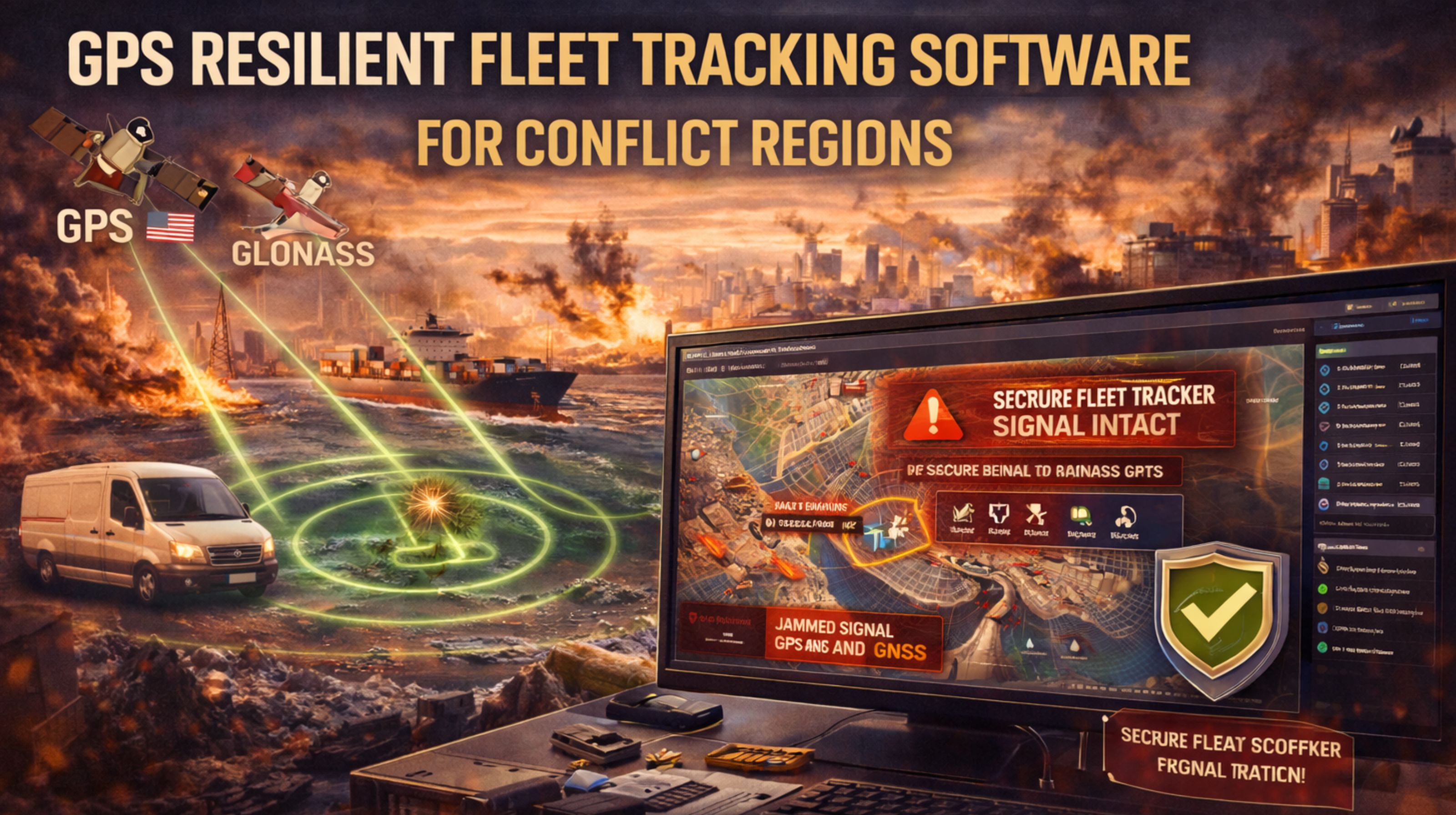
GPS resilient fleet tracking software fails under signal jamming in conflict zones
When your fleet tracking software loses GPS in a conflict region, it's not just a map glitch—it's a complete operational blackout. And the software's so-called resilience gets tested by signal jamming, satellite spoofing, and network blackouts, which creates this cascade of failures from lost vehicles to missed deliveries. You end up with no way to verify driver safety.
What resilient tracking actually means in a live conflict zone
Resilience here isn't about better maps. It's really about layered fallbacks. From what real-world fleets report, when primary GPS is jammed, the software has to instantly switch to something else—inertial navigation, last-known cellular triangulation, or pre-loaded offline route maps. A common failure point is software that just waits too long for a GPS fix to come back. That creates a 15-minute data gap while a truck is essentially driving blind through a checkpoint.
The reality of vehicle scale under electronic warfare conditions
At scale, the problem gets worse. With 50 or more vehicles, sporadic jamming doesn't hit all units equally, so you get this fragmented, unreliable picture of your fleet. Controllers end up seeing some trucks moving, others frozen, with alerts firing randomly. The fleet management software backend struggles to make sense of these inconsistent data streams, and often it just defaults to showing the last clean GPS point. Which is dangerously misleading.
Critical mistakes and hidden compliance risks
The biggest mistake is thinking resilience is just a software feature. It isn't. It requires hardware capable of multi-constellation and multi-frequency reception to even have a chance against basic jamming. Then there's a hidden risk: audit failure. If your software can't produce an immutable, time-stamped log that proves it tried to get a location fix during an outage, your insurance or contractual compliance for high-value cargo in sanctioned regions? It's basically void.
Decision help: when to reconfigure software versus replace the entire stack
The boundary is usually pretty clear. If your current system lacks configurable data-source fallback priorities and can't log raw sensor attempts during outages, no amount of tuning will fix it. You have to replace the stack. If it has the framework but is just misconfigured—like if it's prioritizing cellular data over inertial sensors in an area where cell towers are sabotaged—then a deep reconfiguration by a specialist who knows real-time vehicle tracking in hostile environments might work. But often, you need a full redesign for a gps controller ecosystem that's built for signal denial from the ground up.
FAQ
q How does GPS tracking work in war zones?
a It has to rely on fallback systems like inertial measurement units (IMUs) and pre-programmed waypoints when satellite signals are jammed or spoofed. You can't count on a continuous GPS lock.
q Can my existing fleet software be made resilient?
a Only if it's already architected for modular sensor input and has an offline-first data logging core. The truth is, most consumer-grade platforms can't be retrofitted.
q What is the biggest data risk in conflict area tracking?
a Data corruption from spoofing. That's where the software accepts false location signals, creating a completely fictional—but believable—route log that invalidates all your reporting.
q When should we abandon our current tracking solution?
a When you start seeing unrecoverable data gaps during outages, or when you can't verify the integrity of your location data after a mission. That's when you need a platform built specifically for denied environments.


Comments
Post a Comment