GPS Fleet Tracking BLE Tool Alerts Failing Under Real Service Van Conditions
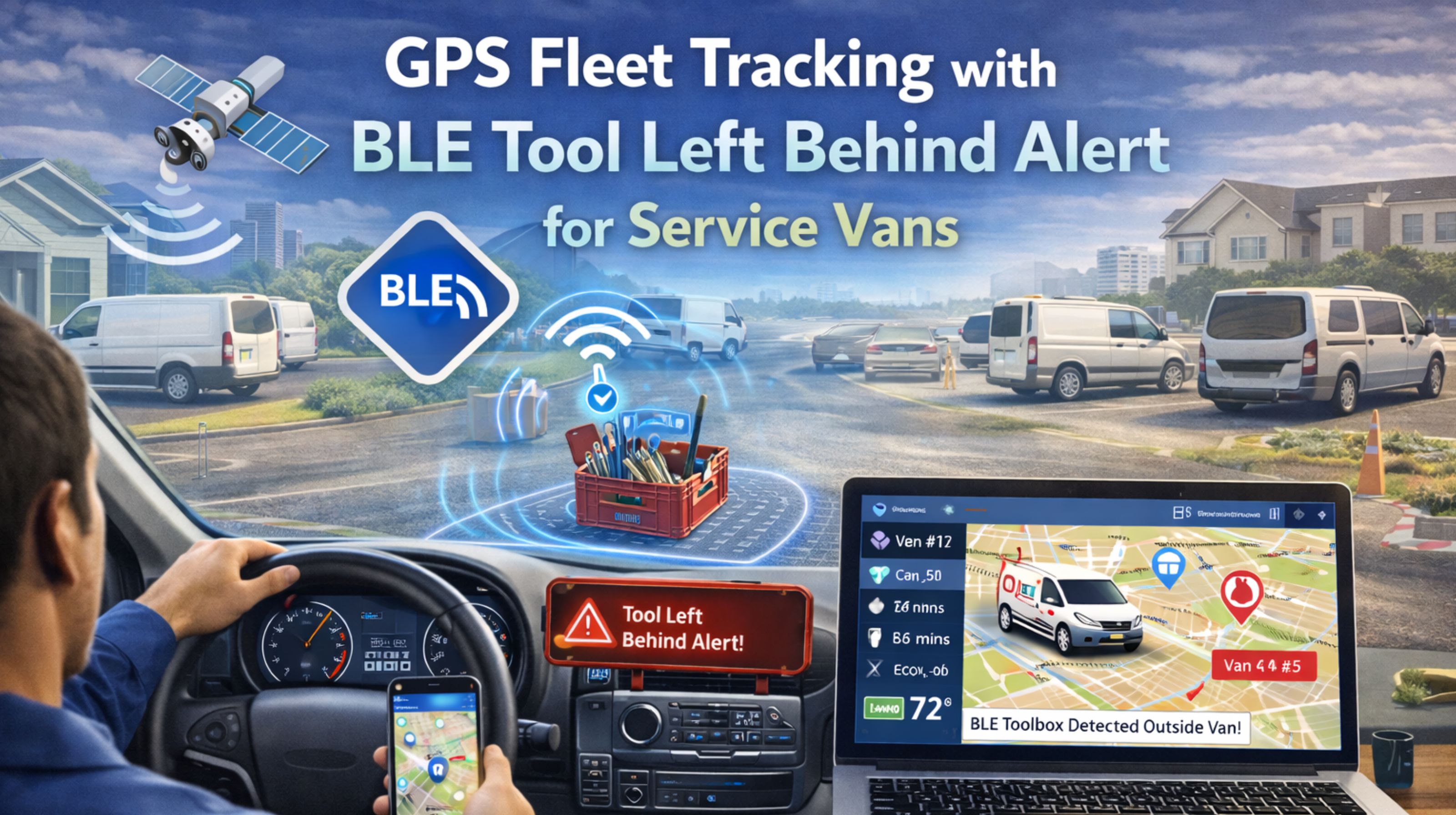
GPS Fleet Tracking BLE Tool Alerts Failing Under Real Service Van Conditions
When a Bluetooth Low Energy (BLE) tag stops reporting a left-behind alert from a service van, the failure is rarely just in the dashboard. In my experience, the real problem is usually a silent signal handoff between the van's GPS tracker and the BLE tag. That handoff gets disrupted by things you can't see on a map—engine vibration, metal toolboxes, even the driver's routine. Fleet managers tend to notice the issue only during a post-job audit, when a missing tool isn't flagged. That's when you see the real compliance gap in asset accountability.
What BLE Tool Alert Failure Means for Live Fleet Tracking
In practice, a BLE left-behind system depends on the van's telematics unit reliably detecting the tag's signal. The idea is simple: when the van moves beyond a set geofence without the tag, an alert should trigger. But the failure happens in the "last seen" logic. If the GPS tracker's BLE radio is momentarily interrupted—say, when a van starts up in a concrete parking garage—the system might incorrectly assume the tag is still nearby, and it kills the alert. This isn't really a software bug. It's a real-world RF environment issue that standard IoT asset monitoring setups often just don't account for.
Reality Check at Scale: When Alerts Stop Working
With 20 or more vans running jobs at the same time, the failure rate doesn't just add up—it multiplies. Radio interference stacks, GPS polling cycles fall out of sync with BLE scans, and delayed geofence exits create false negatives. What you'll see is tools marked "in vehicle" long after the van left the site. Or you might get an alert a full 30 minutes post-departure, when the driver is already on the highway. That delay makes recovery impossible. It points to a core system design limit under load, not some simple configuration error you can just tweak.
Common Mistakes That Escalate BLE Tracking Failures
The biggest misunderstanding is treating BLE tags like they're GPS units. Managers often assume a stronger signal means better tracking, but BLE is really designed for proximity, not precision location. Placing tags inside metal toolboxes, or mounting the vehicle gateway right near the transmission tunnel, practically guarantees signal loss. Another critical error is not setting up a secondary validation rule, like cross-checking door sensor events. Skipping that turns a single-point failure into a total asset tracking blackout.
Decision Help: Tune, Redesign, or Replace the Alert Workflow
The boundary for internal fixes is pretty clear: if you're adjusting tag placement and gateway settings more than twice a month per vehicle, the architecture itself is probably wrong. For basic reliability, you really need to redesign the alert logic to include motion and ignition triggers as secondary validation. But if missed alerts are starting to impact job completion or audit compliance, then you likely need a system-level replacement. That means integrating tool tracking directly into the job dispatch workflow, not just treating it as a separate BLE layer. A robust fleet management software platform should handle this natively.
FAQ
q How does a BLE tool tracking system actually work with GPS fleet tracking?
a The van's telematics gateway has a BLE radio that periodically scans for registered tag IDs. When the van moves outside a geofence, the system checks the last scan; if the tag ID wasn't seen, it triggers a "left behind" alert. The failure point is usually that scan cycle missing the tag due to interference.
q Why do BLE tool alerts sometimes work in the yard but fail on job sites?
a Yard conditions are controlled. Job sites introduce steel structures, generator noise, and multiple vehicles—all of which scatter BLE signals. The gateway's scan might even pick up a tag from a nearby van, causing a false "present" reading that suppresses your alert.
q Can adding more BLE gateways or repeaters solve alert failures?
a Sometimes, but it introduces a lot of complexity. More gateways mean more data handoffs and potential sync errors. If the core issue is the timing between the scan cycle and vehicle movement, extra hardware might just add new points of failure without actually fixing the alert logic.
q When is it time to stop troubleshooting BLE and consider a different system?
a When missed alerts start causing service delays, when tool loss costs exceed the price of a new system, or when audit reports consistently show unaccounted assets. At that point, the risk shifts from being a technical bug to a straight-up business liability. That's when you need a platform-level solution, which is where evaluating a dedicated gps controller platform becomes the logical next step.


Comments
Post a Comment