GPS fleet software with natural language reporting dashboard
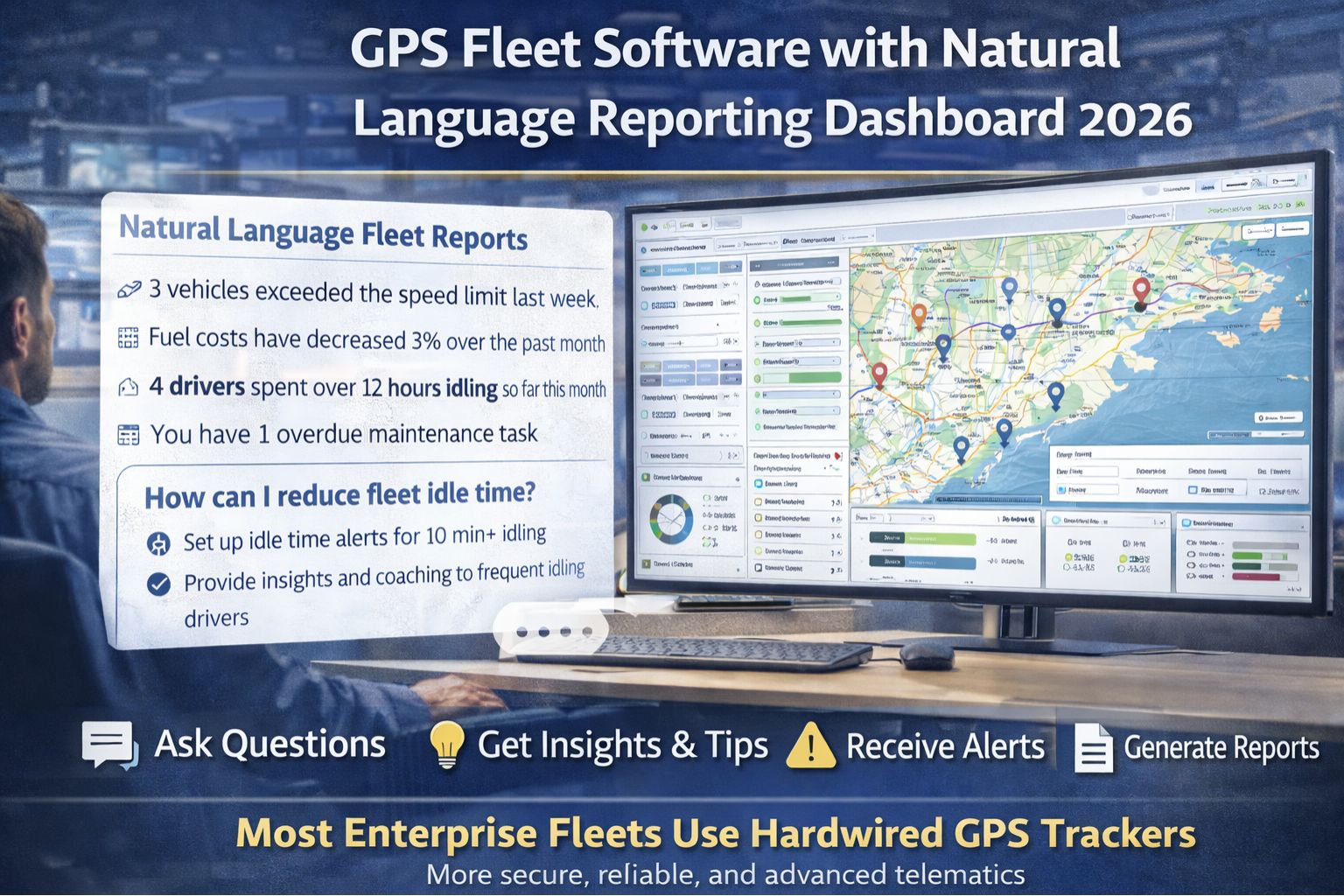
GPS fleet software with natural language reporting dashboard
So your GPS fleet software has this natural language reporting dashboard. You can type in "show me all trucks that idled over 30 minutes yesterday" and get a report back instantly. It's powerful—it turns all that raw data into something you can actually use. But here's the thing: that whole value proposition just falls apart if the location and engine data underneath is stale or full of holes because of a GPS signal delay. The dashboard is only ever as reliable as the data pipeline that's feeding it. Period.
What natural language reporting really means for fleet managers
This isn't just a fancy search bar, you know? A real natural language dashboard gets what you're trying to *do*. You could ask, "Which routes had the highest fuel consumption per stop last week?" and it digs into your specific data—PTO usage, idle times, the route sequence—to give you a visual answer. The danger is you can't see it: if a vehicle's GPS signal dropped for 15 minutes in a city canyon, the reported route and stop times are basically guesses. That makes your nice, clean report fundamentally wrong. You end up making decisions based on corrupted intelligence without even realizing it.
The operational reality when your dashboard lies
In the real world, these signal gaps create a whole cascade of errors that the dashboard just presents as fact. It might show a driver as stationary at the depot because the GPS fix is old, but in reality they were 10 miles away. That triggers a delayed geofence alert way later. Then you're using the dashboard to investigate "unauthorized stops," wasting hours on a compliance issue that never actually happened. The more you lean on the dashboard for daily meetings and coaching, the more you bake those inaccuracies into everything, and trust in the whole system just erodes.
The critical mistake: trusting the interface over the data stream
This is the most common, and costly, error: assuming that because the reporting front-end is sophisticated, the data underneath must be solid. It's easy to get seduced by how simple it is to ask questions in plain English. You forget to check how fresh and complete the actual telematics feed is. You might set up complex alerts for "real-time" things like harsh braking, but if the location data is five minutes old, those alerts are just historical footnotes. They're not preventing anything. You're managing a fiction of the past, not your live fleet.
When to tune, reconfigure, or replace your reporting system
Your decision really comes down to figuring out where the failure is. If your queries are just slow but the answers are right when data *is* there, maybe it's a database tuning issue. If the reports themselves show obvious gaps or delays, then you've got to reconfigure the data ingestion—maybe add a secondary location source. But if the core problem is the telematics hardware or network protocol itself, and it introduces a latency that just can't be fixed... well, then every insight is a historical snapshot. You've hit a boundary. Sticking with a fleet management software platform that has fundamentally unreliable data becomes a strategic risk. At that point, the conversation isn't about software features anymore. It's about data fidelity.
FAQ
Question: How does GPS delay actually break a natural language report?
Answer: The dashboard works by aggregating data points with timestamps. If the GPS signals are delayed, the sequence of events is wrong. So a report on "route completion time" will be off because the system doesn't know the vehicle left a stop late; it just gets the data out of order and calculates the durations incorrectly.
Question: Can't the software just interpolate or guess the missing data?
Answer: Some systems do try to interpolate, yeah. They'll draw a straight line between the last-known points. But that creates false travel paths and stop locations. For something like a compliance or payroll report, that guessed data is actually worse than having no data at all—it's fabricated evidence you could never defend in an audit.
Question: We have great cellular coverage; why would our dashboard data be bad?
Answer: People mix this up a lot. Cellular coverage and GPS signal are two totally different things. A vehicle can have full 4G bars for sending data but be in a tunnel or under thick trees where the GPS antenna can't get a satellite fix. The device might just keep sending the "last known good" location over that strong cellular connection, flooding your dashboard with stale, duplicate coordinates.
Question: What's the final sign we need a new system, not just a fix?
Answer: It's when your team starts manually checking every single dashboard insight against driver logs or some other system because they just don't trust the automated reports anymore. That means the software has failed its core job. You need a platform where data integrity is the foundational feature, not an afterthought. That's where evaluating a solution like gps controller should start—looking at its data acquisition and validation protocols first, not just how nice the query interface looks.


Comments
Post a Comment