GPS Controller with passenger count sensor for school bus fleet 2026
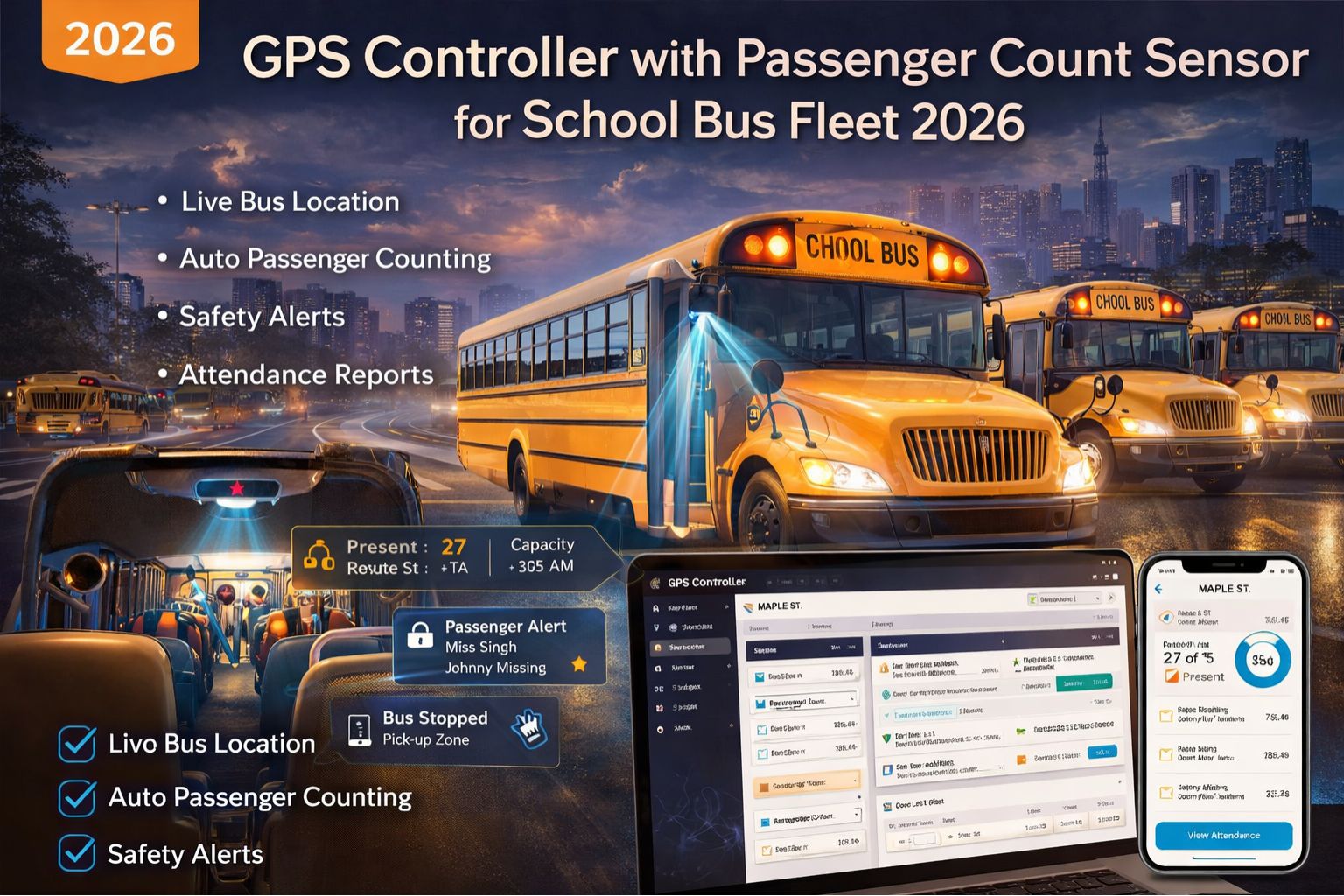
GPS Controller with passenger count sensor for school bus fleet 2026
When your school bus fleet's passenger count sensor starts reporting zeros, or maybe ghost passengers, it's not just a data error—it feels like a direct threat to student safety and district compliance. This failure means your GPS controller can't confirm if a child was left on board or if a bus is overloaded, which basically turns a routine tracking system into a liability. Honestly, the core issue is often a mismatch between the sensor's data stream and the telematics unit's processing logic, especially after those firmware updates or network changes that never seem to go smoothly.
What Passenger Count Failure Really Means for Your Fleet
In live operations, a failing passenger count sensor doesn't just show wrong numbers; it breaks the chain of custody for every student on your buses. You end up with dispatchers seeing a bus as empty when it's actually carrying 40 kids, or a parked bus that shows 2 passengers long after the last child has gotten off. This creates real blind spots in your real-time vehicle tracking dashboard, where the location is accurate but occupancy is just a guess. The symptom that really keeps people up at night? It's that delayed or missing geofence alert for an "empty" bus entering the depot, when in reality a sleeping student might still be on board.
The Reality of Scaling a Faulty Sensor Network
Under real operational scale, the problem just compounds. One bus with a flickering sensor is manageable, but a third of your fleet reporting inconsistent counts during afternoon dismissal? That's a crisis. The network detail a lot of operators miss is how passenger data gets timestamped and batched. If the GPS controller's clock drifts even a few seconds from the sensor's internal clock, passenger-on and passenger-off events get misaligned with location pings, making historical reports practically useless for incident reconstruction. At that scale, manual verification is impossible, and trust in the entire telematics system just collapses.
The Critical Mistake: Treating It as a Hardware Glitch
The wrong assumption that causes things to escalate is believing this is purely a sensor or wiring issue. More often than not, the failure is in the GPS controller's application layer, which can't reconcile sudden, simultaneous door-open events with Bluetooth tag scans or seat weight sensors. There's a common misunderstanding that resetting the device will fix it, but that only clears the volatile memory log—destroying the very data you need to diagnose the communication protocol failure. This leads districts to waste weeks replacing hardware when the real fault is buried in the data integration logic.
Your 2026 Decision: Patch, Reconfigure, or Replace
So now you face a clear choice. You can try to *patch* it by manually auditing logs, which only works if fewer than 5% of trips are affected—and that's a big if. You can attempt to *reconfigure* the data-handling rules in your fleet software, but that requires deep API access and assumes your current GPS controller even supports modern sensor fusion. The boundary where internal fixes stop is when passenger data and location data arrive on different latency cycles. That's a core architectural limit of older telematics units. Beyond this point, you really have to *replace* the controller with a system designed for synchronized multimodal data, like those built for 2026's integrated safety standards. This is where evaluating a purpose-built GPS controller platform becomes an operational necessity, not just an optional upgrade.
FAQ
Question: How accurate are passenger count sensors on school buses?
Answer: Modern infrared or weight-based sensors are 98-99% accurate under ideal conditions, but that accuracy plummets when they're integrated with an older GPS controller that samples data too slowly. It just misses those rapid boarding and exiting events during busy school stops.
Question: Can a GPS tracking system work if the passenger sensor fails?
Answer: Yes, the location tracking continues, but the system loses all occupancy intelligence. That creates major compliance risks, especially as states are increasingly requiring logged passenger manifests alongside location history for safety audits.
Question: What causes passenger count data to desync from GPS location?
Answer: The primary cause is usually a latency mismatch. The sensor counts in real-time, but the GPS controller might process and transmit location and occupancy data in separate, unsynchronized batches. This gets worse in areas with poor cellular coverage.
Question: When should a school district replace its GPS controller for passenger counting?
Answer: You should consider replacing it when discrepancies affect more than 10% of daily routes, when you can't trust historical reports for incident review, or when your current vendor can't guarantee sub-second sensor-to-cloud data synchronization. That last one is becoming a key capability for 2026 operations.


Comments
Post a Comment