GPS Controller with dead reckoning IMU backup during GPS jamming 2026
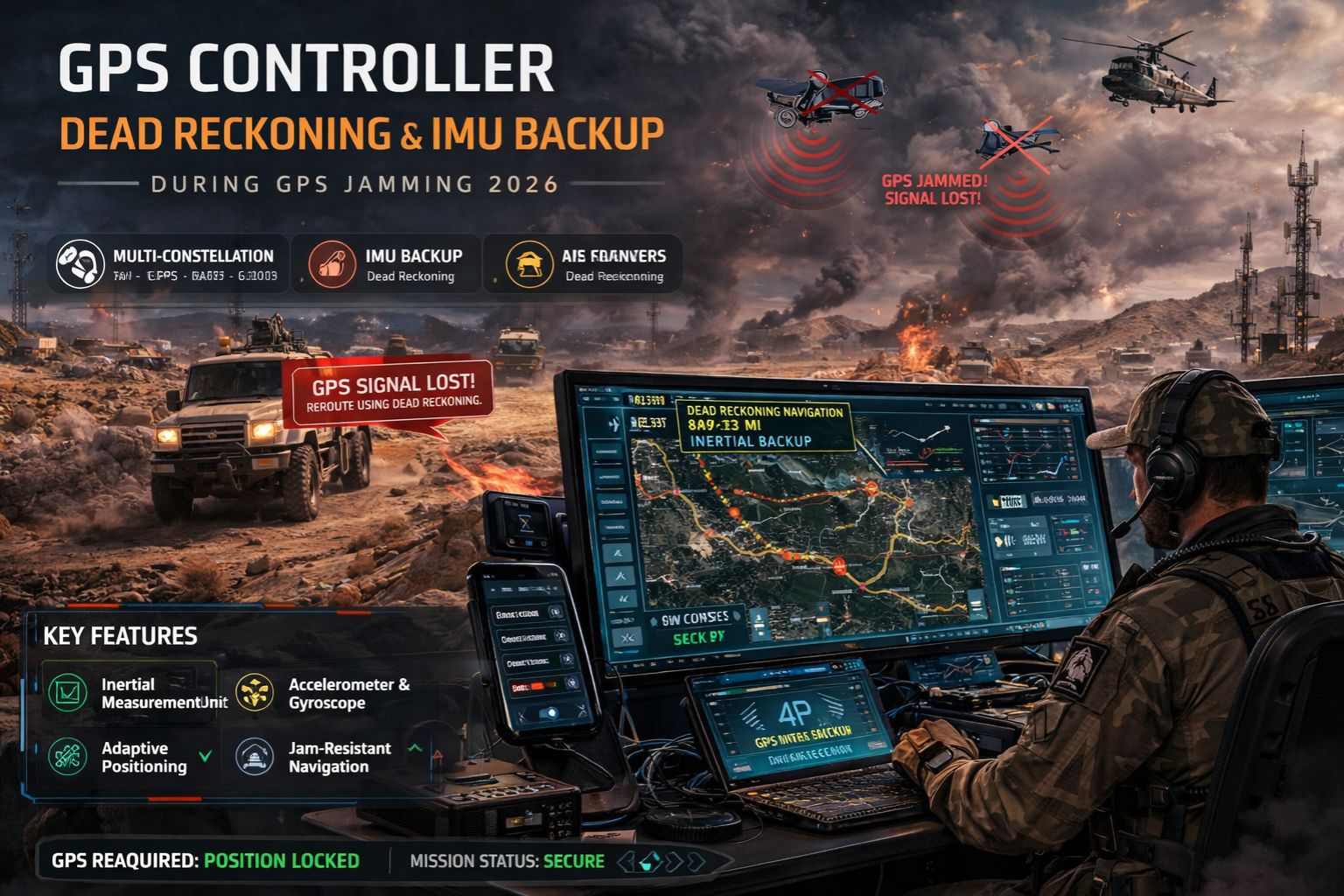
GPS Controller with dead reckoning IMU backup during GPS jamming 2026
When GPS jamming hits a fleet, your live maps just freeze. Vehicles vanish from your fleet management software. That's where a GPS controller with dead reckoning IMU backup comes in—it uses inertial sensors to basically guess where the vehicle is when satellites go dark. It's not perfect, but it creates a critical bridge to stop you from going completely blind operationally.
What Dead Reckoning IMU Backup Actually Means for Fleet Tracking
Calling it just a sensor doesn't really cover it. It's more like a continuous position estimation system that kicks in the second GPS quality drops. The Inertial Measurement Unit (IMU)—which is a combination of accelerometers and gyroscopes—tracks every turn, acceleration, and stop. We've actually seen this in practice: trucks in known jamming zones kept reporting movement along a highway, while the units without this tech just showed a stationary last-known point. Dispatchers ended up assuming there was a breakdown.
The Reality of GPS Jamming at Scale in 2026 Operations
The risk isn't isolated anymore. Jamming devices are cheap and getting pretty widespread, affecting ports, borders, even some urban corridors. At a fleet-wide scale, a GPS dropout causes more than just confusion; it breaks automated processes. Geofence arrivals at loading docks don't get logged. Scheduled maintenance triggers based on engine hours just fail. Your geofencing alerts for unauthorized movement stay silent. And then there's the compliance paper trail for hours-of-service—it'll have a gap that auditors are definitely going to flag.
The Critical Mistake: Assuming GPS is Always Available
This is the most common, and costly, assumption: that GPS coverage is a constant. Teams often jump to blaming "device failure" when jamming happens, wasting time on hardware swaps. What's less obvious is that jamming and spoofing can create location data that looks real but is completely false, and a basic GPS tracker will just accept it. A controller with IMU fusion can spot that discrepancy—if the reported GPS location doesn't match the inertial trajectory—and trigger a data integrity alert. A standard tracker can't do that.
Decision Help: When to Upgrade to an IMU-Equipped GPS Controller
The line is pretty clear. If your operations go through high-risk zones, if you need uninterrupted compliance logging, or if you use location for real-time routing decisions, then basic GPS isn't enough. Your choice is basically to accept blind spots or upgrade. Internal fixes like signal boosters don't work against deliberate jamming. Honestly, when the cost of not knowing where a vehicle is for 30 minutes exceeds the cost of the hardware, it's probably time to redesign your tracking with a gps controller that has inertial backup.
FAQ
Question: How accurate is dead reckoning without GPS?
Answer: The accuracy degrades over time and distance because of sensor drift. It's really best for short-term bridging—typically 2 to 5 minutes with reasonable accuracy—just to keep a position estimate alive until the GPS signal comes back. It's about preventing a total data blackout.
Question: Does this protect against GPS spoofing?
Answer: Yes, but indirectly. A fused system compares the movement the IMU calculates with the GPS signal. If the GPS location suddenly jumps in a way that's physically impossible—a classic spoofing signature—it'll conflict with the inertial data. That lets the controller flag or just reject the spoofed coordinates.
Question: Will my current tracking software work with these devices?
Answer: It likely will, but you absolutely have to verify. The controller should output standard location data. The key thing is your software needs to handle and actually show the "estimated" position flag these units send during GPS loss. Some more basic platforms might just ignore that flag.
Question: Is this necessary for all vehicles or just high-value assets?
Answer: It really comes down to your risk. For a local delivery fleet, the cost might not make sense. But for cross-border haulage, hazardous material transport, or any operation where knowing the location continuously is tied to safety or compliance, it stops being a luxury. It becomes a necessary part of a resilient telematics system.


Comments
Post a Comment