GPS Controller spoofing detection alert for commercial shipping 2026
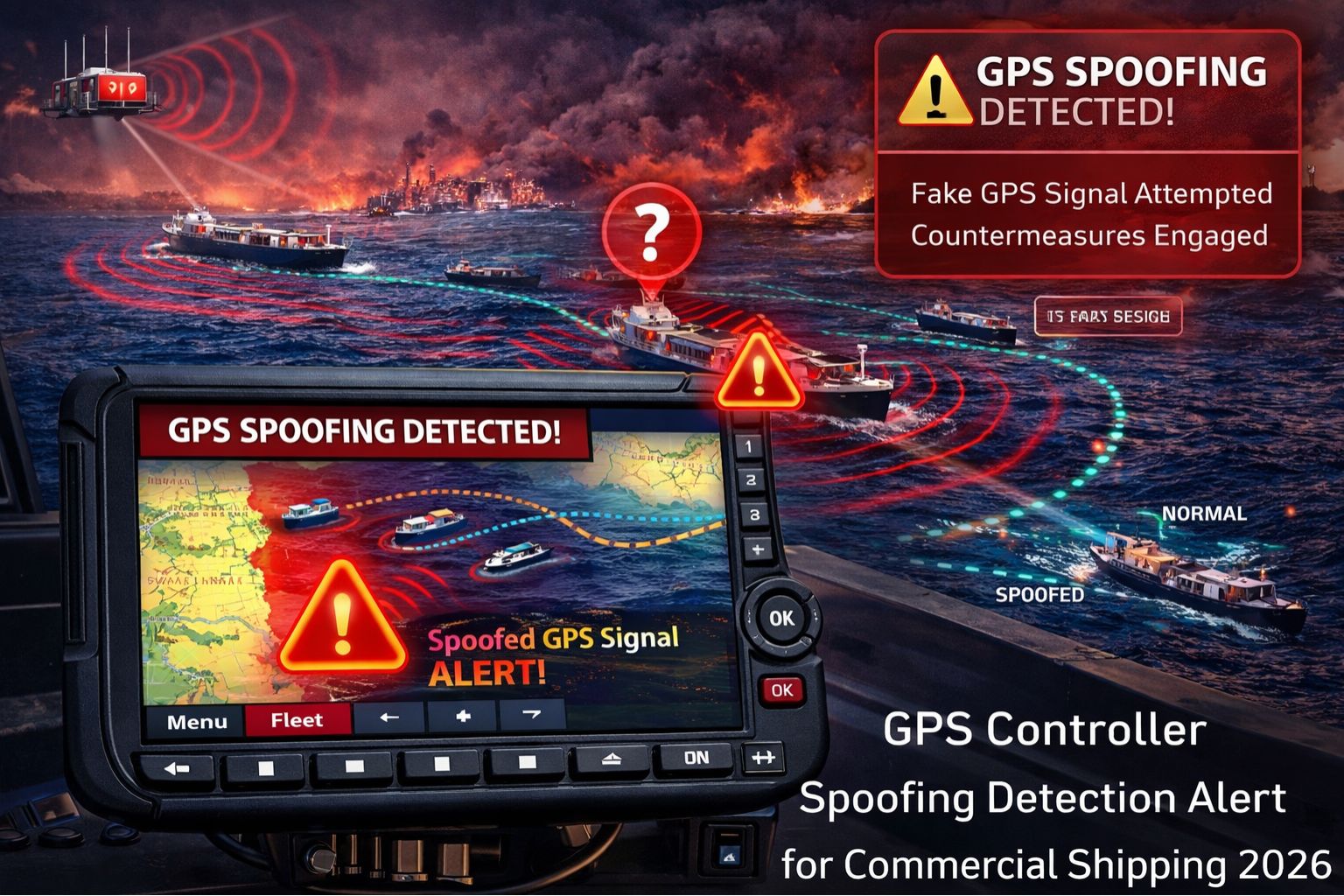
GPS Controller spoofing detection alert for commercial shipping 2026
For commercial shipping operators in 2026, a GPS spoofing detection alert has shifted from a theoretical IT notice to something more urgent—it's a direct signal that your vessel's reported position is being deliberately falsified. That means it could be steering off its plotted course while everything on the bridge looks normal. And this isn't just a weak signal we're talking about; it's a fabricated one, designed specifically to trick your onboard tracking devices and the navigation systems they feed.
What a spoofing alert means on a live vessel
When that alert goes off, it means the vessel's GPS receiver is picking up a conflict. It's comparing the expected satellite signal characteristics against what's actually coming in, and they don't match. In practice, the crew might see a sudden, weird jump in position on the chartplotter while the inertial sensors feel fine. Or the system will flag a speed or acceleration that's just physically impossible. What I've heard from the fleet is that the first real sign is often a mismatch—the GPS says one speed-over-ground, but the vessel's log speed says another. It's a discrepancy an experienced captain tends to notice right away.
The operational reality when spoofing hits at scale
Under real operational pressure, a single spoofed vessel can throw off an entire port schedule. But coordinated spoofing in a strategic corridor? That's where you get real chaos. The non-obvious detail here is that modern spoofers aren't always just blasting a fake signal. Often, they amplify a slightly delayed copy of the real one. That creates a believable but offset position, which slowly drifts the vessel off course. The result is that detection by human eye alone becomes nearly impossible, at least until you've already deviated a significant amount.
Common mistakes that turn an alert into a crisis
The most dangerous misunderstanding is treating a spoofing alert like a standard GPS dropout—just waiting for the signal to "come back." That delay is critical. It allows the spoofed track to get logged into the voyage data recorder and sent to shore-based fleet management software, creating an official but completely false record. Things really fall apart when the spoofing signal is powerful enough to overwhelm both the vessel's primary and backup GPS antennas at once. That's the boundary condition: you're left with no clean signal source for a quick cross-check.
Your decision: recalibrate, harden, or redesign
So you're faced with a choice. You can try to recalibrate on the fly, maybe by switching to secondary systems like GLONASS or Galileo, assuming they're still clean. You can look at hardening your setup, perhaps integrating encrypted military-grade GPS (M-Code) receivers if your operation qualifies. Or, you have to go further and redesign the whole navigation stack to be multi-source, fusing GPS with things like eLoran, celestial updates, or ship-borne inertial systems that don't care about radio frequency spoofing. The line is pretty clear: if your vessels are in high-risk zones and rely solely on commercial GPS, then internal software tweaks via your GPS controller won't cut it. You have to secure the physical signal layer itself.
FAQ
Question: How can I tell if it's real GPS spoofing and not just a bad signal?
Answer: Spoofing usually gives you a strong, clear signal that just happens to be feeding you a plausible lie. A bad or jammed signal typically means you lose the fix entirely, or you get wildly inaccurate, jumping coordinates. A proper spoofing detection system is looking for cryptographic anomalies in the signal structure itself, not just checking the signal strength.
Question: What's the immediate action when a spoofing alert sounds on the bridge?
Answer: Your first move is to cross-reference the GPS position with a second, completely independent system. Check the inertial navigation if you have it, get radar fixes on known landmarks, look at the gyrocompass and log. Crucially, don't trust any automated systems that are taking their cue from the primary GPS for course corrections. You need to manually plot your estimated true position.
Question: Are certain shipping routes more prone to GPS spoofing attacks?
Answer: Definitely. High-traffic chokepoints, politically sensitive regions, and areas near military exercises see a lot more of this activity. Port approaches are a big target too, where spoofing could create a navigational hazard or trigger compliance violations linked to automated geofencing alerts for restricted zones.
Question: Is upgrading our GPS controller software enough to prevent spoofing?
Answer: Not really. Software can help you detect it better, but preventing it requires changes at the hardware level. You need receivers that can analyze the signal structure for tampering, and you need a diversified set of positioning inputs. This is about a system-level security redesign, not just applying a software patch. A robust telematics platform then becomes the integrator, making sense of all these different sources.


Comments
Post a Comment