GPS Controller INS inertial navigation system fusion for war zone fleet 2026
GPS Controller INS inertial navigation system fusion for war zone fleet 2026
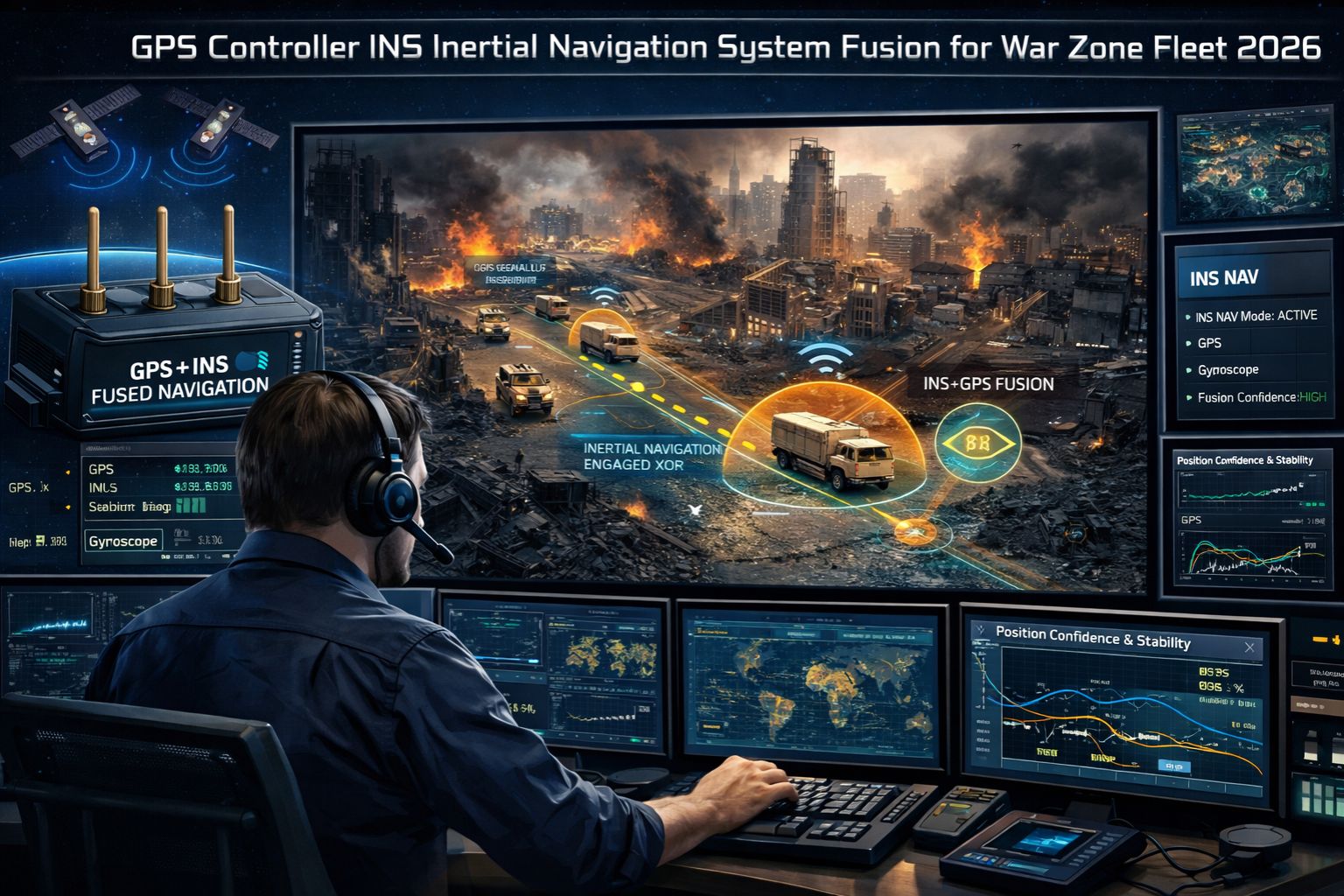
When GPS signals get jammed or spoofed out there, your fleet tracking screen just goes dark. A coordinated convoy turns into a bunch of lost assets, just like that. GPS Controller INS fusion is that operational bridge—it uses an Inertial Navigation System (INS) to calculate position, speed, and heading from internal sensors when the satellites drop out. It stops a total blackout of situational awareness. Honestly, this isn't about getting better accuracy. It's about keeping a basic location fix when the primary system is under attack. For 2026 war zone logistics, that's basically non-negotiable.
What INS Fusion Actually Means for Live War Zone Tracking
So, INS fusion means your telematics hardware has a secondary, self-contained nav system—accelerometers and gyroscopes—that takes over when GPS drops. What you'll actually see is a vehicle icon that keeps moving along the route on your RealtimeVehicleTracking map, but with this growing "position uncertainty" ellipse around it. The system isn't just guessing; it's dead reckoning from the last known good GPS fix and every inertial measurement after. The real fleet observation, the one that matters, is that delayed geofence alert. It still triggers when a truck enters a restricted zone, even with zero live satellite signal to confirm it.
The Reality of Scale and Drift in Contested Environments
At real operational scale, the big problem is error accumulation, or "drift." An INS figures out a new position by integrating acceleration and rotation over time. Tiny sensor errors add up, so the reported location slowly drifts off the true path. After maybe 10 minutes of pure inertial nav following a GPS loss, your position error could be 100 meters. Push it to 30 minutes, and you might be off by over a kilometer. The thing most people miss is the quality of the MEMS sensors and the fusion algorithm itself. A good one uses wheel speed or other vehicle data to correct this drift. That's what separates a basic GPS tracker from a hardened, military-grade unit.
The Critical Mistake: Assuming INS is a Permanent GPS Replacement
This is the most common, and dangerous, misunderstanding: treating INS like a seamless, permanent swap for GPS. It's not. It's a bridge, not the destination. INS fusion keeps things running during short-to-medium outages—which is absolutely crucial for urban canyons, tunnels, or active jamming zones. But the failure pattern kicks in when planners rely on it for hours or days without a plan to get GPS back. The location data becomes useless for precise coordination, your fuel calculations go off, and those compliance logs for movement in regulated areas can't be definitively verified. That's a massive audit risk waiting to happen.
Decision Help: Tune, Harden, or Redesign Your Tracking Stack
Your decision really comes down to how long and how sophisticated the GPS denial is going to be. For occasional jamming in known hotspots, you can probably just *tune* your existing platform. Make sure the INS capabilities are actually enabled and set up alerts for when it kicks into inertial navigation mode. If your convoys are routinely in electronically contested areas, you need to *harden* things. That means getting devices with tactical-grade INS sensors and actually validating their drift performance. And if your whole operational doctrine assumes persistent GPS denial? Then you have to *redesign* the tracking workflow to bring in other positioning sources, like celestial or terrain-referenced navigation. The line in the sand is when the positional uncertainty gets bigger than what your route's safety or mission requirements allow. That's when you need a system, like gps controller, that's actually architected for signal-denied environments from the start.
FAQ
Question: How long can INS keep tracking a vehicle without GPS?
Answer: Technically, forever, but its practical usefulness falls apart in minutes to hours because of drift. A high-quality tactical system might stay usable for 30-60 minutes. A commercial-grade one could drift past an acceptable threshold in under 10. The whole point is to use INS to bridge the gaps until you can get a GPS signal back.
Question: Can INS fusion prevent spoofing attacks?
Answer: Yeah, but indirectly. A robust fusion algorithm is constantly comparing the INS-derived position and trajectory against what the GPS is reporting. If the GPS signal is spoofed and suddenly shows an impossible jump in location or speed—something that contradicts the inertial sensors—the system can flag that GPS data as faulty and ignore it. It'll just rely on the INS until the spoofing ends or it finds a signal it can trust.
Question: What happens to geofence alerts and route compliance during GPS loss?
Answer: With INS fusion, they keep going based on the estimated inertial position. But that "uncertainty" around the position grows the longer you're without GPS. So an alert might still fire, but the system should also report a high confidence interval. It means the vehicle is *likely* in the geofence, but its true spot could be hundreds of meters off. For audit trails, that detail is critical.
Question: Is special hardware required, or is this a software update?
Answer: It needs specific hardware. INS functionality depends on physical inertial measurement units (IMUs)—the accelerometers and gyroscopes—built right into the tracking device. You can't just patch this in with a software update if the hardware doesn't have the sensors. For 2026 war zone readiness, you have to get devices that already come with quality IMUs designed for navigation, not just basic motion detection.


Comments
Post a Comment