GPS Controller Galileo satellite fallback for war zone logistics 2026
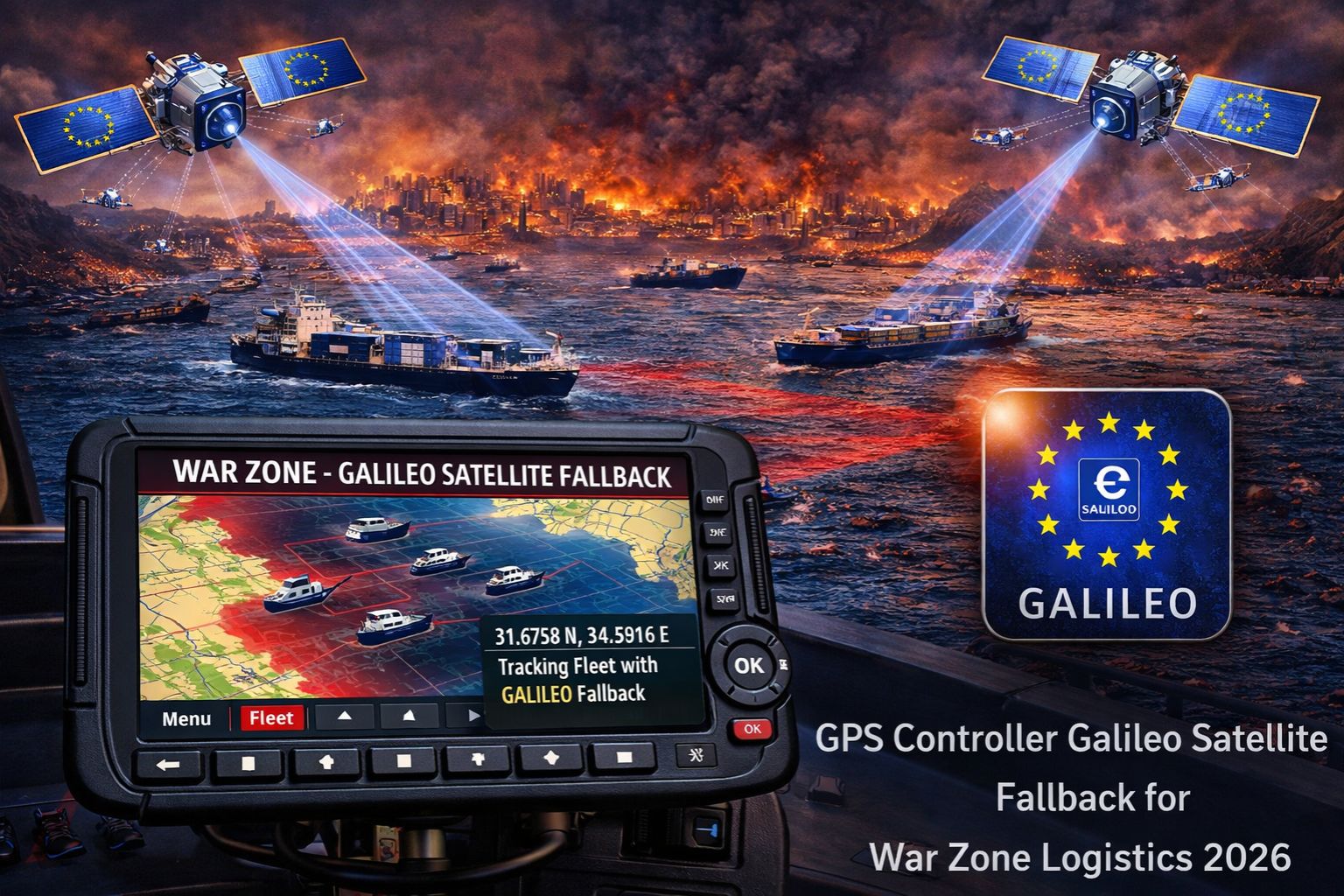
GPS Controller Galileo satellite fallback for war zone logistics 2026
So when primary GPS signals get jammed or spoofed in a conflict zone, logistics teams are supposed to switch to Galileo satellites as a backup. But what we're seeing in 2026 is that this fallback is failing under coordinated electronic warfare. Convoys are left with delayed or just frozen position data. Honestly, the real failure isn't even the lack of a signal—it's that multi-second latency introduced during the handoff between systems. That creates a dangerous blind spot for fleet controllers trying to monitor high-value assets in hostile territory. This gap between satellite systems directly throws off mission timing and, worse, creates unverifiable compliance logs for military and humanitarian aid contracts. It's a paperwork nightmare with real consequences.
What Galileo fallback actually means for live tracking
In practice, "Galileo fallback" isn't a seamless switch. It's a reacquisition process where the tracking device has to lock onto entirely new satellites from a different network. That often takes 15 to 45 seconds under ideal conditions. In a war zone, with constant signal noise and the device moving, this handoff can stretch to over two minutes. During that entire window, the last known position is what's displayed. The vehicle has moved, but you get a "ghost track" showing a truck stationary at a checkpoint it left minutes ago. Fleet managers might see this as a simple blip, but on the ground, it means geofence alerts for safe zones or hostile boundaries are delayed until the new signal stabilizes. It basically renders real-time alerts useless when you need them most.
The scale problem when multiple assets lose lock
The critical failure happens when not one, but an entire convoy or regional fleet experiences simultaneous jamming. Now each device is independently trying to acquire Galileo satellites, flooding the local RF environment with search signals. That creates its own interference, which just prolongs the blackout for everyone. At an operational scale, this means your fleet management dashboard shows a cluster of assets all stuck on their last reported position, while in reality they're moving. Controllers can't distinguish between a legitimate stop and a signal loss. You're forced into risky manual check-ins via satellite phone, which completely breaks the automated tracking workflow the entire logistics operation is built on.
Common mistake: assuming redundancy equals reliability
Here's the most dangerous assumption: thinking that having Galileo listed as a supported fallback on your device spec sheet guarantees continuity. In 2026, adversarial jamming systems are designed to target the specific frequencies and acquisition protocols of backup constellations like Galileo, not just GPS. A device might briefly show a Galileo signal, but the positional accuracy can be deliberately degraded to hundreds of meters—easily enough to misroute a convoy into a restricted area. Teams often mistake this degraded fix for a working system. They don't realize their geofencing alerts are now operating on inaccurate coordinates, which is a major compliance and safety violation waiting to happen.
Decision: when to tune, reconfigure, or replace your stack
The decision boundary is becoming clear: if your devices lose position for more than 90 seconds during constellation switching, you're beyond simple tuning. Reconfiguring device firmware to prioritize signal strength over accuracy might get you a faster lock, but you pay for it with unreliable data. The real breaking point is when the delay starts impacting mission-critical reporting or those contractual chain-of-custody logs. That's the stage where a system redesign is necessary, incorporating inertial measurement units (IMUs) for dead reckoning during signal loss. For 2026 war zone logistics, relying solely on any satellite fallback, even from a specialized gps controller, has become an unacceptable single point of failure.
FAQ
Question: How long does it take to switch from GPS to Galileo?
Answer: Under ideal, lab-like conditions, maybe 15-45 seconds. In the active jamming environments we're seeing in 2026 conflict zones, you should expect 2-4 minutes of complete positional blackout. During that time, the vehicle location is essentially unknown and unreported.
Question: Can jamming affect Galileo as badly as GPS?
Answer: Absolutely. Modern electronic warfare systems target all civilian satellite navigation frequencies. Galileo isn't inherently more secure than GPS; it's often equally vulnerable to broad-spectrum jamming. That whole fallback strategy can be rendered ineffective from the start.
Question: What's the compliance risk with delayed tracking data?
Answer: It's significant. Contracts for war zone logistics often mandate real-time tracking with no gaps exceeding 60 seconds for the audit trail. These signal handoff delays create unverifiable logs, which breaches contract terms and can jeopardize both payment and future bids.
Question: When should we abandon satellite-only tracking?
Answer: Basically, when signal loss delays exceed your operational tolerance—which is typically the moment it starts affecting convoy routing or safety protocols. The practical solution now integrates inertial and cellular-based positioning to bridge those satellite gaps. It's a necessary evolution for operating in 2026.


Comments
Post a Comment