GPS Controller frequency agile GNSS receiver for conflict zone logistics 2026
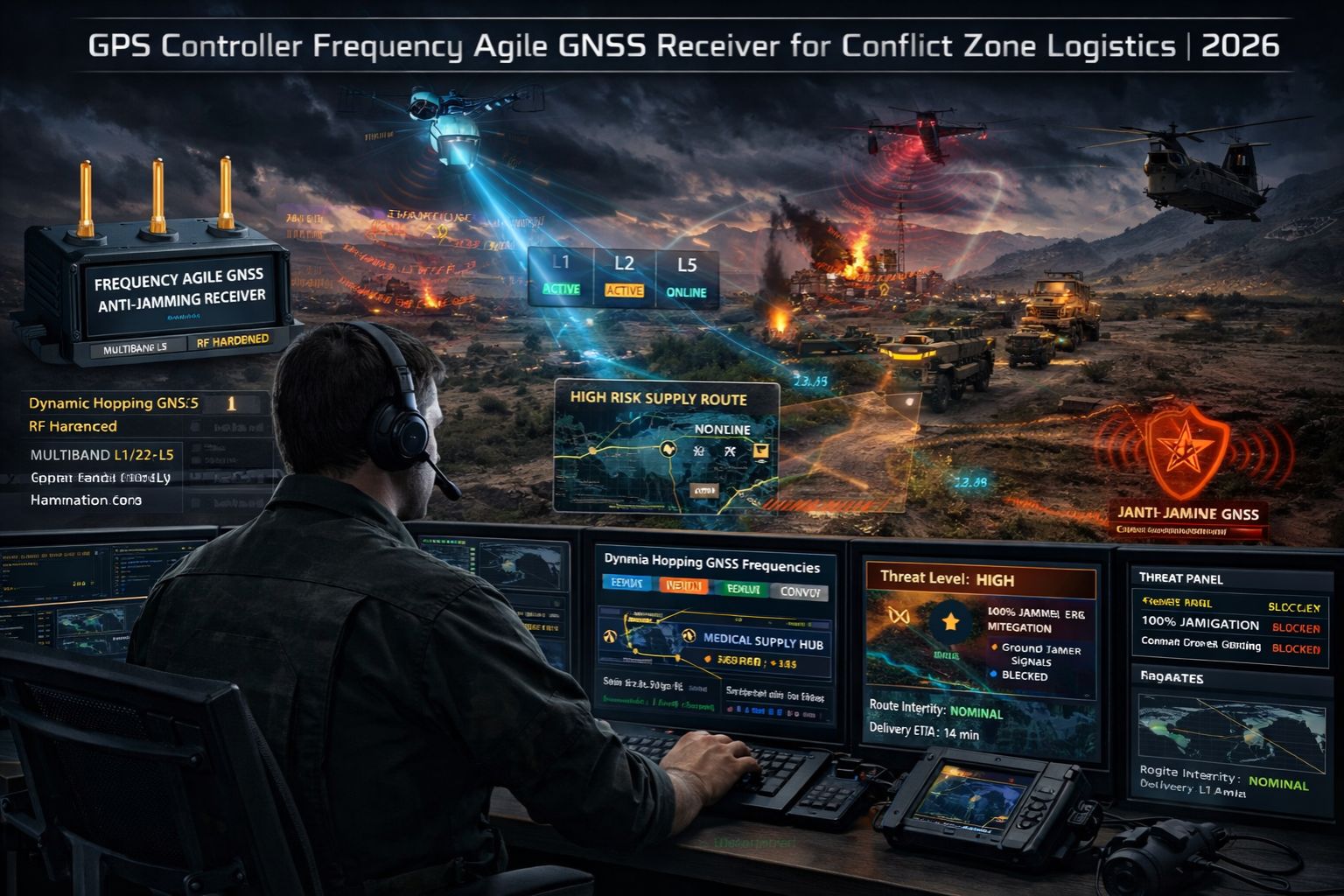
GPS Controller frequency agile GNSS receiver for conflict zone logistics 2026
In conflict zone logistics, a standard GPS tracker becomes a liability the moment its single-frequency signal is jammed or spoofed. Suddenly, a convoy's location and safety status are just gone. The 2026-ready frequency agile GNSS receiver isn't just an upgrade; it's a fundamental shift. It moves from passive tracking to actively fighting for a signal, hopping across L1, L2, and L5 bands to keep a position fix where other devices go completely dark. That changes the problem from "we lost the signal" to "we kept it alive under attack." For routing fuel or medical supplies, that's not a minor detail—it's everything.
What frequency agility means for live convoy tracking
Here, clarity is about signal persistence, not just pin-point accuracy. A standard receiver locks onto the L1 C/A code and fails when that frequency gets flooded with noise. An agile receiver, though, detects the jamming attempt and autonomously switches to another band, like L5. It's a civilian signal too, but it's much harder to disrupt across the board. What you see in practice is a telematics dashboard holding onto a steady, maybe slightly noisier, position stream. Meanwhile, simpler devices in the same convoy are just reporting "GPS lost" and freezing. That creates dangerous, blind spots in the situational awareness for anyone back at the command center trying to make decisions.
The reality of operating at scale in contested areas
Under real pressure, the challenge isn't a one-off jamming event. It's sustained, adaptive electronic warfare targeting the entire positioning, navigation, and timing layer. A fleet manager might watch a group of assets suddenly show impossible routes or all cluster at a single, spoofed location—a classic tactic to misdirect resources. The non-obvious part? Basic frequency hopping can be beaten by barrage jamming across multiple bands. True agility needs onboard smarts to perform signal integrity analysis, to tell real satellite signals from sophisticated fakes. That's a compute task most standard fleet hardware just can't handle.
The critical mistake: treating agility as a simple filter
The most common failure is assuming any "GNSS receiver" with multi-band support is good enough. That confuses hardware capability with intelligent anti-jam and anti-spoof software. A receiver might physically access L2, but if it lacks the algorithms to use it defensively, the feature is useless during an actual attack. This misunderstanding opens up a catastrophic compliance gap: audit logs for sensitive shipments start showing inexplicable routing errors or long stretches of "no data." That invalidates chain-of-custody documentation and exposes the logistics firm to severe liability—a cost that far exceeds just buying the right advanced hardware in the first place.
Decision help: reconfigure, redesign, or replace
Your decision really comes down to the signal threat levels you're facing. You can reconfigure existing multi-constellation devices if their firmware allows you to prioritize signal sources, but let's be honest, that's a stopgap. You'll need to redesign your tracking stack if your current hardware can't do real-time signal authentication; this means integrating an agile GNSS receiver with inertial measurement units for dead reckoning when the signal is totally gone. The choice to replace becomes non-negotiable when you're operating in known contested corridors—where losing a single load costs far more than investing in resilient telematics devices built for this denial environment. An internal fix won't cut it if the threat model includes state-sponsored spoofing; that's when you need specialized systems, like the ones from GPS Controller.
FAQ
Question: How does a frequency agile receiver actually work?
Answer: It's constantly monitoring multiple GNSS frequency bands—L1, L2, L5—checking for signal strength and integrity. When it senses interference or a power drop on one band, its software-defined radio components rapidly retune to grab and track signals on a cleaner band. It's often cross-referencing constellations like Galileo at the same time, which has stronger civilian encryption, all to maintain one continuous position solution.
Question: Can't we just use satellite communicators like Iridium instead?
Answer: Satellite comms are for data backhaul, not precise positioning. They tell you a message was sent, not the truck's exact coordinates. For actual routing, geofencing high-risk areas, and proving you stuck to approved corridors, you still need resilient GNSS positioning. The two systems work together; one doesn't replace the other.
Question: What's the biggest risk if we get this wrong?
Answer: The highest risk is making decisions based on lies. If a receiver is spoofed, your dashboard could show a convoy safely parked when it's actually being hijacked and diverted. That delays any emergency response, violates sanctioned routes, and can lead to losing both assets and people. The financial and reputational damage from that is pretty much irreversible.
Answer: The line is when your standard tracking fails more than once on a critical run. If you're already layering geofencing alerts with secondary data checks and you're still hitting data blackouts, then your hardware is the weak link. At that point, upgrading to a purpose-built agile receiver isn't an IT cost—it's a core operational security requirement for doing logistics in 2026.


Comments
Post a Comment