GPS Controller for Ras Al Khaimah industrial fleet 2026
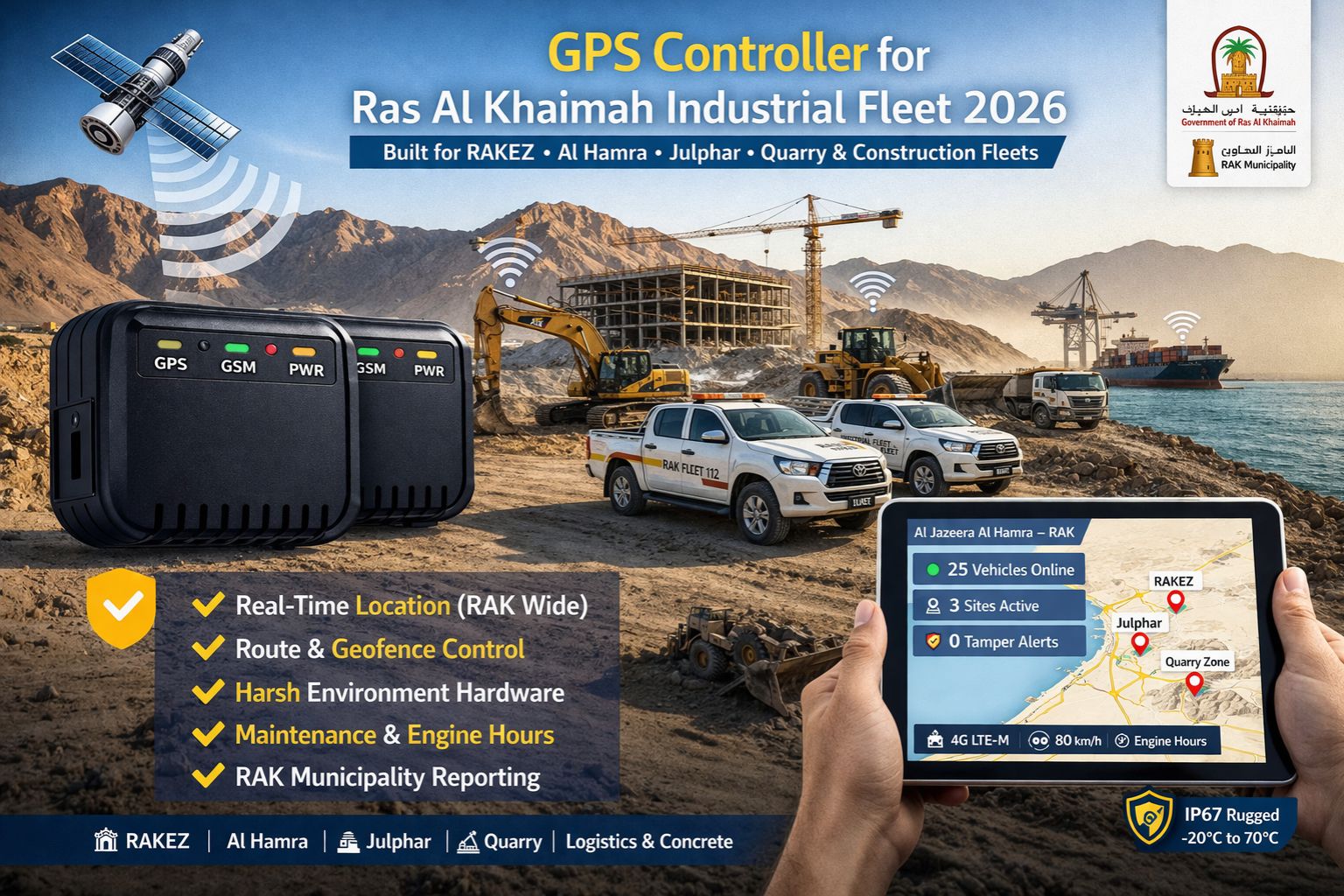
GPS Controller for Ras Al Khaimah industrial fleet 2026
So your Ras Al Khaimah industrial fleet—hauling aggregates from quarries or moving machinery between sites—starts showing vehicles as idle when their engines are clearly running. It's easy to dismiss it as a map glitch, but that's not what this is. This is the actual, daily reality of GPS signal delay. The harsh terrain and dense industrial zones here create a data lag that breaks real-time tracking. It delays those critical geofence alerts, and honestly, it puts your entire 2026 compliance logbook at risk.
What GPS signal delay means for Ras Al Khaimah fleets
Let's be clear: this isn't just a slow map refresh. It's that 90 to 120-second gap between a dump truck actually leaving a quarry gate and your system finally registering the movement. In the RAK corridor, where site access is tightly controlled and driver hours are audited, this delay is crippling. Your geofence exit alerts arrive after the vehicle is already merging onto the highway. You end up managing historical data, not a live operation. That completely invalidates the whole point of having real-time fleet control in the first place.
The real-world failure at scale
The real problem shows up during shift changeovers across multiple sites. Picture this: when 30 or more heavy vehicles all try to transmit location pings at once, the network congestion near industrial hubs like Al Ghail or the cement plants introduces signal jitter. The system gets timestamps completely out of sequence, which causes route replay errors in your compliance reports. You might see a vehicle at point B before it was ever at point A. That creates unexplainable stops that get flagged in safety audits, and it renders your fuel consumption data useless for hitting those 2026 efficiency targets.
The critical mistake in device configuration
Here's the most common misunderstanding: everyone blames the GPS satellite and thinks buying more expensive hardware is the fix. But the failure pattern is usually in the device's own reporting logic. It's often configured for battery saving or to reduce cellular costs, so it transmits data in batches. In RAK's variable coverage zones, these batches get held up and then dumped all at once, creating a false "real-time" spike. Operators see this and think the system is recovering, when it's actually a critical data integrity failure. The problem just escalates quietly until a delivery window is completely missed or a security perimeter alert never triggers.
When to tune, reconfigure, or replace your tracking setup
This is where you have to draw the line. You can probably *tune* the reporting intervals if the delays are under two minutes and at least consistent. But you'll need to *reconfigure* the entire device fleet's communication protocol if jitter is causing out-of-order data. However, if the core issue is that your current platform simply can't process the high-frequency, low-latency data needed for RAK's 2026 industrial traffic density, then you're facing a *replace* decision. Internal fixes won't cut it when the telematics architecture itself can't prioritize a movement alert over a routine status update. That's the boundary where a specialized gps controller platform shifts from being an optional upgrade to an operational necessity.
FAQ
Question: How much GPS delay is normal for Ras Al Khaimah industrial areas?
Answer: A normal delay is maybe 30-45 seconds. If you're seeing consistent delays over 90 seconds, especially around Al Hamra or the mountain quarries, that points to a system or network configuration failure. It's not just a weak signal anymore.
Question: Can delayed GPS data affect driver payroll and compliance?
Answer: Absolutely it can. If clock-in/out is based on geofences and those alerts are delayed, driver logs will show incorrect working hours. That creates direct violations against the UAE's 2026 transport safety and working hour regulations.
Question: Will a stronger cellular signal booster fix tracking delays?
Answer: Often, no. Boosters amplify a signal, but they don't fix the data packet scheduling. The bottleneck is usually in the device's own firmware or the server's processing queue, not the raw signal strength.
Question: When should a fleet manager in RAK consider replacing their entire GPS tracking system?
Answer: When delayed or out-of-sequence data causes weekly audit flags, or when geofence alerts for site security are consistently failing. At that point, trying to patch an outdated system becomes more costly than moving to a platform actually designed for modern industrial telematics density.


Comments
Post a Comment