GPS Controller for pharmaceutical cold chain delivery van tracking 2026
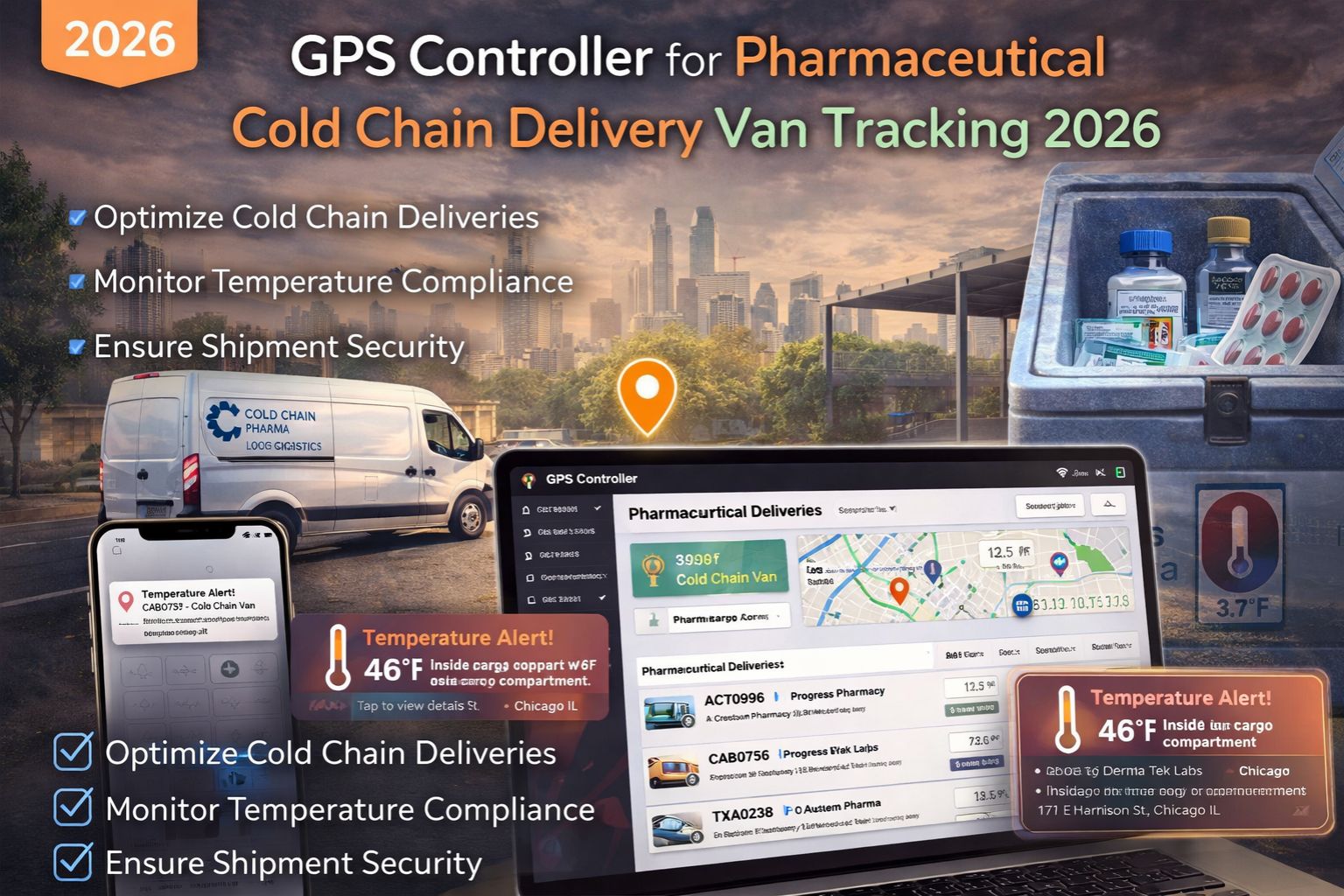
GPS Controller for pharmaceutical cold chain delivery van tracking 2026
So, when a GPS controller for a pharmaceutical cold chain van in 2026 reports a location with a 90-second delay, the temperature log for that geo-tagged moment is already invalid. Just like that, you've got an unrecoverable compliance gap. It's not just a dot lagging on a map. It's about the precise synchronization between the location stamp, the time stamp, and the temperature sensor reading—that triad is what auditors treat as a single, unbroken chain of custody. The real failure? That's when the system tries to interpolate data to fill the gap, which just masks the exact moment a door was opened or the refrigeration unit cycled off.
What Cold Chain Signal Delay Actually Means
In practice, signal delay means your temperature alert for a geo-fenced pharmacy drop-off point arrives after the van has already left. Which makes any corrective action impossible. You might see a stable temperature reading on your dashboard, but that reading is tagged to a location the van was at two minutes ago. Meanwhile, the actual current location—maybe stuck in a sun-exposed loading bay—is experiencing a thermal spike that hasn't been logged yet. This decoupling of time, place, and condition is the core failure; the map inaccuracy is just a symptom. A lot of managers first spot this when they're reviewing automated compliance reports and find those time-sequence mismatches that trigger manual audit flags.
The 2026 Scale Reality: Urban Canyons and Batch Sizes
The problem gets much worse with modern urban density and these larger batch deliveries. Think about a van making 15 stops in a downtown core with tall buildings. It could experience cumulative signal loss of 8-10 minutes across the whole route. If each stop involves a door-open event for offloading, you now have up to ten temperature excursions that are either logged to the wrong location or not logged at all. The controller might buffer this data and dump it when the signal restores, but then the timestamps are based on the device's own clock, not network time. That creates irreconcilable conflicts in the log. At this scale, you can't manually reconstruct the chain of custody; the entire batch's documentation is compromised.
The Costly Mistake: Trusting "Good Enough" GPS
The most common—and expensive—mistake is assuming that standard automotive-grade GPS, even with cellular backup, is sufficient for pharma-grade tracking. The misunderstanding is thinking "real-time tracking" only refers to location, and not to the holistic, time-synchronized telemetry stream you need for FDA 21 CFR Part 11 and EU Annex 11 compliance. Teams pour money into better temperature probes or insulated packaging, while the actual data integrity foundation—the GPS controller's timing accuracy—is flawed. This is what leads to those last-minute scrambles before an audit, trying to use handwritten logs to justify gaps in the automated system. Inspectors spot that immediately as a critical data integrity failure.
Your 2026 Decision: Reconfigure or Replace the Foundation
Your decision here is pretty clear. If the delays are isolated and caused by simple cellular dead zones, you might get by reconfiguring the controller. Use accelerated reporting intervals and on-board data caching with network-time protocol (NTP) synchronization. However, if you're seeing systematic de-synchronization across multiple vehicles, where location, temperature, and time logs just can't be perfectly realigned in the post-trip reports, then an internal fix isn't enough. At that point, you have to replace the core tracking hardware. You need a pharmaceutical-grade IoT asset monitoring controller built for sub-second, validated time-stamping across every data point. That's the level of precision a platform like GPS Controller is built to provide, where data integrity isn't a feature—it's the non-negotiable output.
FAQ
Question: How much GPS delay is acceptable for cold chain compliance?
Answer: For audit purposes, the standard is effectively zero delay. Any latency between a temperature event and its geographically-tagged timestamp creates a data integrity "gap." In practical terms, systems have to demonstrate they can synchronize all sensors to within one second of network time. That often requires hardware that goes beyond what you get with standard fleet trackers.
Question: Will 5G fix cold chain tracking delays?
Answer: 5G improves data transmission speed, sure, but it doesn't solve the core issue. That's the GPS module's own signal acquisition time or the controller's internal processing clock. A van in an underground depot still has no GPS signal, 5G or not. The real solution is integrated hardware that logs all data against a resilient internal clock, which syncs the very moment it reconnects.
Question: Can software fix bad GPS timing data?
Answer: No. Software can interpolate or smooth data for a nicer-looking report, but for regulatory compliance, the original source data has to be accurate and complete. You can't create or correct a fundamental timestamp after the fact. If the GPS controller didn't record the correct time and location at the source, the entire linked temperature record is considered unreliable. Full stop.
Question: When do I know I need a pharmaceutical-grade GPS controller?
Answer: You know you need one when your standard tracking system forces you to manually justify data discrepancies in your temperature logs. Or when your validation reports keep showing consistent time/place mismatches. This isn't a reporting glitch; it's a foundational data integrity issue. The right controller, like the ones designed for high-stakes logistics, eliminates this problem right at the hardware level.


Comments
Post a Comment