GPS Controller for personal safety lone worker tracking 2026
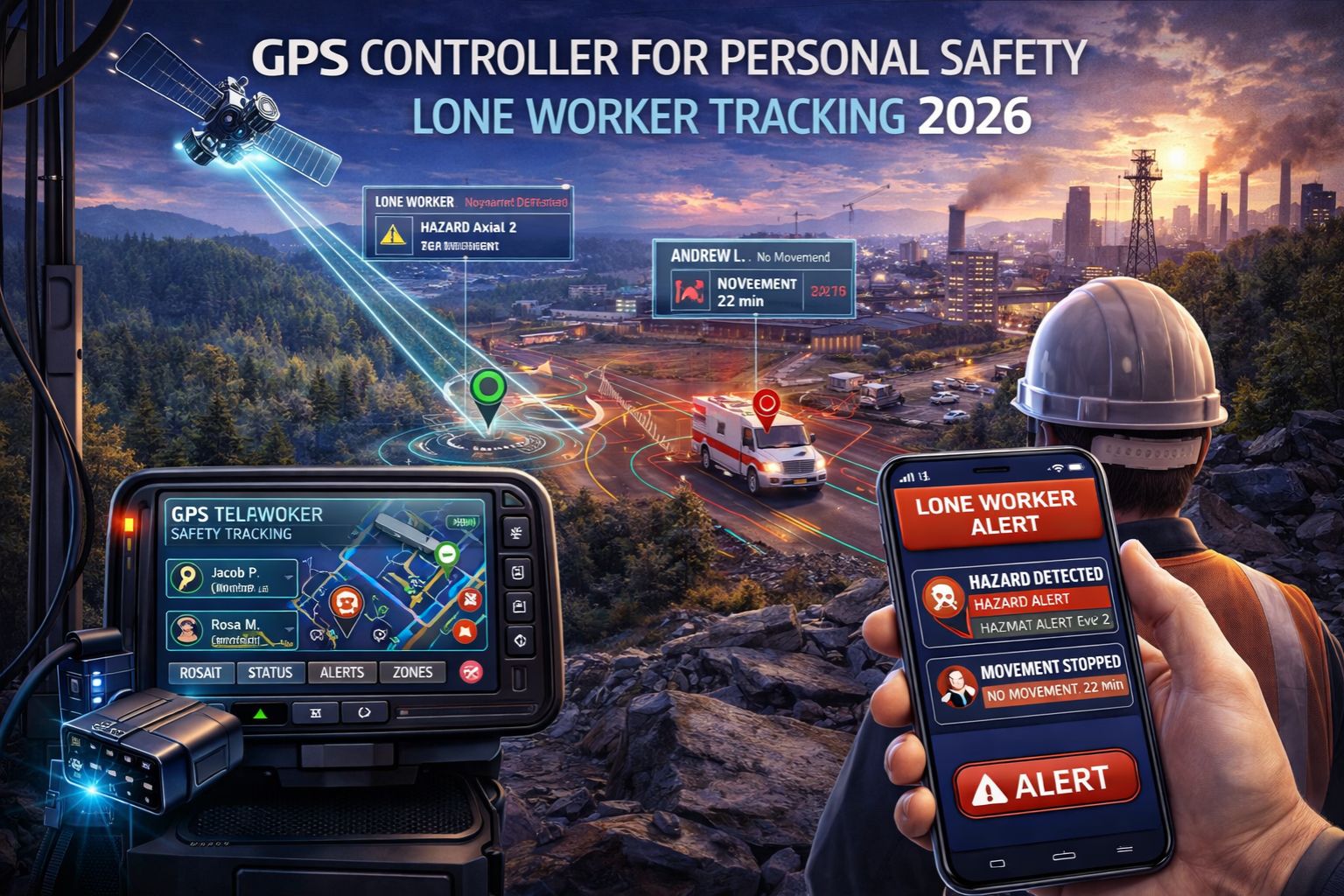
GPS Controller for personal safety lone worker tracking 2026
When a lone worker hits their SOS button in 2026, the GPS Controller managing their safety device really has just one job: get that precise location and alert to a monitoring center with zero delay. But honestly, the failure point isn't the button press itself. It's that whole chain—the signal handoff between the worker's wearable, the cellular network, and the central FleetManagementSoftware dashboard that's supposed to dispatch help. A two-second lag in a warehouse is one thing; out on a remote utility site, it changes everything.
What Lone Worker Safety Tracking Really Means in 2026
It's easy to call it a dot on a map. It's not. It's a continuous, encrypted data stream mashing together GPS location, motion sensor data for fall detection, maybe heart rate, and regular "check-in" pings. The GPS Controller has to process all that, figure out if someone just stumbled or actually fell, and keep a live session open even when the worker dips in and out of cell coverage—which means leaning on satellite or mesh network backups. What people often miss is the signal jitter in places like stairwells or basements. That's what can cause a critical "man down" alert to just sit in a queue instead of screaming to the front of the line.
The Reality of Deploying at Scale
Try to picture managing 500 lone workers across different time zones and terrains. You're not tracking 500 dots. You're managing 500 independent, real-time data sessions, each with its own battery life, network carrier, and alert thresholds. One common failure pattern? Alert fatigue at the monitoring center, caused by too many false positives from bad threshold calibration—like a worker setting their device down too hard and triggering a fall alert. The less obvious detail is power management: if the controller polls for location too aggressively, it can drain the wearable's battery before the shift even ends, leaving the worker unprotected.
Where Most Safety Programs Fail
The biggest mistake is treating lone worker tracking like you'd track a pallet or a truck. Assets don't panic. They don't move erratically during an incident. Their batteries don't die in the middle of an SOS event. There's also a major misunderstanding about "real-time." It doesn't mean the same thing everywhere. In urban canyons, GPS multipath error can put a worker 50 meters away from where they actually are, which delays rescue. The real boundary condition is dense industrial facilities; metal structures can block signals completely, making GPS useless. That forces a switch to less-accurate Bluetooth beacon or WiFi triangulation, and a lot of systems just aren't set up to prioritize that data when it matters.
Choosing Your 2026 Safety Infrastructure
Your decision comes down to this: tune, reconfigure, or replace. You can *tune* things—adjust alert thresholds and check-in frequencies on your current platform. You can *reconfigure* the whole system to use hybrid location (GPS + WiFi + Bluetooth) and redundant cellular carriers. But you have to *replace* the core GPS Controller if it can't maintain sub-10-second alert latency when the signal is poor, or if it lacks true two-way communication to confirm an SOS. You know you've hit the boundary when your internal IT team is constantly building workarounds for geofence alerts that fire hours late, or for SOS messages that get stuck in a data queue. At that point, the system isn't a safety tool anymore; it's a liability. A modern platform, like gps controller, is actually engineered for that zero-failure tolerance.
FAQ
Question: How accurate is lone worker GPS tracking indoors?
Answer: Standard GPS basically fails indoors. Accurate systems for 2026 use a hybrid approach. They blend the last-known GPS fix with indoor positioning from WiFi, Bluetooth beacons, and even motion sensor dead reckoning to get a location within a building. The accuracy can still swing pretty wildly though, from 5 to 30 meters.
Question: What happens if a lone worker loses cellular signal?
Answer: A robust safety device will store alert events locally and send them the instant any sliver of signal comes back. The best systems go further—they might have a satellite SOS backup (like GNSS) or can even hop an alert through a nearby coworker's device using a mesh network, to prevent a total communications blackout.
Question: Can management track a worker's location all the time?
Answer: Technically, yes, the capability is there. But privacy and compliance are huge here. Ethical programs usually don't. They typically rely on periodic check-ins (say, every 10 minutes) or only switch on continuous tracking during an active SOS alert or if a worker misses a scheduled check-in. It's about balancing safety with privacy.
Question: When is it time to upgrade our lone worker safety system?
Answer: You should seriously consider an upgrade if you're seeing repeated SOS delays, if devices keep dying before a shift ends, or if your reports can't prove compliance for an audit. Here's a clear sign: if your team is manually checking logs because the automated alerts can't be trusted, then the system itself has become a safety risk.


Comments
Post a Comment