GPS Controller for mining and metals heavy equipment tracking 2026
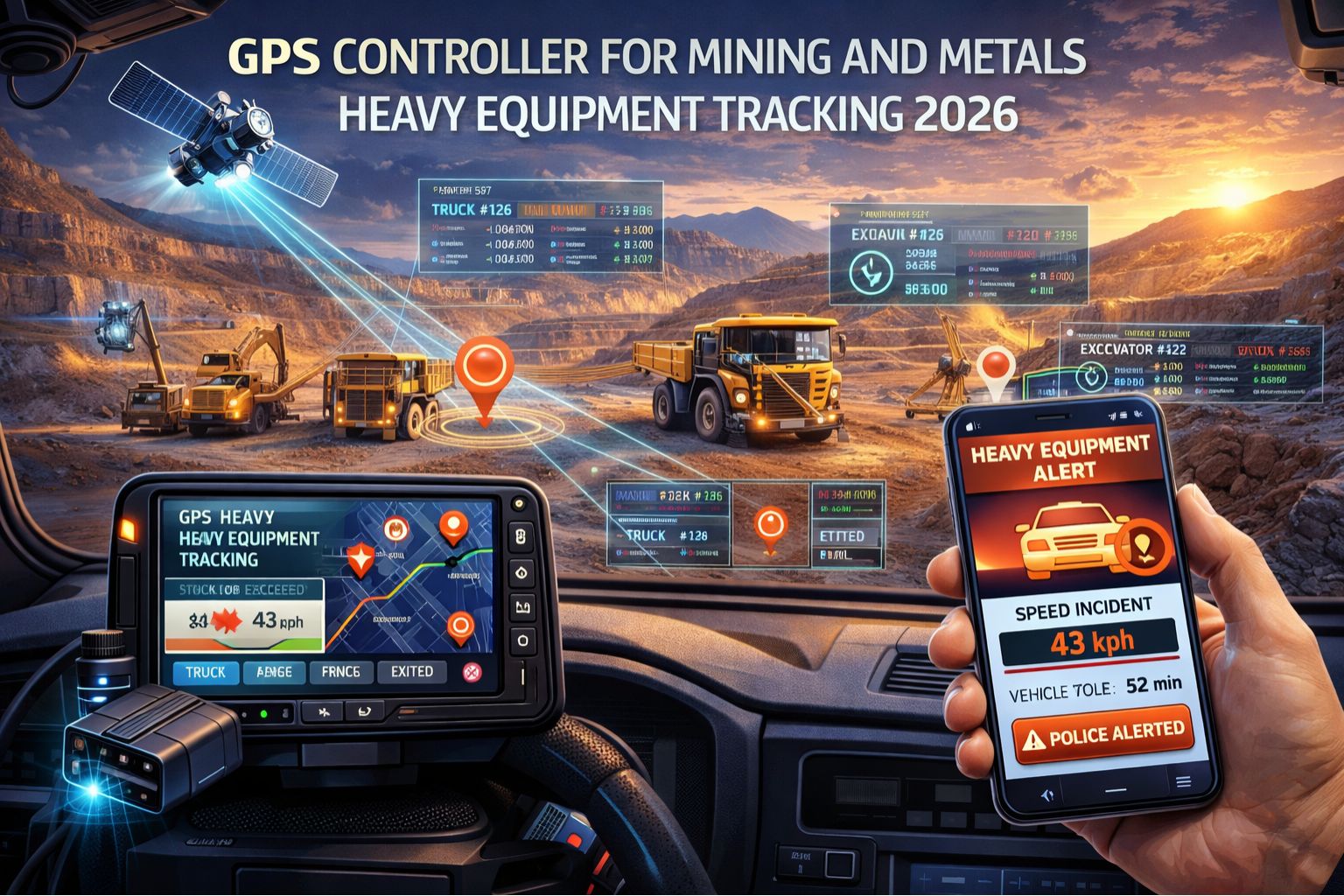
GPS Controller for mining and metals heavy equipment tracking 2026
When your GPS controller for mining and metals heavy equipment shows a location update, that data is already delayed. It creates this dangerous operational blind spot where a 100-ton haul truck could be in a geofenced exclusion zone without triggering an alert in time. This signal latency isn't just a blip; it's a compounding error. In environments where deep pits, steel structures, and remote sites degrade satellite fixes, real-time tracking turns into a historical log that fails its primary safety and productivity mandate. The gap between the timestamp on your fleet management dashboard and the machine's actual position—that's where compliance audits fail and preventable incidents begin.
What GPS Signal Delay Really Means on a Mine Site
On a live mine site, GPS delay means your dispatch team sees a loader as "idle at the crusher" for 15 minutes. In reality, it's been moving slowly in a blind corner for the last 12 of those minutes, creating a near-miss risk your system can't warn you about. The non-obvious detail? The delay often isn't constant. It's a jitter caused by the equipment's own metal frame and engine interference, combined with the controller's processing queue. It gets worse during shift changes when dozens of assets report at once. This isn't a simple connectivity issue; it's a systemic data integrity failure that has you making critical operational decisions based on stale information.
The Real-World Scale Problem in 2026
Under real operational scale, the failure pattern escalates. It goes from single-asset latency to a cascading data collapse. You might have 50 pieces of heavy equipment reporting, but the delay causes their reported routes to overlap virtually on your map, masking actual congestion at the pit exit. A common misunderstanding is that upgrading to a "faster" GPS module solves it. But the bottleneck is often the telematics gateway's ability to timestamp and queue data before transmission over a stretched private LTE network. You hit the boundary condition during peak blasting or haul cycles, when the system's designed latency threshold is exceeded. That's when geofence alerts arrive 30 seconds after an excavator has already left a designated safe zone.
The Costly Mistake: Assuming It's Just a "Lag"
The most expensive risk is treating GPS signal delay as an inevitable "lag" rather than a critical failure of the tracking system's core promise. Fleet managers often try to compensate by manually adding buffer times to schedules, which only institutionalizes the inaccuracy. It hides the growing compliance gap in maintenance logs and safety reports. This wrong assumption leads to escalating costs. Decisions about fuel allocation, preventive maintenance, and operator hours get based on erroneous engine idle times and location histories. That directly impacts profitability and regulatory reporting for things like emissions and hours of service.
Your 2026 Decision: Tune, Reconfigure, or Replace
Your decision boundary is pretty clear. If delay is isolated to specific deep-pit or indoor maintenance bay locations, you can tune reporting intervals and maybe augment with secondary sensors. If the delay is network-wide and affects compliance reporting, you have to reconfigure the entire data pipeline, including the telematics hardware and its integration with your central fleet management software. But if the latency is baked into the controller's architecture and creates consistent blind spots in safety-critical zones, internal fixes just aren't enough; you're in a replace scenario. Choosing to continue with a system that can't provide truthfulness at scale is a choice to accept operational and compliance risk. It's a threshold no modern mining operation can afford by 2026.
FAQ
Question: How much GPS delay is normal for mining equipment?
Answer: In open-pit mining, a 5-10 second delay might be considered "normal." But any latency over 15 seconds, especially for assets moving in high-traffic or safety-sensitive areas, that constitutes a tracking failure. It requires immediate investigation into the GPS controller and the network backend.
Question: Can better antennas fix heavy equipment tracking delay?
Answer: High-gain antennas can improve signal acquisition, sure. But they don't address the processing and transmission delay within the telematics unit itself. If the controller's firmware or cellular modem is the bottleneck, a new antenna only gives you a marginal, often temporary, improvement.
Question: Why does GPS delay cause compliance issues?
Answer: Regulations for equipment operation, driver rest periods, emission idling—they often require timestamp-accurate logs. A consistent delay creates an un-auditable discrepancy between the machine's actual activity and the digital record. That opens the operation up to violations and fines.
Answer: The decision to replace hinges on whether the delay creates "unknowable" periods in your operational timeline. If you can't trust the system's data for post-incident analysis or real-time safety alerts in specific, repeatable scenarios, then tuning is a waste of resources. You need a system architected for deterministic latency. That's a core principle for any modern GPS controller in heavy industry.


Comments
Post a Comment