GPS Controller for e-commerce last mile delivery UAE 2026
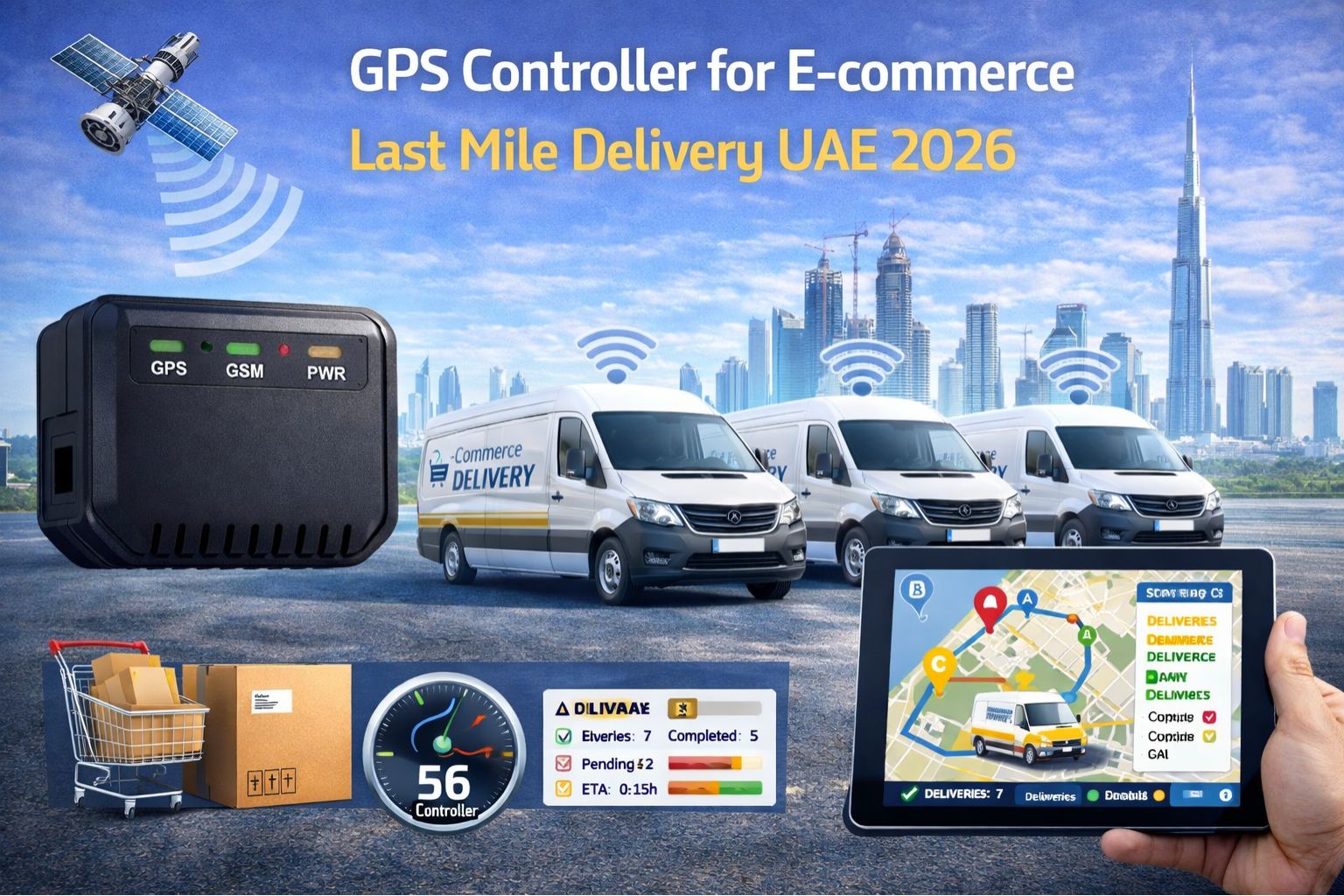
GPS Controller for e-commerce last mile delivery UAE 2026
In the dense urban canyons and sprawling suburbs of the UAE, a GPS controller isn't just a tracking tool—it's the central nervous system for e-commerce last-mile delivery. It's what manages that critical gap between a warehouse dispatch and a customer's doorstep, where signal latency doesn't just mean a delay, it directly translates to failed deliveries and lost revenue.
What GPS Control Means for UAE's Last-Mile Fleets
For a fleet manager in Dubai or Abu Dhabi, control means seeing a driver stuck in Marina traffic with five perishable orders, not just as a delayed pin on a map. It's seeing a live data stream that shows the van's internal temperature is actually rising, while the system knows the next geofence alert is already queued to fail. All because of that cellular network handoff lag between towers that basic tracking just glosses over.
The 2026 Reality: Scale Breaks Basic Tracking
When you're under real operational scale—hundreds of vans making thousands of stops daily—the whole assumption of "real-time" tracking just collapses. You end up with drivers marked 'idle' at a mall loading dock for 20 minutes because the GPS signal is blocked. And your system, if it lacks controller-level logic, completely fails to correlate the still-running engine telemetry with the lost location fix. So you get phantom idle time that totally destroys your route efficiency metrics, and you're making decisions based on a fiction.
The Critical Mistake: Treating GPS as a Simple Tracker
The most common failure pattern is just treating the GPS device as a simple reporter, not a controller. And that leads to a critical misunderstanding: thinking a delayed location update is just a "blip." In reality, it's a cascading failure. A 90-second signal delay in a dynamic routing environment can mean a dispatcher reassigns an order that's already been delivered. So you send a second driver on a futile trip, while the first driver's proof-of-delivery photo is just stuck in a local device buffer, waiting for a stable IoT connection to finally sync.
Your 2026 Decision: Tune, Reconfigure, or Replace
The decision boundary is pretty clear. You can try to *tune* things—adjust thresholds for geofence alerts, play with data transmission intervals. You can *reconfigure* the entire telematics workflow, maybe to prioritize delivery confirmation packets over less critical engine data. But when your fleet's density and delivery windows start demanding sub-30-second accuracy across shifting urban canyons, and your current system can't process cellular/Wi-Fi handoff logic locally on the device... then internal fixes just won't cut it. You hit a hard boundary. That's where you have to *redesign* the data flow with a true GPS controller architecture that makes decisions at the edge, or *replace* those passive tracking units with active control-capable hardware.
FAQ
Question: What is the biggest GPS issue for last-mile delivery in UAE cities?
Answer: Honestly, it's signal multipath and blockage in the high-rise areas—the "urban canyon" effect. It makes location data jump or freeze, which kills live ETA reliability. You end up with geofence alerts for apartment complexes firing way too late, after the driver has already left.
Question: How does GPS delay affect customer delivery promises?
Answer: It creates a domino effect. A delayed location update forces your routing software to use stale data, which generates inefficient next-stop assignments. This silently burns through driver time and fuel, so the later deliveries inevitably miss their promised windows. That's what triggers the customer complaints.
Question: Can better software alone fix last-mile tracking problems?
Answer: No, it really can't. The software is only as good as the data feed from the hardware. If the GPS device itself can't maintain a fix or intelligently buffer data during signal loss, then even the best fleet management software is working with corrupted, delayed information. You're just making better decisions with bad data.
Question: When should a logistics manager consider a full GPS system redesign?
Answer: A few clear signs: when delivery failure audits keep tracing root causes back to data latency (not driver error), when your drivers are consistently bypassing system routes because they know the data is old, and frankly, when the cost of those failed deliveries starts exceeding the investment in a system with true controller logic. That's when you need a dedicated gps controller platform that manages data integrity right at the source.


Comments
Post a Comment