GPS Controller for cab driver tracking with trip history report 2026
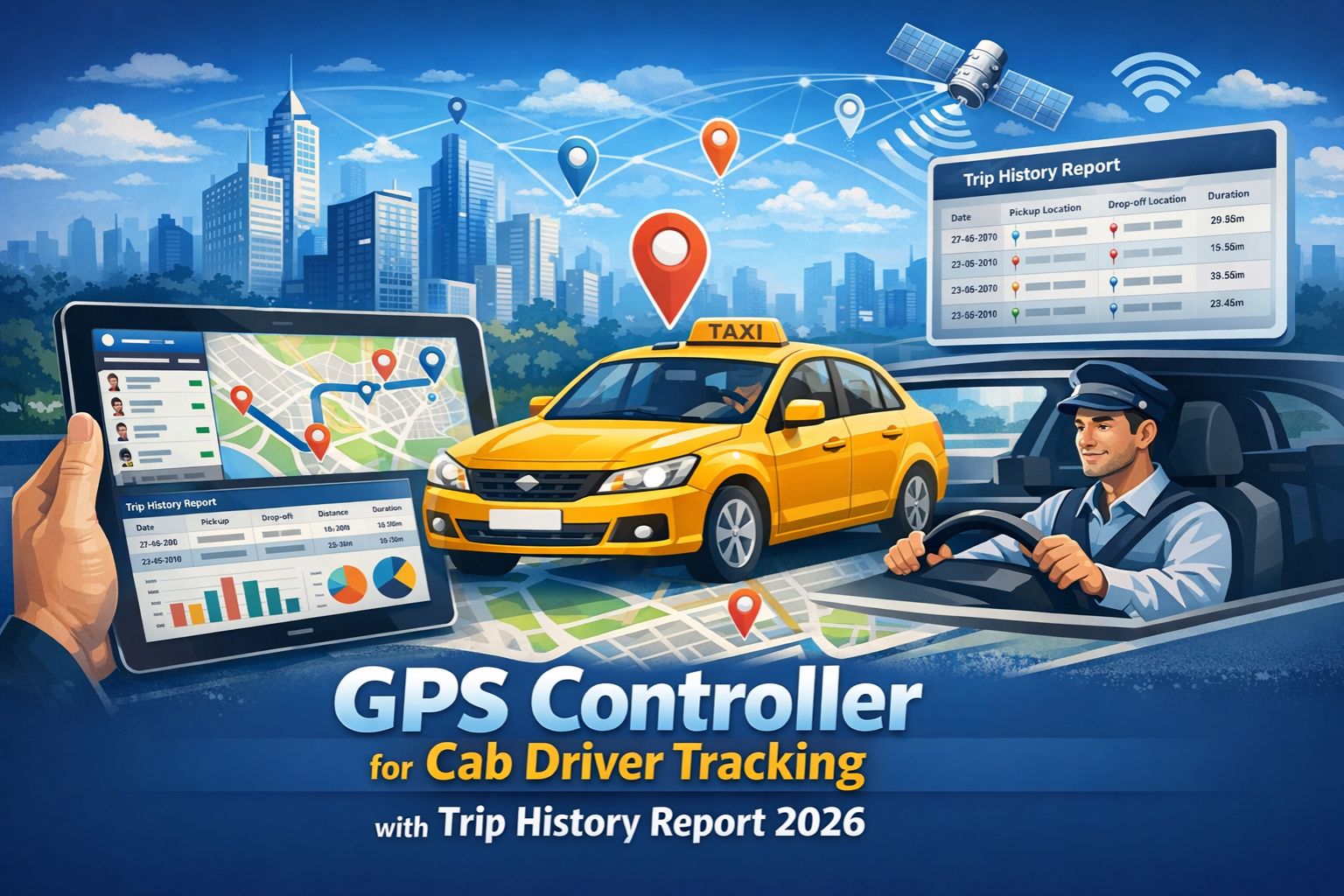
GPS Controller for cab driver tracking with trip history report 2026
In 2026, a GPS controller for cab driver tracking isn't just about dots on a map; it's the central system that stitches together trip start/stop times, route deviations, and passenger drop-offs into a legally defensible trip history report. The real fleet observation—the one that actually matters—is seeing a driver's log show a 22-minute trip, but the passenger's receipt and payment system timestamp show 35 minutes. That creates an immediate billing and wage dispute that needs manual reconciliation. This gap isn't usually a glitch. More often, it's a sign of the controller struggling with urban canyon signal loss or failing to properly hand off between cellular and GPS data streams. When that happens, it corrupts the trip's digital audit trail right from the outset.
What Trip History Reporting Really Means for Cab Fleets
A trip history report is the consolidated record of a fare's lifecycle. It's mandated for compliance, sure, but it's also essential for basic operational clarity. It links the GPS ping at pickup, the route taken, any idle time at stops, and the precise geofenced drop-off location. The non-obvious detail, the one that gets missed, is the dependency on the controller's internal clock. It has to sync perfectly with the vehicle's ignition and the payment terminal. If these clocks drift by even seconds over weeks, trip sequences become totally misaligned. It can look like a driver started a new fare before the previous one ended. This isn't just inaccurate data—it's evidence that wouldn't hold up in a regulatory audit or a driver commission dispute. It puts the entire fleet management software integrity in question.
The Reality of Scale and Data Corruption in 2026
At scale, with hundreds of cabs generating thousands of trips daily, the comfortable assumption that "all data is captured" just collapses. Controllers under heavy I/O load from constant geofencing alerts and real-time tracking can start to prioritize the live location feed over historical log integrity. You'll see trips with correct start and end points but missing mid-route pings. That makes it impossible to reconstruct the actual path taken for a customer complaint or an insurance claim. The real boundary condition is network congestion during peak hours. The controller's buffer fills up, and it starts discarding what it sees as lower-priority telemetry—often those intermediate trip events—just to preserve the live connection. Those gaps in the history are then irreversible.
The Costly Mistake: Treating It as a Simple Log Viewer
The most common misunderstanding—the one that causes real escalation—is treating the trip history module as a passive log viewer. It's not. It needs to be an active, integrated reporting engine. Operations managers often assume missing data is just a "sync issue" that will resolve itself. But in 2026's architectures, if the controller doesn't timestamp and encrypt the trip event right at the source, it's lost forever. This mistake leads to trying to backfill reports from secondary sources like payment gateways. The problem is, those sources lack the granular location and event data you need for true trip reconstruction. The result is flawed business intelligence and driver disputes that never get resolved.
Your 2026 Decision: Patch, Reconfigure, or Replace
Your decision boundary is pretty clear. If trip histories are missing 5% or more of intermediate events, or have consistent clock-drift errors, patching the software isn't going to work. You can try to reconfigure the controller's data transmission priorities, making sure trip event logging takes precedence over non-critical alerts. But if the hardware or firmware itself can't support atomic logging—where each trip event is written as an immutable, time-stamped block—then you've hit the limit of internal fixes. At that point, the choice is stark. You either redesign the whole data pipeline with a modern platform, or you replace the controller units with devices actually built for 2026's demand for audit-ready telemetry. That's where solutions like gps controller are designed for this exact forensic-level reporting.
FAQ
Question: What is the most important feature in a GPS controller for cab trip reports?
Answer: Atomic logging. It's non-negotiable. Each trip event—pickup, route point, stop, drop-off—has to be recorded as a single, unchangeable unit with a synchronized timestamp the exact moment it happens. Not batched and sent later. That's what prevents data loss during signal dropouts.
Question: Can old GPS trackers provide compliant trip history for 2026 regulations?
Answer: Unlikely. Older devices often just lack the processing power and secure memory to perform atomic logging and maintain that critical clock sync with external systems like payment terminals. That's what leads directly to the report gaps and inaccuracies that trigger compliance failures.
Question: How does signal loss in cities affect my trip history report?
Answer: A robust controller won't just log "no signal" and give up. It should use dead reckoning and sensor data—like ignition status and odometer readings—to infer and log probable route segments during the outage. Then it annotates them clearly in the report for a complete, even if estimated, trip reconstruction.
Question: When should a fleet manager decide to replace their GPS controllers for reporting?
Answer: When reconciling driver logs, customer receipts, and GPS reports becomes a daily manual task. Or when preparing for an audit requires you to manipulate the data to make it coherent. That's a core system failure. At that stage, the investment needs to shift from constantly fixing reports to installing a controller system where the report itself is the primary, trustworthy output.


Comments
Post a Comment