GPS Controller EV battery health degradation monitoring software 2026
GPS Controller EV battery health degradation monitoring software 2026
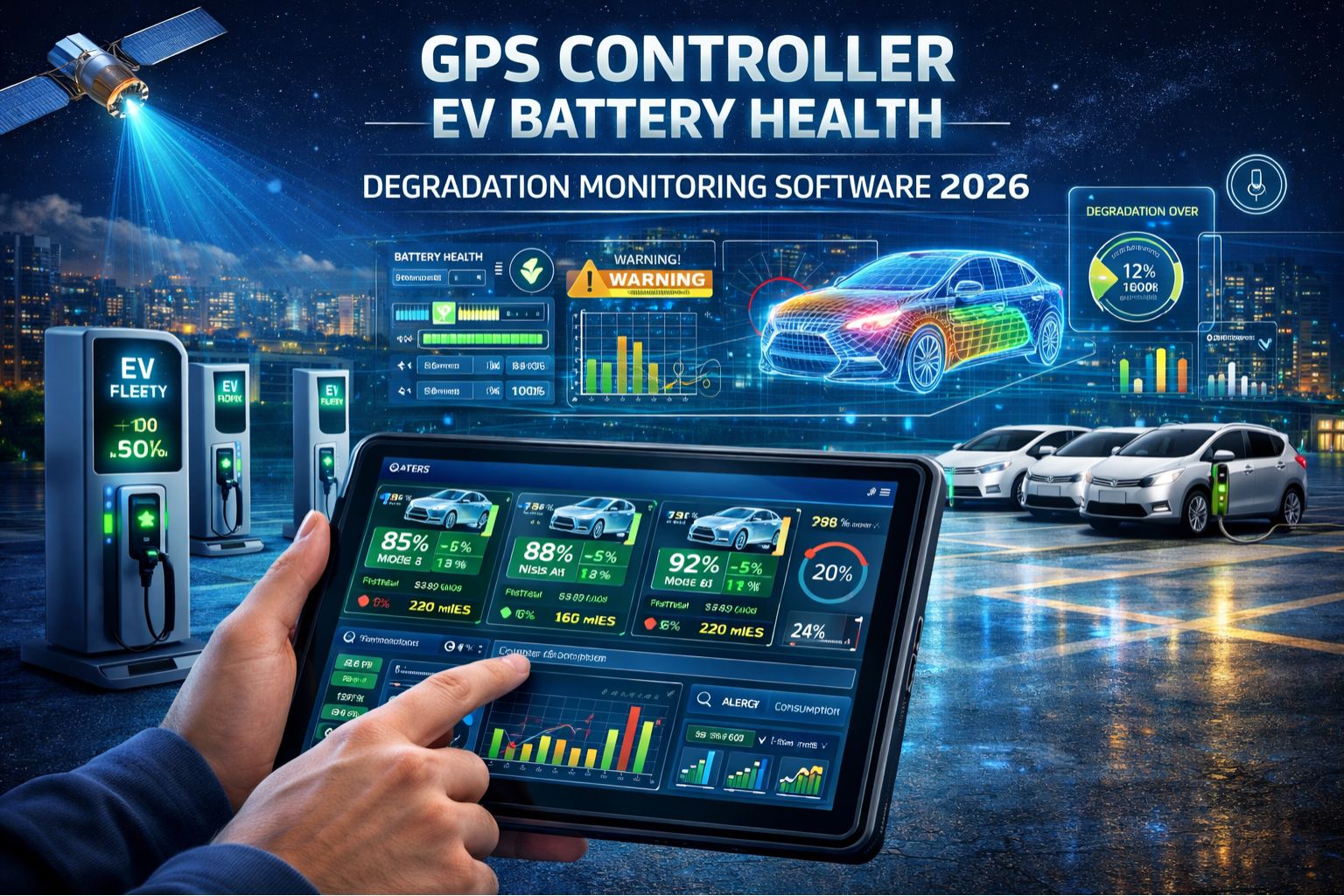
When your EV fleet's reported range starts dropping faster than the maintenance schedule predicts, you're not just looking at a data point—you're staring down a cascade of missed deliveries, stranded vehicles, and warranty disputes. The 2026 monitoring software from GPS Controller moves beyond simple state-of-charge readings to track the silent killers: cumulative thermal stress from fast-charging cycles and the irreversible capacity fade that rewrites your route planning overnight. Honestly, this isn't about watching a battery percentage; it's about predicting which vehicle will fail its assigned route next Thursday.
What EV Battery Health Monitoring Really Means for Fleets
For a fleet manager, battery health monitoring is the difference between a vehicle being an asset and a liability. It's the software that finally connects the dots, like correlating a driver's habitual 95% fast-charge with a specific cell group's rising internal resistance—a detail completely invisible on a standard dashboard. This granularity is what actually explains why two identical models on the same route show wildly different degradation rates. The real signal isn't the overall health score; it's the deviation pattern of individual battery modules, which often flags a cooling system issue long before a diagnostic code is triggered. This depth of insight is critical if you want reliable RouteOptimization that accounts for actual, not theoretical, vehicle capability.
The Reality of Scale: When Fleet-Wide Degradation Hits Operations
At scale, degradation isn't linear or uniform. You might see a cluster of vehicles from a specific procurement batch all hitting a 15% capacity threshold within the same quarter, which suddenly renders a whole segment of your fleet unable to complete their standard loops without a mid-day charge. The operational reality is a frantic reshuffling of assets and drivers. The non-obvious trigger? It's often a shared firmware version or a common charging infrastructure that applies uneven load. When this happens, generic fleet management platforms will show all vehicles as "operational," while specialized monitoring shows you an impending collapse of schedule adherence, directly impacting delivery compliance logs.
The Costly Mistake: Relying on OEM Dashboards Alone
The most common and expensive mistake is assuming the vehicle's built-in telematics provides sufficient battery health data. The truth is, OEM systems are designed for consumer warranties, not fleet depreciation forecasting. They often average out cell voltages, masking early failure points, and they lack the historical trend analysis needed to project replacement cycles. This misunderstanding leads to a catastrophic escalation: a vehicle is suddenly unavailable, a costly emergency rental is secured, and only then is the root cause—a months-long degradation trend—discovered. This gap in predictive insight turns what should be a manageable, planned capital expense into an acute operational crisis and safety risk.
Your 2026 Decision: Patch, Integrate, or Replace
You now face a clear boundary. You can *patch* by adding standalone loggers, but that just creates more data silos. You can *integrate* a dedicated health monitoring layer like GPS Controller's 2026 software into your existing telematics stack, which unifies battery data with route and driver behavior. Or, you must *replace* your entire telematics platform if it simply cannot process electrochemical state data at the required fidelity. The decision line is drawn at predictability: if you cannot confidently forecast which specific vehicles will fall below 70% usable capacity in the next 90 days, then your current system is insufficient. At that point, internal fixes fail, and a platform designed for EV-specific telemetry becomes non-negotiable for protecting asset value.
FAQ
Question: What does battery health "degradation" actually measure in fleet EVs?
Answer: It measures the irreversible loss of total energy capacity (in kWh) and the increase in internal resistance, which reduces power output. For fleets, this translates directly to lost range per charge and slower acceleration, impacting route completion times and driver safety during merges.
Question: Can sudden range loss be caught before a vehicle gets stranded?
Answer: Yes, but not by voltage alone. Advanced monitoring tracks the rate of voltage sag under a known load (like a consistent hill on a route) and the battery's temperature recovery time after charging. A sharp change in these patterns often gives a 1-2 week warning of a major capacity drop, allowing for preemptive reassignment.
Question: How does hot weather or constant fast-charging show up in the data?
Answer: It appears as a cumulative "thermal history" metric. The software analyzes the duration and frequency that specific battery modules spend above optimal temperature ranges. A high thermal history score directly correlates with accelerated chemical aging. So, a battery on a desert route with daily fast-charging will degrade much faster than one on a mild-weather, slow-charge cycle, even with identical mileage.
Question: When is it time to replace an EV in the fleet based on battery data?
Answer: The replacement trigger is economic, not just technical. It's when the cost of the lost productivity—more charging downtime, shorter routes, replacement vehicle rentals—and the rising risk of a roadside failure exceeds the depreciation schedule for a new vehicle. Specialized software like gps controller provides the depreciation curve based on real degradation, not time, pinpointing the optimal swap point.


Comments
Post a Comment