GPS Controller anti spoofing real time alert for commercial fleet 2026
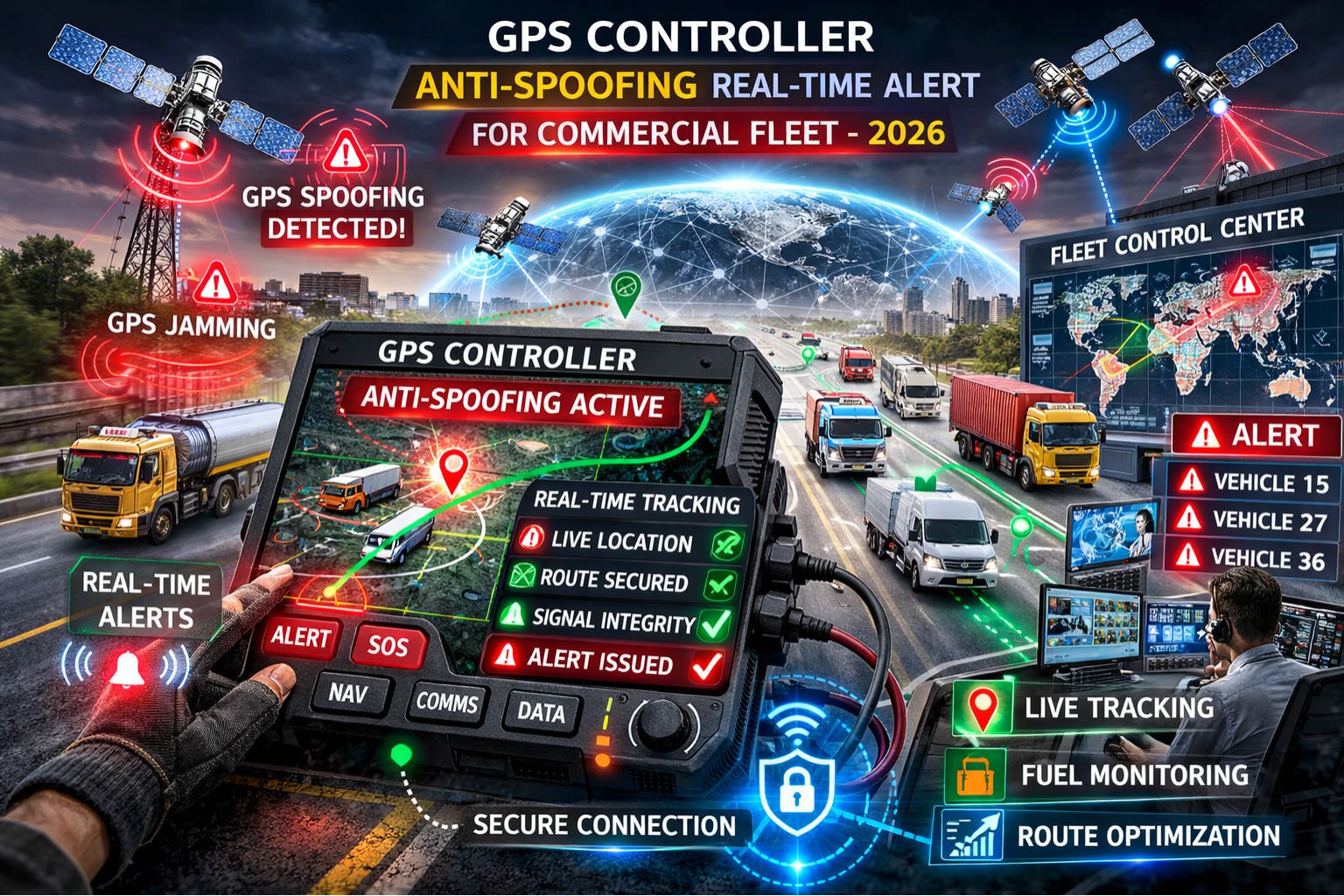
GPS Controller anti spoofing real time alert for commercial fleet 2026
Look, by 2026, a GPS spoofing alert can't just be a nice-to-have feature. It has to be your frontline defense. The kind of location fraud we're talking about can reroute a whole fleet, falsify delivery proofs, and just populate your fleet management dashboard with phantom vehicles. Think about it: a spoofed signal overrides the real data. Your system might show a truck safely parked at the depot, but it's actually miles off-route. That disconnect? It turns your real-time tracking from an asset into a genuine liability.
What Anti-Spoofing Detection Actually Means for Fleet Ops
We need to be clear here, because there's a misconception. Anti-spoofing isn't just about encryption. It's really about your system's ability to recognize when the GPS data—coordinates, speed, heading—is mathematically *too* perfect, or just doesn't line up with what the vehicle's own inertial sensors are saying. That's the sign of a fabricated signal. In practice, this means catching the exact moment a driver's device broadcasts a false "stationary" location to hide movement. It's a simple tactic, but it completely bypasses basic geofence rules.
The 2026 Reality: Spoofing Isn't Just Location Theft
When it happens at scale, the risk changes. It's not just single-vehicle fraud anymore; it's a systemic compromise. We've seen spoofing attacks used to create fake "congestion" patterns. The goal? To trick route optimization engines into rerouting other fleet assets away from a specific area. Here's a non-obvious detail: network latency. A spoofed signal often has zero jitter, which is actually a detection trigger. But the cheap spoofers are getting smarter—they're now adding artificial delay to mimic real satellite inconsistency.
The Critical Mistake: Assuming Your Current GPS Platform Alerts
This is the most common misunderstanding, hands down. People assume their standard tracking platform has native, real-time spoofing alerts built in. Most legacy systems don't. They'll log the anomalous data, sure, but only flag it in a daily report. By the time you see it, the spoofing event—and whatever operational or financial impact it had—is long over. The failure pattern is a silent data takeover. Your compliance logs might show a perfectly valid journey, while the telematics data from the truck's actual engine control unit tells a completely different story.
Your 2026 Decision: Monitor, Isolate, or Replace
Your real boundary here is defined by alert latency. If your system detects spoofing but the alert doesn't reach your security team for 30 minutes, you're not preventing anything. You're just auditing after the fact. So the decision becomes pretty clear. You can try to tune your existing systems with third-party signal integrity plugins. You can reconfigure your entire alerting workflow to prioritize spoofing flags. Or, you redesign your tracking stack with a platform built for this specific threat from the ground up—like GPS Controller, where signal authentication is a core layer, not an add-on.
FAQ
Question: What does a GPS spoofing attack look like on a live fleet map?
Answer: It can look a few ways. Often, it's a vehicle jumping to an illogical location without any transit history in between. Or it might move in a perfectly straight line at a constant speed. Sometimes you'll see two devices from the same truck reporting different coordinates. The key sign is data that just violates physics or the known road network.
Question: Can spoofing affect ELD compliance and hours-of-service logs?
Answer: Absolutely it can. If the spoofed signal shows the vehicle as stationary, it can falsify drive time. That creates compliant-looking logs for a driver who is actually operating. This turns a security breach into a direct regulatory and liability problem, especially during an audit.
Question: How fast does a real-time spoofing alert need to be to be useful?
Answer: Operational usefulness basically collapses after about 90 seconds. For a fleet manager to do anything, an alert has to arrive in under a minute. That's the window to do a direct driver check-in or send a remote immobilization command, before the spoofed movement completes whatever fraud it's attempting—like an unauthorized stop or a diversion.
Question: Is this a problem only for high-value cargo fleets?
Answer: No, not anymore. The barrier to entry has shifted. Cheap software-defined radios have made spoofing accessible. Now it can target any fleet for things like petty theft, false insurance claims, or just masking side jobs. If your operation depends on trusting location data—for payroll, customer updates, or safety—then you're a target. The workflow dependency is universal now.


Comments
Post a Comment