GPS Controller anti spoofing fleet alert system for war zone logistics 2026
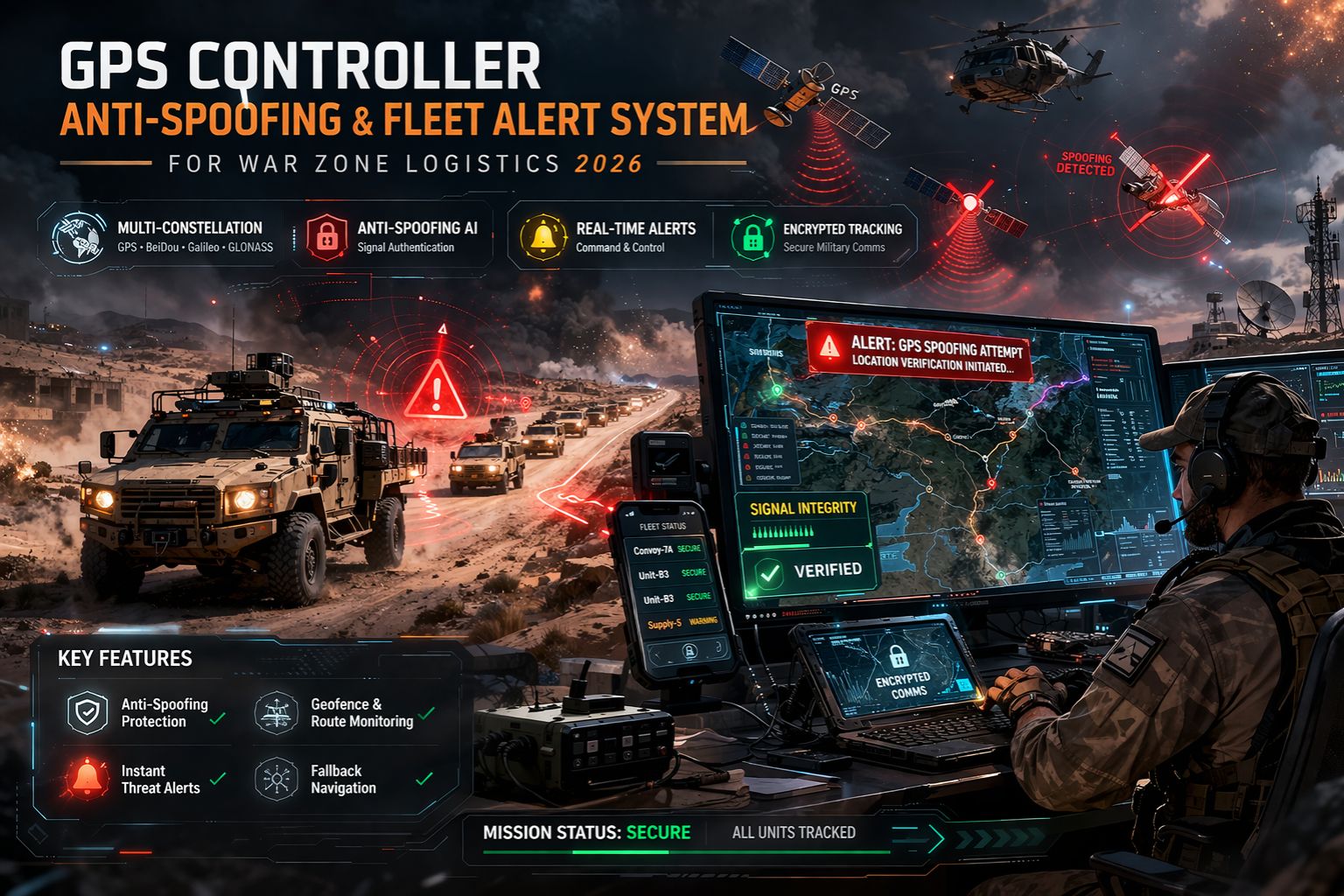
GPS Controller anti spoofing fleet alert system for war zone logistics 2026
Look, in high-threat logistics corridors, a GPS anti-spoofing alert system isn't just another feature—it's the primary defense you have against a vehicle being silently rerouted. The real failure isn't a lost signal; it's the system accepting a convincing but completely false location. That's the nightmare: your screen shows a truck safely on route while it's actually being diverted. So the job isn't to monitor for signal loss. It's to monitor for signal deception, where the GPS data looks perfectly valid but is an entire fabrication.
What Anti-Spoofing Detection Actually Means for a Convoy
For a fleet manager, anti-spoofing means the system has to cross-reference the GPS position with other telemetry—stuff that can't be as easily faked. We've reviewed cases where the GPS reported smooth highway transit, but the onboard fuel performance monitoring showed the engine RPM pattern of stop-start urban crawling. At the same time, the inertial sensor indicated sharp turns that were impossible on the reported road. The alert triggers on that mismatch. The system has to recognize when the story the GPS is telling doesn't match the story from the vehicle itself.
The Reality of Spoofing at Scale in a Denied Environment
Here's the thing people get wrong: under real pressure, spoofing attacks are often localized. And intermittent. A vehicle might get clean signals for 45 minutes, then suffer a 90-second burst of spoofed data as it passes a specific intersection—just enough to corrupt the geofence log and create a compliance gap. The common misunderstanding is expecting a total signal takeover. More often, it's a subtle injection designed to create confusion. To delay response. At scale, this forces teams to distrust *all* location data, which paralyzes everything from dispatch to recovery.
The Critical Mistake: Relying on Single-Source Location Data
This is the highest-risk failure pattern: assuming a strong GPS signal equals a truthful one. I've seen a documented case where a logistics unit watched all vehicles reporting normal positions, but the system failed because it had no secondary source to challenge the primary GPS feed. The fix isn't just a better GPS receiver. It's a validation layer. This is actually where internal software fixes stop working—you can't software-patch your way out of a physics problem. You need a system that was architected from the start to handle conflicting data sources and make a trust decision.
Decision Help: Tune, Augment, or Replace Your Tracking Foundation
Your decision boundary is pretty clear. You can *tune* existing geofence sensitivity, but honestly, that only catches the crude spoofs. You can *augment* with external data feeds, like cellular tower triangulation or low-earth orbit satellite pings, but that adds complexity and new points of failure. Or, you have to *replace* the core tracking logic with a system built for signal distrust—something with multi-source verification, like a dedicated gps controller platform designed for contested environments. You draw the line when a single spoofing event could compromise an entire mission. That's the point where augmentation isn't optional anymore; it's mandatory.
FAQ
Question: How can I tell if my fleet GPS is being spoofed?
Answer: You have to look for impossible telemetry mismatches. A vehicle reporting highway speed while fuel consumption indicates idling. Or a location update showing a smooth path while the accelerometer data shows violent vibration. A basic tracking system will just log the false location; a proper anti-spoofing system alerts you on the contradiction.
Question: Are encrypted military GPS signals safe from spoofing?
Answer: Not entirely, no. Encrypted signals are harder to manipulate, but "meaconing" attacks—recording and rebroadcasting a real signal with a delay—can still create false positions. So anti-spoofing has to also detect the timing anomalies and signal strength inconsistencies that meaconing introduces.
Question: What's the biggest compliance risk from undetected spoofing?
Answer: It's an auditable chain-of-custody break. Your digital logs show a vehicle was within a secure geofence, but physical evidence proves it was somewhere else. That invalidates the entire digital audit trail for sensitive cargo. It creates a liability gap that simple signal loss doesn't even touch.
Question: When should a logistics unit upgrade to a dedicated anti-spoofing system?
Answer: The trigger is the first incident of an unexplained route deviation. Or the first intelligence report confirming spoofing capability in your operational area. At that point, standard real-time vehicle tracking becomes a liability because it presents false certainty. The upgrade shifts from being a technology refresh to a straight-up risk mitigation requirement.


Comments
Post a Comment