GPS Controller AI Predicts Breakdown 7 Days Before It Happens 2026
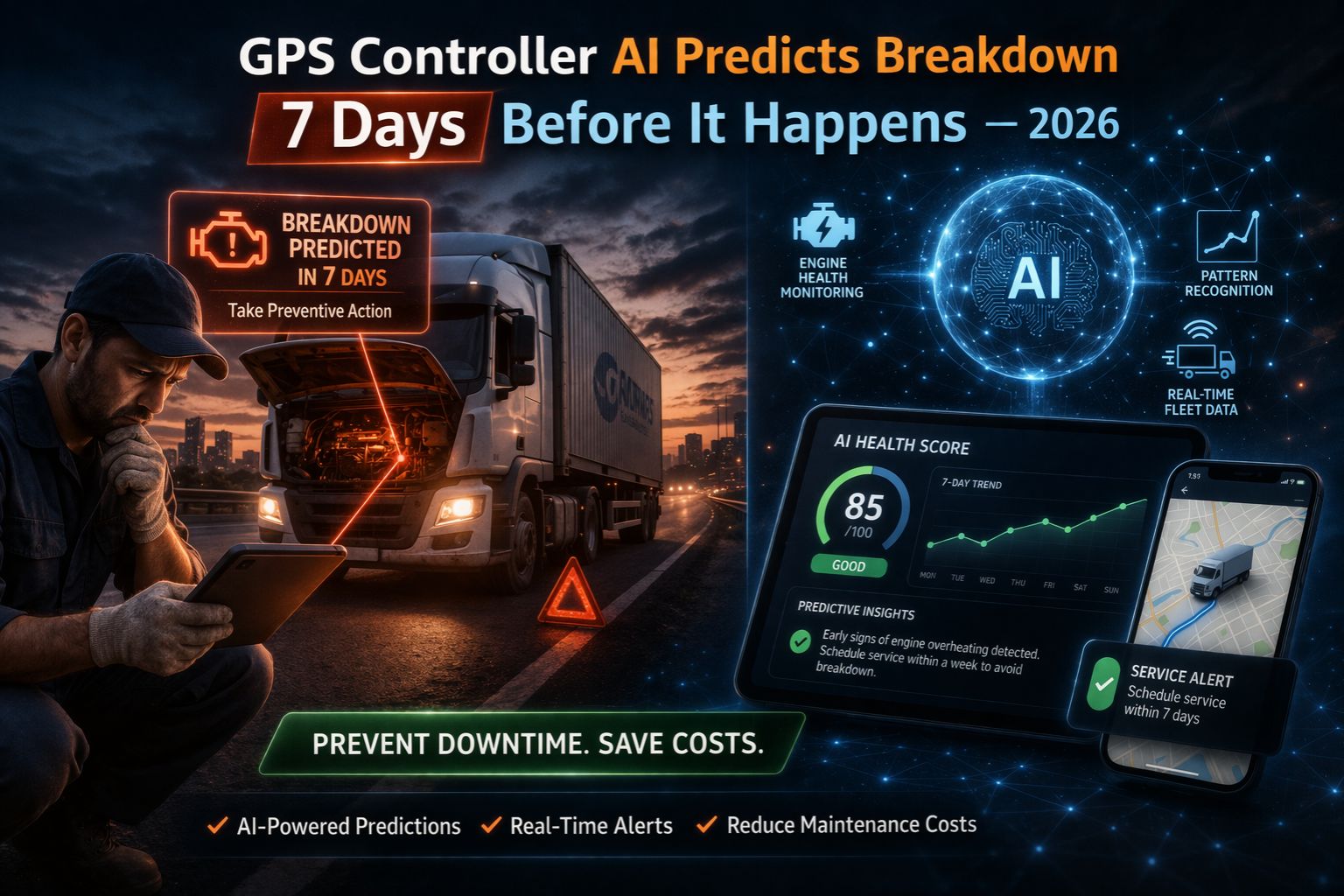
GPS Controller AI Predicts Breakdown 7 Days Before It Happens 2026
The promise of predictive maintenance is finally moving past simple alerts into actual forecasting. So when a GPS controller AI flags a truck's transmission for potential failure in exactly seven days, it's not just guessing. It's piecing together a specific story from compounding data—heat cycles, odd vibrations, power draw that's just a bit off—and comparing that signature to millions of miles of historical telemetry. That changes everything. The question stops being "what broke?" and starts being "what's *going* to break, and exactly when?" It completely upends how you schedule maintenance and deploy your resources.
What 7-Day Predictive Alerts Actually Mean for Your Fleet
Forget the basic "check engine" light. A seven-day window is a specific, calculated operational gap. It's the point where the AI's confidence score crosses a critical threshold. In reality, what we often see is something subtle—like a gradual creep in coolant temperature variance paired with a barely-there drop in highway fuel efficiency. Stuff you'd never catch in a weekly report. The system then matches these whispers against similar pre-failure patterns from your other trucks, or even anonymized data from the whole network. That's how the model builds itself, getting sharper with every single mile.
The Reality of Acting on a Week's Warning
Here's the hard part: the prediction is one thing, but the operational response is another. A dispatcher gets a "7-day warning" for a truck halfway across the country. What now? Pull it immediately? Reroute it toward a shop you trust? Or just let it run and watch the alert? The failure point we see most often isn't the tech—it's workflow. The AI dumps the alert on the maintenance manager's screen, but if it's not talking to the parts inventory system, that whole week of lead time can vanish while someone hunts down a specific alternator. Suddenly, your technological edge turns into a frantic logistical race.
Where Predictive Models Fail and Assumptions Escalate Cost
This is where costs can spiral: treating every "7-day" alert with the same level of panic. The AI gives you a probability, not a certainty. A 92% confidence score on a brake pad sensor is a world apart from a 78% score on some weird electrical flutter. Managers who order immediate downtime for every single alert will burn through labor hours and parts on false positives. On the flip side, brushing off lower-confidence alerts for older trucks can land you with a catastrophic roadside failure. The mistake is reading the AI's output as a direct work order, instead of what it is—a prioritized signal that needs a human to layer on context about route importance and driver experience.
Your Decision: Tune, Integrate, or Redesign the Workflow
So you're left with a choice, really. You can tune the AI's alert thresholds to match your own risk tolerance, which cuts down on noise but might mean you miss the earliest, faintest signals. You can integrate the predictive feed right into your Fleet Management Software and parts system, so it auto-generates a repair ticket with suggested parts. Or, you might have to redesign your whole maintenance workflow around this stream of predictive data. The line is pretty clear: if your team consistently can't act on alerts within the lead time, the problem isn't the AI's accuracy anymore—it's your operational readiness. At that point, just adding more tech won't fix a thing without changing the underlying process.
FAQ
Question: How accurate is a 7-day vehicle breakdown prediction?
Answer: It really depends on the data and what's failing. For mechanical parts with clear sensor data—think oil pressure or tire pressure—confidence can be over 90%. For trickier, intermittent electrical problems, the accuracy might be lower. In those cases, the alert is more of a strong suggestion to monitor closely, not a hard deadline.
Question: What data does the AI use to predict a breakdown?
Answer: It pulls from a few places: real-time engine diagnostics (OBD-II), the vehicle's maintenance history, GPS driving behavior (hard braking, long idling), and even outside stuff like ambient temperature. It's looking for tiny deviations from that specific vehicle's normal pattern, and from what the rest of the fleet typically does.
Question: Won't this cause us to perform unnecessary maintenance?
Answer: It changes maintenance from a calendar-based chore to an action based on actual condition. The goal is to stop the breakdown, not to swap a part the second something looks odd. A good technician uses the alert to do a focused inspection. Often, they find stuff like a loose connection or early wear that can be fixed well before it turns into a major failure.
Answer: The system is built to plug into what you already do. The trick is making sure the alerts get to the right person—dispatcher, maintenance manager—in a format they can use, and that your processes have the flexibility to act. The whole value disappears if the alert just sits in an inbox while the truck is booked for its routine service a month out. You have to treat the predictive alert as a high-priority operational signal, or it's just more noise.


Comments
Post a Comment