GPS Controller AI powered route replay for fleet compliance audit 2026
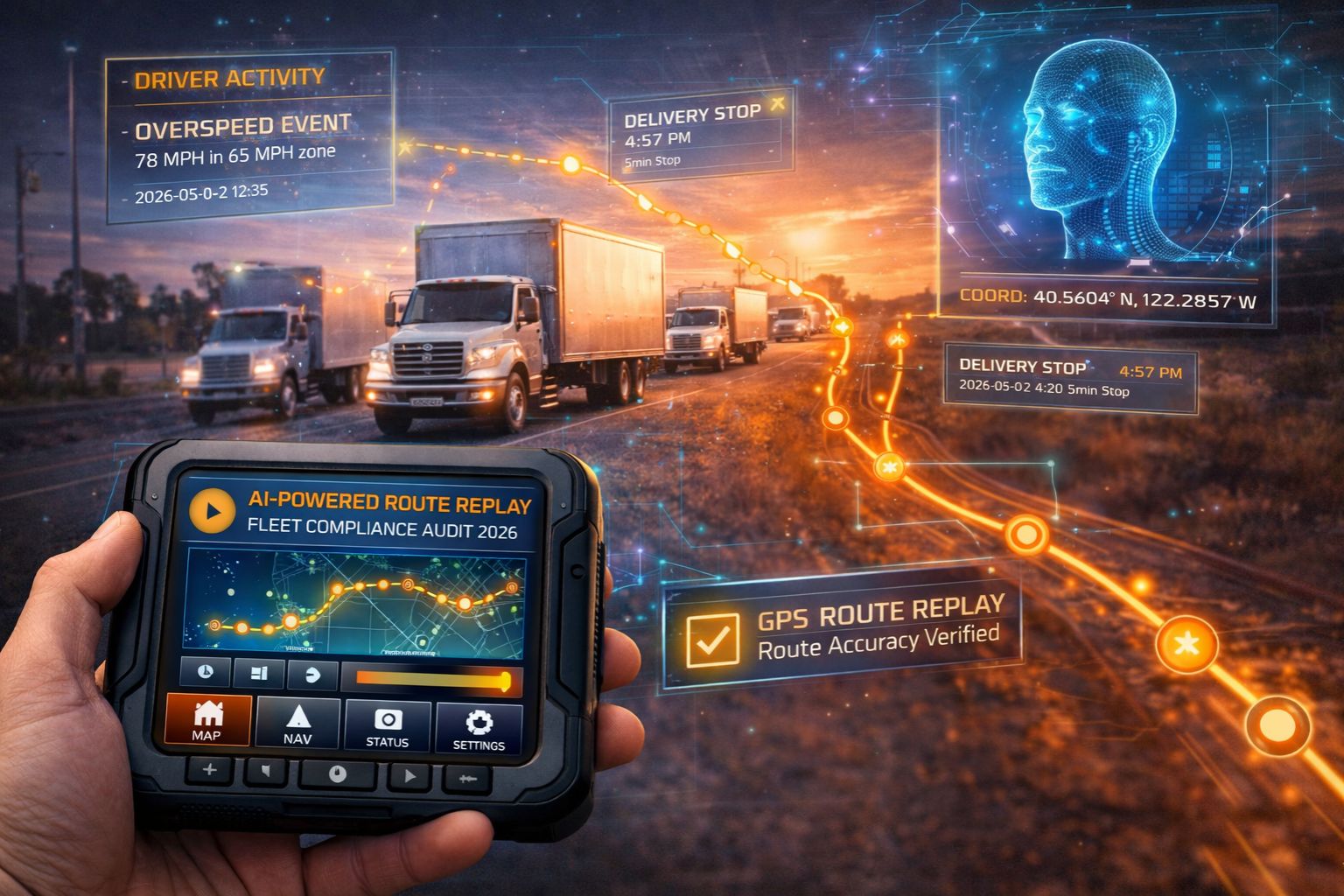
GPS Controller AI powered route replay for fleet compliance audit 2026
The sales pitch for AI-powered route replay is this perfect, animated timeline of every vehicle's path, ready for your 2026 audit. But the reality? It's more like a reconstructed narrative built from fragmented GPS pings. Think about it—a 90-second signal loss in an urban canyon can get logged as an "unaccounted stop" that violates hours-of-service rules. This isn't just simple playback; it feels more like running a liability simulation that depends entirely on how good your raw telemetry data really is.
What AI Route Replay Actually Shows Auditors
An auditor isn't just sitting there watching a dot move on a screen. What they're really doing is cross-referencing the AI's reconstructed path against everything else: the ELD data, geofence timestamps, driver logs. The AI fills in the gaps with its best guess, its predictive path. But here's the thing—if the underlying GPS data has jitter (which is super common for fleet tracking during downtown deliveries), the replayed route might show a vehicle drifting into a restricted zone it never actually entered. That creates a false violation. And the worst part? The system's own confidence score in that guess is invisible to the auditor. They only see the alleged path it presents.
The Scale Problem: When "Good Enough" Data Fails
With a handful of vehicles, say five, you can manually spot-check the weird anomalies. At fifty, you're basically trusting the AI's interpolation completely. The real failure happens at scale. Imagine a consistent 100-meter positional drift across every unit in one specific industrial park, all caused by some local interference. The AI replay will smoothly animate this error, making it look like your entire fleet repeatedly violated the site's entry protocol. It bakes systemic data corruption into what appears, on screen, to be a willful compliance breach. And try arguing with the "evidence" your own system generated.
Common Mistake: Assuming Replay is Raw Footage
This is probably the most dangerous assumption: treating the AI's output as definitive GPS truth. It's not. It's a best-guess model. I've seen this escalation path before—a fleet manager uses a beautifully rendered replay to discipline a driver for a route deviation. Only later do they discover the assigned delivery dock was closed that day, forcing the detour. The AI just connected the pings with the shortest path, completely missing the real-world context. That destroys driver trust and leaves you with an audit trail that flat-out contradicts what actually happened.
Decision Help: Validate, Don't Just Trust
Your decision line is pretty clear: you have to validate the AI's reconstruction with independent data points before you treat it as audit evidence. That means correlating the replay with other sources, like fuel transaction geodata, warehouse gate sensor logs, or even time-stamped geofence alerts from your primary system. If you can't establish that validation layer, then the AI replay is just a presentation tool, not a real compliance tool. And listen, when signal loss exceeds 5% of a trip's duration, or when positional accuracy regularly falls outside 15 meters, internal software fixes won't cut it. At that point, you need a hardware or network device upgrade.
FAQ
Question: How accurate is AI route replay for proving driver location during an audit?
Answer: Its accuracy is entirely dependent on the raw GPS fix quality and frequency. The AI fills in missing data, sure, but an auditor can challenge those interpolated segments as unverified. It really only proves location where a clear, high-accuracy GPS fix was actually recorded.
Question: Can old GPS data from 2024 be replayed with new AI for a current audit?
Answer: Technically, yes, you can do it. But it's high-risk. Older data often lacks the ping frequency or detail that the 2026 standards will likely mandate. Replaying it with modern AI creates an "enhanced" record that might not withstand scrutiny if the original data stream was too sparse.
Question: What's the biggest compliance risk with automated route replay?
Answer: The risk is creating a definitive-looking record that's just wrong. If the system confidently replays a route that shows a speed limit violation based on drifted coordinates, you've essentially automated the creation of false evidence against yourself.
Answer: The boundary is data quality. If your standard tracking already shows frequent signal loss or latency, then adding AI replay just animates those existing problems. You have to solve the core telemetry integrity first. That's a fundamental step, and it's why a platform like GPS Controller focuses on ensuring data fidelity before any analysis even happens.


Comments
Post a Comment