GNSS Spoofing Risks Causing Delivery Fleet Location Failures and Route Sabotage
GNSS Spoofing Risks Causing Delivery Fleet Location Failures and Route Sabotage
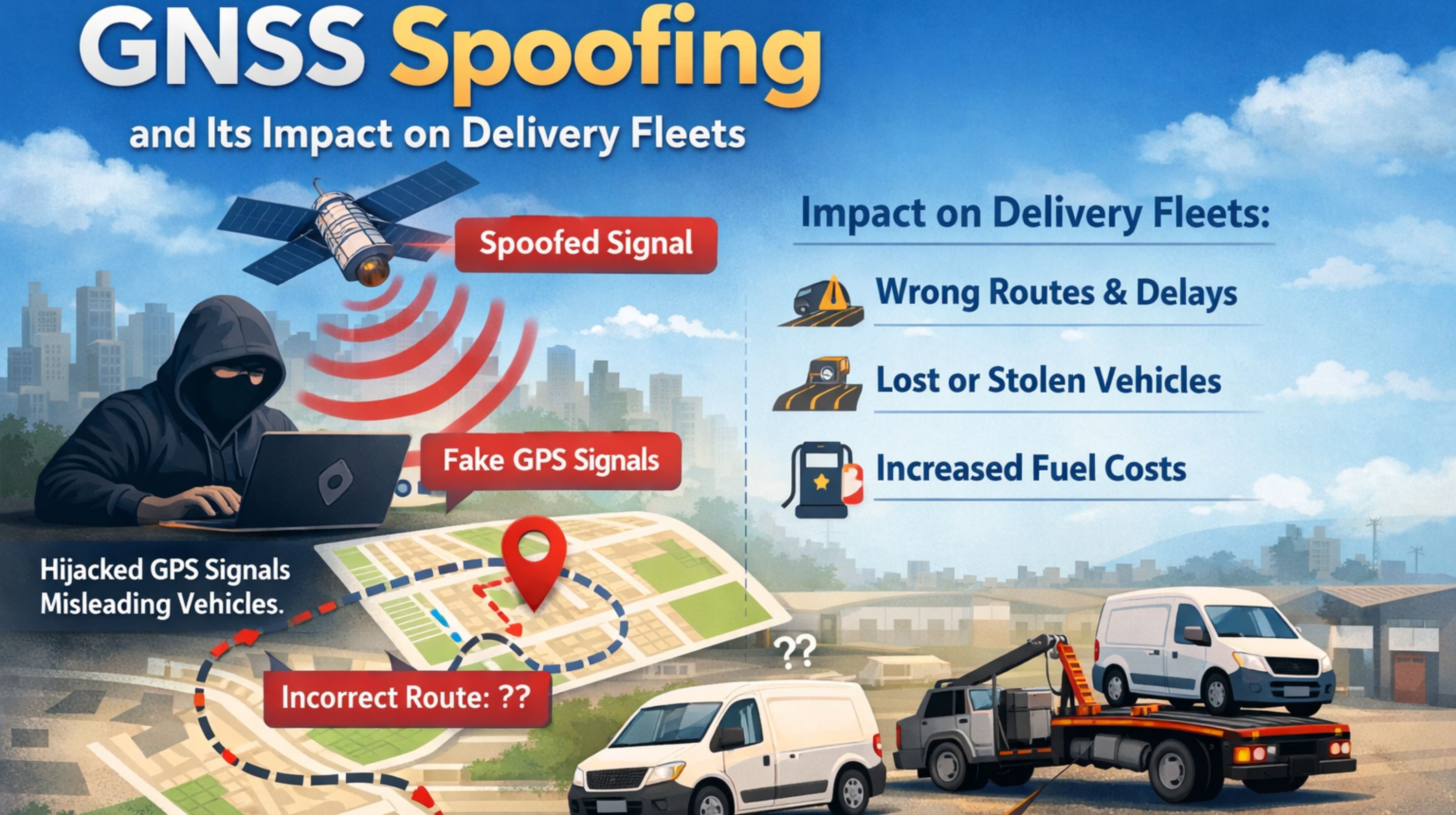
In live fleet tracking, GNSS spoofing is basically the deliberate transmission of fake satellite signals. It overrides a vehicle's legitimate GPS data, which causes the telematics unit to report a location, speed, or time that's completely wrong. This isn't just a weak signal or a delay; it's an active attack that makes your system confidently wrong. Usually, the first sign is something weird, like a vehicle appearing to teleport or travel impossibly fast. Or maybe a driver supposedly completes a 4-hour route in 20 minutes on the real-time vehicle tracking map, while the actual delivery proof tells a totally different story.
What GNSS Spoofing Actually Does to a Moving Delivery Truck
When it happens under real operational load, spoofing creates a cascade of failures. A truck getting spoofed coordinates might be guided off its optimized route because the navigation system is being fed bad data, which just wastes fuel and hours. Geofence alerts for warehouse arrivals or customer sites won't trigger because, digitally, the asset isn't "there." There's a more subtle problem too: spoofing can mess with the Coordinated Universal Time (UTC) sync in the tracker. That corrupts event timestamps and creates logs for things like hours-of-service or proof-of-delivery that you can't really audit. It's a direct compliance breach. The scary part is the system shows a clean, plausible timeline that simply never happened.
The Critical Mistake: Assuming Spoofing is Just a "Bad GPS Signal"
The most common—and costly—misunderstanding is treating spoofing errors like they're just routine GPS drift or urban canyon effects. Teams end up wasting days troubleshooting antennas, blaming cellular networks, or suspecting faulty hardware. The defining pattern is *plausible but impossible* data. Think routes that follow roads but at speeds that make no sense, or clusters of vehicles suddenly reporting the same wrong coordinates, or consistent time-stamp shifts. If you ignore this distinction, your security and operational blind spots just get worse. The real root cause—a directed radio frequency attack—goes completely unaddressed while your fuel performance monitoring and scheduling systems are making decisions based on fabricated information.
Decision Help: When to Harden Your Fleet Tracking vs. Accept the Risk
Look, the boundary for internal fixes is pretty clear. If your standard GPS trackers have zero spoofing detection and you're operating high-value or time-critical deliveries in sensitive areas—geopolitically tense spots or high-theft zones—then basic configuration changes won't cut it. You're left with a choice: accept the risk of manipulated data, or redesign a layer of your telematics stack. That means moving beyond standard NMEA data consumers to systems that can cross-verify location. They might use inertial sensors, cellular tower triangulation, or you might need to deploy devices with certified anti-spoofing tech, like Galileo OSNMA or specialized RF filtering. The bottom line is, your gps controller platform has to be able to ingest and actually flag these integrity alerts from the hardened hardware.
FAQ
q How can I tell if my delivery van is being spoofed?
a You have to look for a mismatch. Check if the GPS track contradicts other data: like the vehicle reporting movement while the engine is off according to the CAN bus, or driver app check-ins showing a different location than the telematics map. Sudden, sustained jumps in location paired with perfect signal strength is a huge red flag.
q What's the biggest compliance risk from GNSS spoofing for fleets?
a It creates falsified electronic logging device (ELD) records. If the spoofing alters the time, your drivers could be showing false driving hours. That leads straight to FMCSA violations and audit failures, even if the driver followed all the rules.
q Does spoofing affect an entire fleet at once or just one truck?
a It really depends on the attack. A wide-area broadcast from a powerful transmitter could hit every vehicle in a depot or a city neighborhood. A targeted attack with a portable device would usually just impact one vehicle at a time, which honestly can be harder to spot at a large scale.
q When is it time to upgrade our hardware versus just using software alerts?
a If you've had confirmed incidents, or you operate in a known high-risk corridor, software alerts are just reactive. You need hardware with anti-spoofing features when the cost of a single messed-up route—like losing a high-value load or failing a major safety audit—exceeds the cost of upgrading the telematics units for that part of your operation.


Comments
Post a Comment