Fleet GPS Failure During Electronic Warfare and Jamming Attacks
Fleet GPS Failure During Electronic Warfare and Jamming Attacks
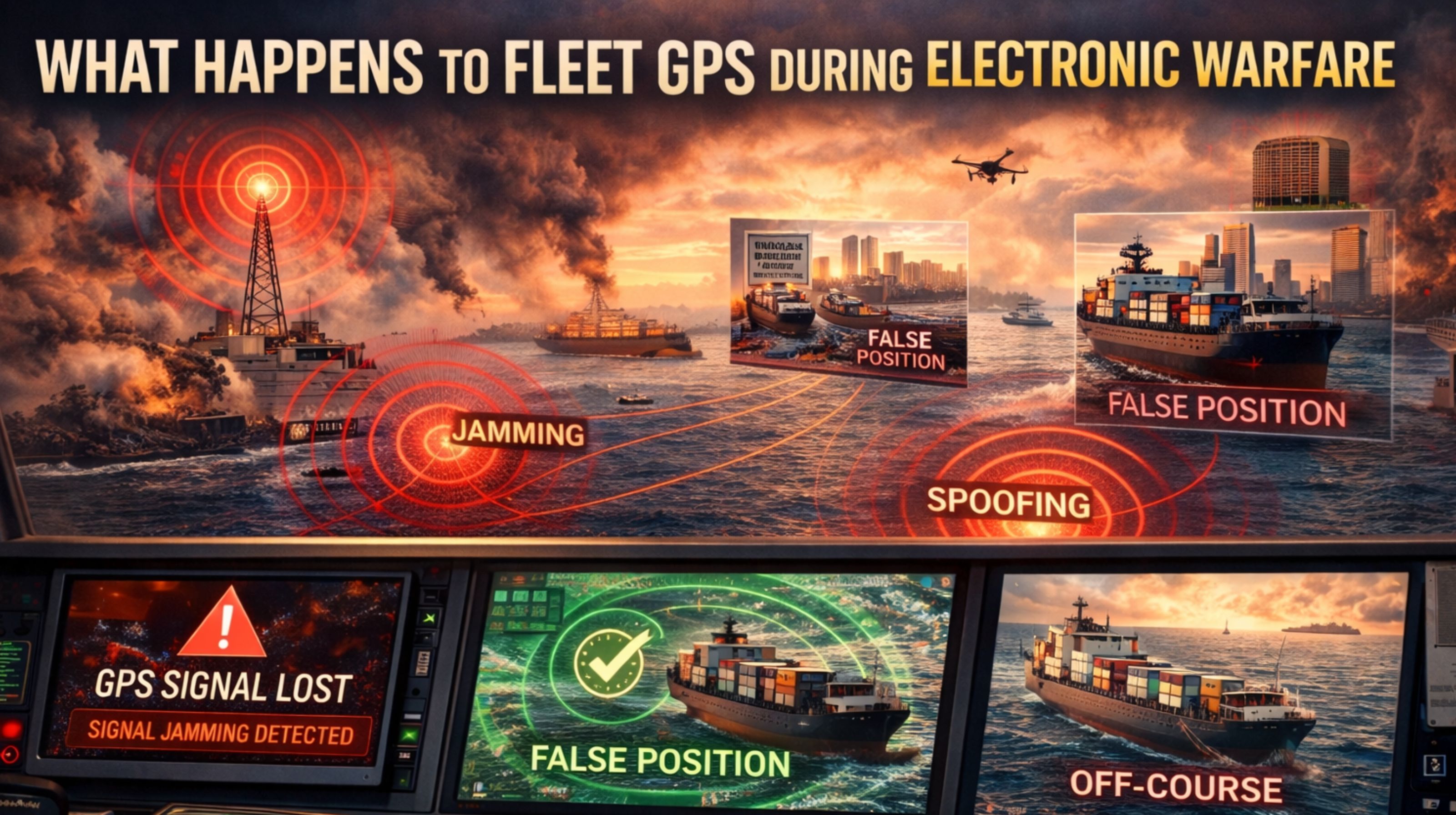
When electronic warfare targets GPS signals, fleet tracking systems don't just show old data—they often stop reporting entirely. That leaves operations blind to vehicle location, speed, and status. So the immediate failure isn't really a map error; it's that complete loss of the real-time data stream. The one that controllers and dispatchers are depending on for routing and safety.
What GPS Signal Loss Means for Live Fleet Operations
In a live fleet, losing the GPS fix means more than a stale dot on a map. For one, geofence alerts for yard exits or site arrivals just fail to trigger. Then, automated route optimization engines stall because they're working with outdated positions, and driver ETA updates stop. Usually, controllers first notice the problem through delayed "vehicle stopped" alerts. Or they'll see a cluster of assets suddenly reporting the same impossible coordinates from a spoofing source.
Reality Under Scale: When Jamming Hits an Entire Fleet
At real fleet scale, a wide-area jamming attack creates cascading failures. Dispatch boards freeze. Fuel consumption calculations, the ones based on distance traveled, become invalid. Compliance reports for hours of service (HOS) develop gaps that trigger audit flags. Here's a common, non-obvious detail: many telematics devices will cache data and then dump large batches of invalid positional data once a signal returns. That can overwhelm the fleet management software with garbage points and cause serious system lag.
Common Misunderstandings and Escalating Risks
A major misunderstanding is assuming backup cellular data will compensate. But if the GPS receiver itself is being spoofed or jammed, the device still transmits—it just sends wrong location data, or none at all. This leads to escalated risks. Vehicles could be routed into unsafe areas based on spoofed coordinates. Maintenance schedules might be skipped because engine hour data isn't linked to actual movement. And the compliance gap from missing electronic logging device (ELD) location stamps? That's a real and immediate violation.
Decision Boundary: When to Redesign Tracking for Signal Resilience
The decision boundary gets pretty clear: if your operations are in a region where jamming is a credible threat, internal tuning of standard GPS devices just isn't enough. You have to redesign for resilience. That means moving to systems that integrate inertial measurement units (IMUs) for dead reckoning, that can leverage multi-constellation GNSS (like GLONASS or Galileo), and have protocols to detect spoofing and switch to a degraded but safe mode. This is exactly where a robust gps controller platform—one capable of fusing multiple data sources—becomes critical. Not optional.
FAQ
q Can fleet GPS work if GPS is jammed?
a No, the standard GPS receiver in most fleet devices will lose its fix. Operations continue blind unless the system has a non-GPS backup, like inertial sensors or cellular tower triangulation. Those are less precise, though.
q What is the biggest compliance risk during a GPS outage?
a The biggest risk is gaps in the required electronic logging device (ELD) location history during driving periods. That can lead to violations during a safety audit, since the record can't be reconstructed.
q How can I tell if my fleet is being spoofed, not just jammed?
a Spoofing often shows as multiple vehicles suddenly reporting the same, improbable static location. Or they might look like they're moving in a perfect, unphysical formation. Jamming, on the other hand, typically shows as a total loss of signal and no position reports at all.
q At what point should we replace our current trackers for EW resilience?
a Replace when you're operating in high-risk zones, and when the cost of a single blind routing decision or compliance violation outweighs the investment in hardened devices. You need ones with multi-frequency GNSS and sensor fusion—a capability offered by advanced gps controller systems.


Comments
Post a Comment